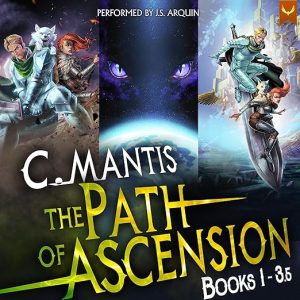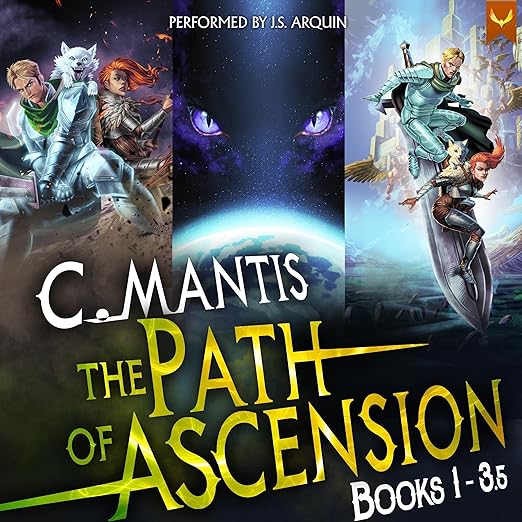
Progression fantasy runs on accounting, and this audiobook hands a listener four ledgers at once. Aethon Audio has packed the first three Path of Ascension novels together with book 3.5, a novella the copy calls exclusive and places between the third and fourth volumes, into a single file of seventy hours and two minutes. Matt is orphaned by monsters, rated detrimental by the Tier One Talent assessment that decides everything about a life in this world, and turned away by every guild and group that might have taken him. He ends up working at an inn near the rifts he wanted to delve. What happens after that is the entire series.
Aaron Sher, the only four-star among five written responses, supplies the most useful description of what separates this from its shelf neighbors: high technology mixed with magic, and galaxy-spanning empires sitting behind the dungeon crawling. That combination is genuinely unusual in the subgenre and it is the thing a browser is actually buying. The same August 2025 response is also the only one to name a weakness, and names it as a wish rather than a grievance: Aster has not yet turned into a real person. Across three novels and a novella, that is a reasonable thing to want, and it points at exactly where the character work runs thinnest.
Numbers behind the badge deserve a moment, because a large panel is more informative than a small one. A 4.8 across 193 ratings puts the pool's total somewhere between 917 and 936 against a ceiling of 965, which leaves twenty-nine to forty-eight stars missing, roughly the equivalent of seven to twelve one-star votes. That is not a criticism of the bundle. It is a reminder that a high average on a big panel is never unanimity, and that the arithmetic has already priced in dissent nobody bothered to write down.
Why It Works in Audio
Matt's Tier One Talent is rated detrimental, and that verdict is the premise doing its most interesting work. Most power-fantasy openings hand the lead a hidden advantage. This one hands him an official assessment that he is worth less than nothing, then parks him behind an inn counter while the empire's ranked ladder climbs on without him. The mysterious couple who eventually offer a recommendation, and the stolen Skill the copy mentions in passing, function as loopholes rather than gifts. Everything the sequence does later with tiers, empires and living legends rests on the fact that the system tried to filter him out first.
Mental health is not a phrase most progression fantasy blurbs go anywhere near, and the five-star of March 16 singles it out for praise: the author normalizes and encourages it, and that reader opened the series expecting very little. The rest of that verdict reads like a checklist of what the subgenre routinely promises and frequently skips, including a romance that works, character development that accumulates, a magic system with internal logic, and worldbuilding that justifies the hours. Coming from someone who started skeptical and finished converted, it carries more weight than enthusiasm from a reader who was already sold.
Weak Spots in The Path of Ascension: Books 1-3.5
Female voices are where the recording thins out, and the November 2024 five-star says so in its own headline. J.S. Arquin holds the whole bundle alone. That response reports that the male characters get some distinction from one another while the female characters tend to converge, and it is careful to add that once a listener accepts the limitation the reading is very good and the tale worth the time. Honest, specific and useful, it is also the only piece of listener evidence about this recording anywhere on the page. For a bundle carrying three novels' worth of cast arriving in sequence, it is the thing to test in the sample first.
Aethon's use of the word exclusive deserves attention before anyone reaches for the buy button. Readers who already own the first three novels are being asked to repurchase all of them in order to reach what amounts to a novella of new material, and the record does not state how long that section runs or where in the file it begins. A listener arriving fresh has no such problem, since the sequence plays straight through and the novella occupies its chronological slot between the third and fourth books. The value of this package depends entirely on which of those two buyers you happen to be.
Who Will Get the Most From It
Newcomers get the cleanest deal here by some distance. The five-star of March 21 recommends the series to anyone at all who enjoys LitRPG and progression-style fantasy, which is broad, but the format earns the breadth: one credited reader, one continuous arc, no gaps to fill in later, and a premise that teaches its own rules as it goes. Listeners who want mechanical advancement they can follow line by line, an underdog refused by the system rather than chosen by it, and a story that keeps moving without waiting for permission are the audience this was assembled for.
Overlap is the thing to price before buying. If the first three novels already sit on your shelf, this package is mostly a reread with one novella attached, and nothing on the listing quantifies how much of the running time that novella accounts for. Anyone impatient with long-form progression should also stay clear, because the appeal here is cumulative and the payoff deliberately deferred; the early hours spend their time establishing rules that pay out much later. Everything else about the bundle is refreshingly straightforward, which is more than most box sets in this corner of the shelf manage.
Where does this audiobook bundle actually stop?
It ends with book 3.5, a novella the publisher places between the third and fourth novels and describes as exclusive to this collection. A listener finishing the file is positioned to buy the fourth novel next, with no gap in the sequence and nothing skipped along the way.
Is this audiobook a reasonable first LitRPG?
It works better than most as an entry point. The premise explains its own systems while using them, the progression is legible rather than assumed, and buying the sequence in one piece removes the usual problem of arriving at book two having forgotten how the tiers were defined.