Quick Take
- Narration: J.S. Arquin is the right voice for this series, he handles the LitRPG stat sequences without robotic delivery and brings enough character differentiation to keep the large cast navigable across 23-plus hours.
- Themes: power through adversity, the cost of ambition in a tiered cosmos, loyalty tested under extreme conditions
- Mood: High-stakes and kinetic, with moments of genuine emotional texture
- Verdict: Book six rewards readers who have followed Matt, Liz, and Aster from the beginning, the Minkalla arc is the series at its most ambitious, though the vignette structure divides opinion.
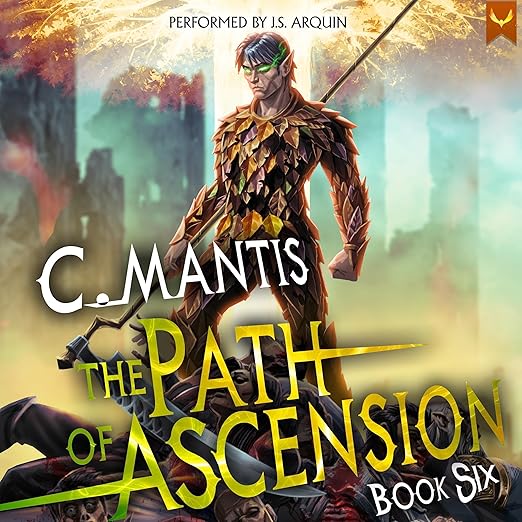
I came late to The Path of Ascension and had to do serious catching up before I could touch book six. The series has a reputation among LitRPG readers as one of the more intellectually serious entries in the genre, a book that plays by its own internal rules with a rigor that many comparable series do not bother with. By the time I got to book six, I understood what that reputation was about, and the Minkalla arc does nothing to undermine it.
C. Mantis has built a progression system that is internally consistent in a way that matters: when Matt or Liz or Aster gains power, it means something because the tiers, the talents, and the mechanics have been established with enough care that the rewards feel earned. Book six takes the trio to Minkalla, a planet accessible only to those below Tier 15, where the rules invert, the weaker you enter, the greater the potential rewards. Matt and the team go in at Tier 11, which puts them in the middle of something far more dangerous than a simple dungeon crawl.
Our Take on The Path of Ascension 6
The Minkalla arc works because the constraints are both external and internal. The planetary rules limit what the characters can do in expected ways, but Mantis layers in a political dimension, all eight Great Powers are sending representatives into Minkalla, and the fight is not just for survival but for position in a geopolitical contest that dwarfs any individual encounter. Matt’s particular talent, which allows him to cheat outrageously within established rules, becomes a question of strategy rather than raw power, and that shift is welcome at this point in the series.
One reviewer described the opening vignettes, brief chapters following characters who are not the main trio, as giving the entire multiverse sharp detail. Another found the same vignettes frustrating, preferring to stay with the established leads. Both reactions are honest responses to a genuine structural risk Mantis is taking. The vignettes are some of the best writing in the book, characters sketched in a few paragraphs who become fully real before some of them die or are placed in untenable positions. But they require a tolerance for narrative investment that does not pay off in the conventional sense.
Why Listen to The Path of Ascension 6
J.S. Arquin has been the right narrator for this series from the start, and book six confirms it. He handles the LitRPG mechanics, stat readouts, skill descriptions, tier assessments, without the flat, procedural delivery that makes some genre audiobooks feel like listening to someone read a spreadsheet. He differentiates Matt, Liz, and Aster clearly, and his work with the vignette characters is impressive: each brief perspective feels distinct rather than generically voiced.
At 23-plus hours, this is an enormous listen by any measure, and Arquin’s stamina is evident throughout. The fight sequences, which are detailed and technically demanding, lose none of their urgency in audio. The pacing of the Minkalla floors, seven floors of increasing danger and increasing stakes, is well-sustained across the runtime, and the resolution of the arc lands with genuine weight.
What to Watch For in The Path of Ascension 6
One reviewer noted that the power upgrades the party receives at the conclusion of the Minkalla arc are not clearly telegraphed, the specifics of how they have grown stronger are somewhat opaque. Mantis is more interested in the experience of power than in the precise quantification of it, which is a reasonable artistic choice but can leave LitRPG readers who want exact numbers slightly frustrated. The system’s internal logic is present but not always foregrounded at the moment of reward.
This is emphatically not a series entry point. Six books of careful progression sit beneath this one, and diving in here means missing the character development that makes the emotional beats land. New readers to the series should start at book one, which is also available in audio with Arquin narrating.
Who Should Listen to The Path of Ascension 6
Existing Path of Ascension readers will find this a satisfying and ambitious installment, the Minkalla concept is the most original setting Mantis has built in the series. LitRPG readers who appreciate worldbuilding rigor and internally consistent progression over pure action will find Mantis’s approach distinctive. Anyone who bounces off the vignette structure in the opening section should push through; it resolves into the main story with clearer momentum.
Frequently Asked Questions
Can The Path of Ascension 6 be listened to without the earlier books?
Not recommended. The series builds its power structure, character relationships, and political landscape across six books. Jumping in at book six means missing the accumulated emotional investment that makes the stakes in the Minkalla arc legible. Start at book one, the progression pays dividends by this point.
What is the Minkalla concept and how does it change the series dynamic?
Minkalla is a planet accessible only to those below Tier 15, where the normal rules invert, lower-tier entrants receive greater potential rewards. Matt and the team enter at Tier 11, putting them in competition with representatives from all eight Great Powers at levels they can barely survive. It shifts the series from personal progression into something with broader political and cosmic stakes.
How does J.S. Arquin handle the vignette sections featuring new characters?
Well. Each perspective voice is distinct, which matters because the vignettes sketch characters quickly and some of them die or disappear. Arquin gives each enough individuality that the brief stories feel like complete portraits rather than disposable filler. This is where his performance is most impressive in book six.
Is The Path of Ascension more LitRPG or Xianxia, and does that affect how accessible it is?
Mantis describes it as a car that looks like a LitRPG but has Xianxia underneath, there are dungeons, skills, and tiers from the LitRPG tradition, but the internal logic, the cultivation philosophy, and the martial world-building are Xianxia in spirit. Readers familiar with either genre will find the blend comfortable; readers new to both may need time to adjust to the genre’s assumptions.