Quick Take
- Narration: J.S. Arquin has developed a deep familiarity with this series and handles the tournament arc’s ensemble cast with strong differentiation across nearly 28 hours.
- Themes: Competition as self-revelation, the gap between strength and recognition, the question of what progression ultimately means
- Mood: Energetic and world-saturated, with genuine warmth between the core trio
- Verdict: A thoroughly satisfying fifth entry for series loyalists, though the deliberately lighter tone of this volume means it functions more as a reward than an escalation.
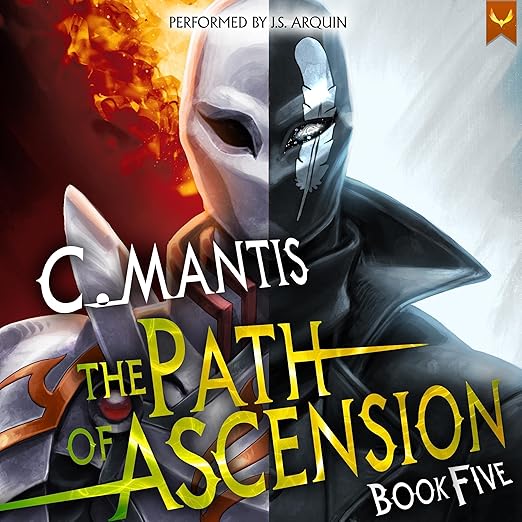
I came to The Path of Ascension 5 as someone with enough familiarity with LitRPG and Xianxia as genres to know what they do well and where they tend to drift. C. Mantis has built something genuinely distinctive across this series, and the fifth book is where that distinctiveness becomes most visible: by choosing to pivot from the escalating stakes of the previous volumes into what is essentially a tournament arc with lower consequences and higher fun, the author makes a structural choice that is either a relief or a frustration depending on what you came here for.
Matt, Liz, and Aster have reached Tier 10. That means the Pather tournament, where they will face opponents at their level for the first time. The twist is that they have to compete twice: once as themselves, and again in masked restriction mode, designed to prove they are genuinely the strongest rather than beneficiaries of their specific builds. Luna, their guide, has years of investment in this moment. The stakes are real but not existential, and that is precisely the point. Reviewer Jackson Cheuvront describes the book as the kind that makes you form theories about the canon and demands you ask questions, and that is the right energy: this is a book that rewards being invested in the world rather than being new to it.
Our Take on The Path of Ascension 5
The series has always distinguished itself by treating its magic system and progression logic with internal consistency rather than convenient hand-waving. What one reviewer describes as amazing world-building and character development, noting that the writing has only gotten better with each book, is accurate. Mantis does not linger on events just to pad runtime, and the time skips that cover training montages feel earned rather than lazy. The relationship between the three core characters remains the emotional center: Matt and Liz’s partnership, and Aster’s presence as the third corner of the dynamic, has accumulated enough history by book five that their interactions carry genuine weight.
Why Listen to The Path of Ascension 5
J.S. Arquin has been with this series long enough that his performance has the confidence of deep familiarity. At 27 hours and 35 minutes, this is a long listen, and Arquin’s ability to sustain clarity and energy across that runtime is one of the consistent strengths of the audiobook editions. The tournament structure gives him more character-on-character dialogue than previous volumes, which plays to his differentiation skills. The energy is lighter than the recent books in the series, which is either a feature or a limitation: reviewer Lonnie describes the tournament as being about fun and rewards rather than dark urgency, and that captures the tonal shift accurately.
What to Watch For in The Path of Ascension 5
Reviewer Tyler, who identifies as a series loyalist, raised a specific frustration worth noting: there are moments where the author engineers situations that make Matt appear weaker or less capable than his build and progression should logically allow, in service of maintaining tension. The implication in one Luna and Kurt conversation that Liz will eventually surpass Matt struck this reviewer as inconsistent with the established power logic. For listeners who track the system closely, these moments pull you out of the fiction briefly. The review also notes repetitive phrasing and comparative words that recur across the text, which is a persistent minor friction in an otherwise strong series.
Who Should Listen to The Path of Ascension 5
Do not start here. This is book five of an ongoing progression fantasy series that builds its emotional and mechanical stakes cumulatively. Series readers who are current will find this a deeply satisfying installment, particularly if they have wanted to see the Tier 10 tournament that has been foreshadowed for several books. For listeners who are new to the genre and wondering whether this series is worth starting from the beginning: if you enjoy both LitRPG mechanics and Xianxia cultivation philosophy, and you want a series where those two systems are integrated rather than bolted together awkwardly, start with book one. By the time you reach book five, the tournament will feel like the reward it is designed to be.
Frequently Asked Questions
Is this a good entry point for someone new to LitRPG or Xianxia?
No. The series builds its world, power systems, and character relationships from book one, and book five depends heavily on all of that accumulated context. Start with The Path of Ascension 1 if you are new to the series.
How does book five compare in tone to the earlier installments?
Deliberately lighter. The tournament arc is designed to be a moment of relatively consequence-free competition after the heavier stakes of previous volumes. Reviewers who love the series enjoy this shift; those who want continuous escalation may find the pacing less urgent.
At nearly 28 hours, does the audiobook ever feel like it is dragging?
Less than you might expect given the runtime. Mantis moves efficiently through events and the tournament structure provides natural pacing markers. The book earns its length through the density of its world-building and character interactions rather than through repetition.
Is the power system logic consistent enough to follow without taking notes?
For most listeners, yes. The series is more internally rigorous than most LitRPG, but the audio format does mean you cannot flip back easily to check details. Some listeners keep notes on tier and mana mechanics, which helps for the more system-heavy discussions.