At a Glance
- Voice: One credited reader, J.S. Arquin, for a volume whose drama is a training contract rather than a battlefield.
- Big ideas: Cultivation and progression mechanics, mentorship as coercion, tournament arcs, long time skips
- Atmosphere: Methodical and grinding, with a deadline overhead
- Worth it?: Preparation rather than payoff, and the right buy only if the ledger itself is the pleasure.
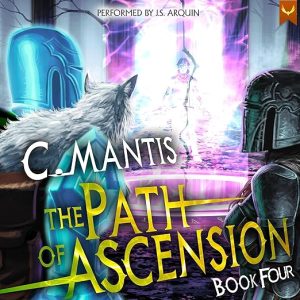
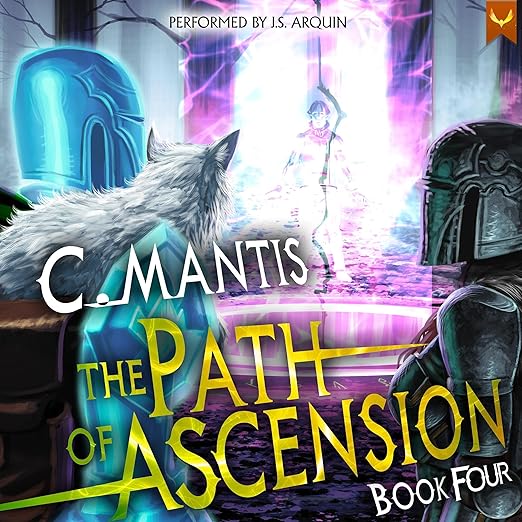
Luna arrives as a manager and behaves like a threat. She is the new fixture in book four of C. Mantis's progression series, brought in to push Matt, Liz and Aster toward a Tier-10 tournament, and the publisher's copy is blunt that she will drive them off the Path if they slack. That is an unusual engine for an audiobook running just under seventeen hours: not a war, not an invading empire, but a training contract with penalties attached. The vassal war is finished. What replaces it is a schedule, plus a Tier-40 who has produced several Ascenders before and at least one other party working an angle of their own.
What We Made of It
Shauterson, the one four-star in the column, calls this a training montage in book form, and that remains the most accurate description of the structure anybody has written down. Book four is about work. The group that walked out of the vassal war spends the length of the volume grinding toward a tournament under supervision, and that same March 2025 response adds the detail that unsettles it: this is the first book in that reader's experience where many years pass and the cast comes out noticeably older than it went in. The response still lands on four stars and still calls the execution well done. The hesitation is about what the time skip does to a reader, not about whether it works.
Add the visible grades together and you reach twenty-four stars, a mean of 4.8. The panel prints 4.6 over five ratings. Either the badge is weighted rather than averaged, or the five ratings and the five texts are not the same five people. Both explanations are ordinary and neither is worth much alarm, but the arithmetic is worth stating plainly, because a five-vote panel on the fourth volume of an active series carries almost no statistical weight in either direction. The written responses tell you more in a paragraph than the number tells you at all.
Cultivation progress is what the September 2023 five-star came away pleased about: the characters made a lot of it, and that made the story feel like it was going somewhere. In a progression series that is not a small compliment, it is the entire contract. C. Mantis sells these books as a vehicle that looks like LitRPG from the outside with a xianxia engine underneath, and book four is where the engine shows through the bodywork. The tournament supplies a deadline. Luna supplies a cost. What a listener gets is a ledger that actually moves, which is more than a lot of long-running progression fiction manages by its fourth entry.
Aethon Audio's copy makes three specific promises: a magic system and a progression system that are logically and internally consistent, realistic fight scenes, and a rational lead. Those happen to be the three complaints readers most often bring to this genre, listed and pre-empted in the same paragraph. Book four largely keeps them. The rules that governed the vassal war still govern the preparation for the tournament, and gains cost something. The Tier-40 hovering over the arc functions as a structural threat rather than a monster, someone who has built Ascenders before and therefore knows the machinery from the inside, which makes the danger procedural.
Before You Commit to The Path of Ascension 4
Repetition is the one craft complaint filed against the prose, and it arrives inside a five-star, which makes it worth considerably more than a hostile note would be. The January 2025 response praises the worldbuilding and the character work, states that the time skips never feel forced or unreasonable, then notes that the writing leans on a small set of favorite phrases and comparative words that get repetitive, before signing off by naming a rival progression series it still beats. On the page an eye skates over a recycled construction. In a recording it arrives at full volume, in the same rhythm, every time. A book this long gives a verbal tic room to become the thing you start listening for.
J.S. Arquin reads all sixteen hours and fifty-seven minutes, and not one of the five responses says a word about the recording. That is the gap this page cannot close for you. Every grade here is a grade on the story. Anyone choosing between the text and the audio gets no help at all from the review column, which leaves the sample as the only available test, and it matters more here than on most listings: a book built on tiers, skill names and numeric thresholds asks a reader to keep several dozen proper nouns audible and distinct from one another across a long stretch of listening.
Best Suited For
Anyone already three books deep should keep going, and Krimon, writing at the start of 2026, compresses the volume into a single sentence that works as a buying test: at the close of the vassal war the young couple meets their new trainer, and Meathead Matt takes all the abuse she can dish out in order to improve himself. If that sounds like a good use of an evening, this is the book. Progression readers who want visible mechanical payoff, who like their protagonists stubborn rather than clever, and who have patience for preparation as a subject in itself will get what they came for.
Time skips are the thing to check before buying. Many years pass inside this volume and the cast emerges older, a structural choice the description never mentions and one that will bother some listeners more than a slow chapter ever could. Newcomers should not start here either; the copy opens after the vassal war and assumes everything before it, including who Liz and Aster are and why the Path matters. Buyers who came looking for a tournament will find one waiting at the end of a great deal of preparation, and the preparation is the book.