Before You Press Play
- Read by: Carlotta Brentan reads the trilogy's closing volume alone, on a text whose sentence rhythms sit slightly above its age band and benefit from being spoken.
- At its heart: A trilogy finale against annihilation, imagination as a physical place, ghosts and witch hunters, betrayal inside a group of friends
- Vibe: Strange and wintry, with real menace under the invention
- Short version: A genuinely inventive middle-grade ending that rewards shared listening, provided the first two books came first.
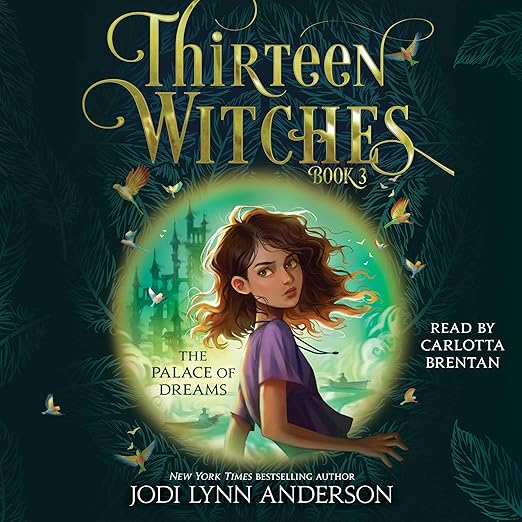
Rosie has one stand left in her when this audiobook opens, and the listing assumes you already know why that matters. Book three closes the Thirteen Witches trilogy, and the description begins in the middle of a catastrophe already underway: our heroine and her friends have escaped Earth with the League of Witch Hunters and are hiding on a barely inhabited planet from the Nothing King and his followers. Eight hours and fourteen minutes of finale, then, with no recap on the page and Carlotta Brentan reading. Jodi Lynn Anderson has built something odd and expansive here, and this is where it lands.
The Review
Earth survived, which is the first surprise the messenger brings, but only because the Nothing King wants one last treasure before he drags everything into oblivion. That treasure is the Museum of Imagined Things: infinitely tall, made only of mist and figments, glimpsed once by Rosie during a visit to the Brightweaver in the clouds and then bundled up and hidden for safekeeping. So the League crosses the galaxy looking for a building made of imagination, collecting a gaggle of the world's last ghosts out of Limbo along the way. As premises for a middle-grade finale go, that is unusually strange and unusually good. Anderson has resisted the obvious ending, which would have been a battle, in favor of a quest for an object that exists only because people imagined it. That choice tells you what the trilogy has been about the whole time, and it gives the last volume something to argue rather than merely something to resolve.
Five written comments sit on this page and every one of them is a five-star grade, while the listing displays an average of 4.8 across 69 ratings. The arithmetic is worth pausing on. If the visible verdicts are all fives and the aggregate lands below five, the votes nobody can see are the ones dragging it down, which means at least one grader went lower than any commenter did. One comment praises the author's imagination as compelling and interesting, names this as the third of the trilogy, and recommends the first two alongside it, which is the most practical thing anyone in that column has said about order.
The Best Parts of The Palace of Dreams
Imagination is the literal subject and that gives the audio format an unusual advantage. A museum made of mist and figments is easier to build in a listener's head than on a page, because nothing on the page is competing with the reader's own picture of it. Another comment describes these books as imaginative and nuanced, bringing joy and inquiry and magic, and mentions picking one up while babysitting and then being unable to stop before the end. That is the right instinct about this trilogy: it works on adults who did not intend to be reading it.
Carlotta Brentan is the credited reader, and the strongest argument for this recording comes from a parent rather than from a critic. A parent's comment explains that these were bought for an eleven-year-old daughter who found them a little advanced to tackle alone, and that reading them aloud together produced the real value, the conversations afterward about what was happening. An audiobook does exactly that job. It puts the story into the room at a pace a younger listener can follow, and it leaves both people free to talk about it while it runs. That is a genuinely underrated case for children's audio, and it is stronger here than on most titles, because this book is dense with invented places and creatures that a child will want to ask about the moment they appear.
The Caveats
Germ and Ebb are characters one written comment cares about a great deal, along with a certain bird it calls phenomenal, and none of those names appears anywhere in the description. Neither does Gemma, whom a different comment gives as the name of Rosie's friend. That is the trilogy tax. A closing volume is entitled to assume its cast, but a listener arriving cold gets no help at all from this page, and the first of those two comments breaks off mid-word before it can finish the thought it started about how it feels to reach the end.
Kirkus is quoted on the listing calling the book thoroughly satisfying, and the comparison offered is the Newbery winner The Girl Who Drank the Moon, which sets an expectation worth testing against your own reader. This trilogy is stranger and colder than that comp suggests, with real betrayals inside the group and an antagonist whose stated goal is oblivion rather than conquest. The middle-grade shelf covers a wide emotional range and this sits at its darker end. Nothing on the listing gives an age guide beyond the category label, and no publisher note qualifies it either, so a parent buying blind has only the comparison title to steer by.
Who Jodi Lynn Anderson Is Writing For
Families already three books deep are the readers this was made for, and it delivers the ending they have been waiting through two volumes to reach. Beyond them, the shared-listening case is strong: a household with a young reader who is confident by ear and hesitant on the page gets more from these eight hours than from the printed edition, since the vocabulary and the sentence rhythms are pitched slightly above the age band. Adults reading across into middle grade for the invention will find plenty here that does not condescend, and the eight hours pass faster than the number implies because the plot keeps relocating.
Newcomers should start at book one, and not out of purism. The description opens mid-flight with a league, a king, a planet and a museum already established, and the recording gives you no glossary and no recap to hold on to. Anyone whose young listener needs a tidy ending should also know that the description promises surprises and betrayals inside the group before the finish, so trust between the characters is not a settled thing. And if you want a gentle bedtime listen, look at the other shelf entirely. Oblivion is on the table here from the first chapter, and the book means it.
A Few Questions About The Palace of Dreams
Can The Palace of Dreams audiobook be listened to without the first two books?
Not comfortably. The listing marks it as the third of three and the description opens with an escape, a league and an enemy already in motion. No recap is offered on the page, and no summary of the first two volumes appears in any field a buyer can read before choosing.
Who reads this one, and for how long?
Eight hours and fourteen minutes, read by Carlotta Brentan, the only performer named. Simon and Schuster Audio issued it on March 7, 2023. Nobody else is named at all, which leaves one voice carrying the whole ensemble of hunters, ghosts and witches.
What age is this audiobook aimed at?
The listing gives only a children's category and no age guidance in any field. The comparison title named on the page is a Newbery winner, which places it in middle grade, and the vocabulary sits at the upper end of that, so shared listening suits younger children better than solo listening.
Is this really the end of the Thirteen Witches story?
The description calls it the third and final book of the trilogy, and the series field on the listing numbers it three. Nothing on the page points to further volumes or to a spin-off, so treat this as a complete ending rather than a stopping point before more.