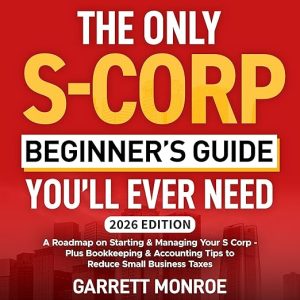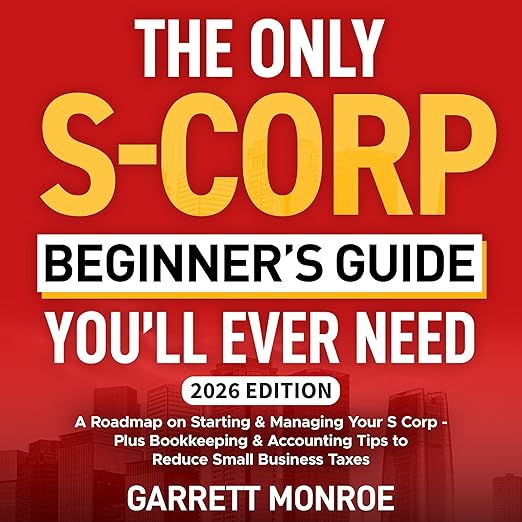
Garrett Monroe's The Only S-Corp Beginner's Guide You'll Ever Need opens with a promise that its title makes explicit: this audiobook will give you everything you need to understand S-Corporations as a business structure. That is an ambitious claim for four hours of audio, but the book comes reasonably close to earning it within its stated scope, covering S-Corp formation, tax advantages, financial management, and hiring for the specific entrepreneur who has been operating as a sole proprietor or LLC and is wondering whether making the S-Corp election makes sense for their situation.
Narrator Clayton Brown handles the material with the kind of measured competence that business and financial audiobooks require. The content sits in the Small Business and Taxes series, which signals its orientation clearly: this is practical financial education aimed at entrepreneurs who are not accountants, delivered in a format they can absorb without sitting down with a textbook.
The structural premise of the book is smart. Rather than beginning with definitions and regulatory history, Monroe frames the S-Corp question around what entrepreneurs are actually trying to accomplish: reducing self-employment tax burden, creating a more defensible financial structure, and building a business entity that can attract the kind of employees and contractors who signal that a company is serious. That problem-first framing makes the tax mechanics that follow feel like solutions rather than obstacles to compliance.
Reviewer Bruce describes the book as simplifying intricate procedures in a way that instills confidence, which is precisely the register a good business basics audiobook should hit. Reviewer Kelly S. uses the word roadmap and means it literally, noting the step-by-step structure moves from formation through payroll compliance to financial management without assuming prior knowledge of any of it. That scaffolding is the book's real contribution: not deep expertise, but the clear conceptual map that tells a new S-Corp owner what questions to ask their accountant and why asking them intelligently changes the quality and cost of the advice they receive.
The 2025 update framing is a meaningful distinction for a topic where regulatory changes and new tax credit availability shift the strategic calculus significantly from year to year. Tax content that is even two or three years old can lead entrepreneurs toward structures or strategies that have since changed, and Monroe's attention to current law gives this edition an advantage that older titles in the same space simply cannot match.
Clayton Brown's Pace Matches a Four-Hour Runtime
The audiobook format works unusually well for business-basics content because the listener's goal is conceptual familiarity rather than memorization. You are not trying to recall specific figures or regulatory citations; you are trying to build the mental model that makes subsequent conversations with professionals productive. That kind of understanding transfers effectively from audio listening during a commute or workout in a way that dense regulatory reading does not.
Clayton Brown's narration is clear and well-paced throughout. He does not editorialize or add warmth where the material does not call for it, which is the right choice for tax content. Attempts to make financial regulation entertaining tend to produce awkward results, and Brown avoids them by keeping his energy consistent and his delivery clean. The four-hour-ten-minute runtime is well-calibrated to the scope: enough to cover the material properly without padding it into a multi-session project that loses momentum between listening occasions.
The bonus PDF materials, accessible from your Audible library after purchase, include a Negotiation Mastery cheat sheet and a Mindfulness Hacks for Entrepreneurs guide. These supplementary documents extend the practical content of the audiobook into written form, which is particularly useful for the sections where specific numbers, steps, or frameworks benefit from a reference that can be consulted without replaying audio.
Tax Credits to Study, Payroll Mistakes to Avoid
The sections on what Monroe calls the full spectrum of little-known S-Corp tax credits are worth your most careful listening. This is the content that most beginning entrepreneurs miss entirely. Not the formation mechanics, which are well documented elsewhere, but the ongoing tax advantages that make the S-Corp structure worth the additional administrative complexity once the initial setup is complete. Monroe moves from general principle to specific application in these passages in a way that rewards active note-taking or a second listen.
The hiring and management material is more general than the tax content and draws on broader business-management principles that are not S-Corp-specific. It is useful context, but listeners should recognize it as supplementary to the core financial argument rather than a distinctive contribution to the S-Corp literature. The payroll compliance sections, by contrast, are among the most practically important in the audiobook because failing to handle payroll correctly is the most common way that new S-Corp owners create the exact tax problems they were trying to avoid.
Built for Solo Owners Weighing the S-Corp Election
Solo entrepreneurs, freelancers, and small business owners who have been operating without a formal corporate structure and are seriously considering the S-Corp election will get the most direct value from this audiobook. It assumes no prior knowledge of corporate structure or tax law, making it genuinely accessible to first-time business owners. Listeners who already have an established S-Corp relationship with a CPA will likely find the formation material familiar and will want to focus on the tax credit and financial management sections. This is not a reference for practicing accountants; it is a conceptual primer for the business owner sitting across the desk from them, preparing for that conversation to be productive.
Before You Press Play
- Voice: Clayton Brown delivers a clean, professional read that suits the instructional material well; his voice has the neutral clarity that works best for tax and business content, where the listener needs to absorb information rather than follow a performance.
- Big ideas: S-Corporation tax efficiency, small business structure, entrepreneur financial strategy
- Atmosphere: Practical and confidence-building
- Worth it?: A genuinely useful starter guide to S-Corp formation and tax strategy, narrated in a format that makes dense financial material accessible during a commute or workout.
Is The Only S-Corp Beginner's Guide audiobook updated for current tax law, or is the content potentially outdated?
The synopsis explicitly describes this as a 2025 updated version, which is a meaningful distinction for tax content where regulatory changes and new credit availability can shift the strategic picture significantly. That said, always verify specific figures and requirements with a qualified tax professional.
What is included in the PDF that accompanies this audiobook in your Audible library?
The accompanying PDF includes two bonus materials: a Negotiation Mastery cheat sheet and a Mindfulness Hacks for Entrepreneurs guide. These are supplementary to the core S-Corp content rather than essential to the main argument, but the negotiation resource in particular has practical value beyond the audiobook itself.
How does this audiobook handle the payroll complexity that comes with an S-Corp election?
Monroe covers payroll compliance as one of the core operational topics, correctly identifying it as one of the most common areas where new S-Corp owners make costly errors. The treatment is introductory rather than exhaustive, but it covers the conceptual requirements and the typical mistakes clearly enough to prepare a listener for informed professional guidance.