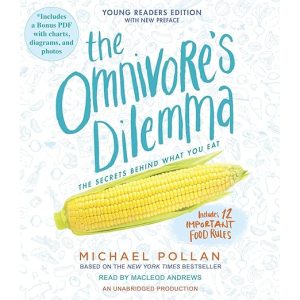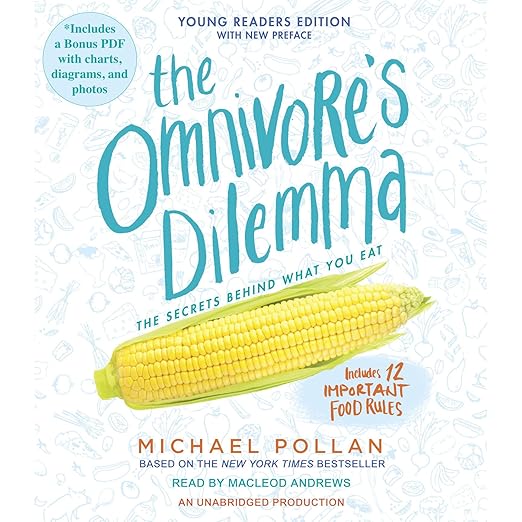
The verdict on The Omnivore's Dilemma was clear before the young readers' adaptation existed: Michael Pollan's original investigation into the American food chain was one of the most consequential pieces of food writing in the past two decades, and it changed how a significant portion of the country thinks about what they eat and where it comes from. The question the adaptation raises is whether that investigation can survive the translation to a younger audience without losing what made it genuinely unsettling and valuable. This audiobook, narrated by MacLeod Andrews and running seven hours and thirty-two minutes, makes a strong case that the answer is yes, provided listeners approach it with the understanding that this is an adapted text rather than the unabridged original.
Pollan structures the book around four food chains: industrial agriculture, industrial organic, a pastoral small farm, and hunter-gatherer foraging. Each chain is traced from source to meal, and the reader is forced to confront the gaps between their assumptions about food and its actual origins at every step. The young readers' format, as several reviewers note, simplifies some of the economic and philosophical complexity of the original while adding visual material, charts, and an updated afterword that make the argument more digestible for the intended demographic. For audiobook listeners, the visual additions translate into Andrews's narration of what would be supplementary material in the print version, which requires some adjustment in expectations.
Andrews Reads the Feedlot Without Flinching
MacLeod Andrews is a narrator with a substantial audiobook catalog, particularly in genre fiction, and his work here reflects a shift in register that suits the adapted text. He reads Pollan's material with an engaged journalist's energy that avoids both condescension toward younger listeners and the kind of flat educational neutrality that drains food writing of its investigative charge. The passages where Pollan's argument is at its most uncomfortable, the industrial feedlot sections in particular, Andrews reads without flinching but also without editorializing, which is the right call for material that should speak for itself.
Reviewer asnyder5's framing of the audiobook as classroom material captures something important about its design: this is content built to generate discussion rather than simply deliver information. The argument Pollan makes, that abundant food choice has paradoxically created an omnivore's dilemma by disconnecting us from the instinctual and cultural knowledge that historically guided food decisions, is as relevant for a classroom discussion as it is for individual reflection. In the audiobook format, that discussion-generator quality means the content retains its capacity to make listeners uncomfortable with their own food choices in productive rather than guilt-driven ways.
Complex Food Systems Made Legible Without Slogans
Reviewer Sean Bosak's description of the audiobook as eye-opening and easy to understand reflects the specific achievement of Pollan's young readers' adaptation: it makes complex systems, the economics of corn monoculture, the certification politics of organic labeling, the carbon accounting of long-distance food transport, legible without reducing them to slogans. That accessibility has direct value for listeners who were daunted by the full original text. The audiobook at seven hours and thirty-two minutes is substantially longer than most young readers' format titles, which speaks to the depth Pollan retains even in the adapted version.
Reviewer Marc Huete's contextualization of this book within Pollan's broader catalog, including In Defense of Food, Food Rules, and Cooked, is useful for listeners approaching this as an entry point into Pollan's work. The Omnivore's Dilemma is the foundational text in his food-systems investigation, and the young readers' adaptation maintains enough of the original's investigative rigor to serve as a genuine introduction to his methodology rather than a watered-down taster.
The Charts Stay Behind in the Bonus PDF
The adaptation format does create real differences from the original text that listeners should know about. Some of the philosophical and political dimensions of Pollan's argument, particularly his engagement with the ethics of eating animals and his more ambivalent conclusions about organic food's commercial evolution, are softened or shortened in the young readers' version. Adult listeners who have not encountered the original may find the audiobook a satisfying experience; adults who know the original well may find the adaptations frustrating. The 4.5 rating across 931 reviews suggests the adapted version is finding its intended audience effectively.
The bonus PDF referenced in the synopsis, which contains charts, diagrams, and photos, is print-companion material that does not translate to the audio format. Andrews narrates the text that accompanies those visuals, but the visual reinforcement that makes data arguments most impactful in the print book is absent from the audio experience. Listeners for whom data visualization is important to how they process complex systems arguments should be aware of that limitation.
This Will Engage, Not Lecture, Young Listeners
This audiobook is for young listeners aged roughly ten through sixteen who are beginning to think about food systems, environmental impact, and personal food choices. Teachers and parents looking for a substantive food-systems audiobook that will engage rather than lecture young listeners will find this well-constructed for that purpose. Adult listeners new to Pollan's work who want an accessible entry point will also find the adapted text genuinely useful, even if the full original text is the more complete experience.
Skip it if you have already read the full original text and want the unabridged argument, or if you are an adult listener primarily interested in Pollan's most sophisticated philosophical claims about food ethics. For its target demographic and for listeners who prioritize accessibility over completeness, the audiobook delivers Pollan's central investigation with enough of its original force intact to make the listening experience worthwhile.
Quick Take
- Performance: MacLeod Andrews brings a clear, engaged energy to Pollan's adapted text that suits the young-readers format without infantilizing the content for adult listeners who may encounter it.
- What it covers: Industrial food systems and their hidden costs, personal food choice as political act, the distance between consumer and source
- Feel: Curious and gently urgent, investigative without being alarmist
- Our call: A well-constructed audiobook adaptation of Pollan's food-chain investigation that gives younger listeners the intellectual substance of the original without sacrificing the argument's essential force.
Questions Listeners Ask
Is this audiobook the full original Omnivore's Dilemma, or is it the young readers' adaptation?
This is the young readers' adaptation of Pollan's original text. It simplifies some of the economic and philosophical complexity of the full book, adds visual supplements in the print version that do not translate fully to the audio format, and includes an updated afterword. Adult listeners seeking the complete original argument should look for the unabridged audiobook of the original Omnivore's Dilemma.
Is this audiobook appropriate for classroom use, and does it generate discussion naturally?
Yes, and it appears to be used that way regularly. Reviewer asnyder5 engaged with it specifically in a classroom context and found it effective. The audiobook's structure, tracing four distinct food chains from source to meal, creates natural discussion points around each chain, and the updated afterword specifically addresses the generation of readers who will inherit the food-system challenges Pollan describes.