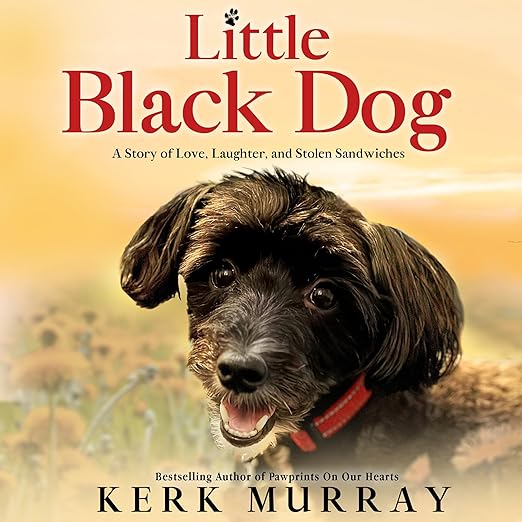
Max the Yorkipoo gets top billing on the cover, and two of the three reviewers on this listing quietly point out that the book belongs at least as much to the man holding the leash. Knowing that in advance changes the experience rather than spoiling it. Little Black Dog is Kerk Murray's follow-up to Pawprints on Our Hearts, a three-hour-and-fifty-four-minute audiobook read by Luke Welland, and it chronicles seven years with a small dog the publisher's copy describes as treating rules as mere suggestions. The opening line of that copy sets the register precisely: he is tiny, he is bossy, and he wants your sandwich.
Part Love Letter, a Reckoning With Time
The description does something unusual for a pet book: it tells you the sad part is coming. 'Part love letter, part reckoning with time' is the copy's own phrase, and the closing line asks readers to 'give our dearest ones their flowers while they're still here to receive them.' That is a bereavement book announcing itself politely. Anyone who has read in this genre knows the shape, and knows that the comedy in the early chapters exists to make the later ones land. Seven years of a dog's life is a complete arc by definition, and building a memoir on that span is a decision about the ending as much as about the beginning.
What lifts it above the standard entry, on the evidence here, is the double subject. Janet's review describes the book as 'a lovely mix of autobiography, love story,' and a rescue tale 'all wrapped up in one,' written, the same review says, 'in the style of a friend talking with a friend,' before the sentence runs on into how Murray tells his own story alongside theirs. Two dogs are involved rather than one. Reviewers name Maximus and Spartacus, and one of them singles out 'Devilish Maximus who loves with his whole heart' before the review is cut off. A book that braids an owner's own story through the lives of the dogs is a different proposition from a straight animal portrait, and it is worth deciding which of those you actually want.
Luke Welland's Warmth, Without the Performance
Under four hours is exactly the right size for this material, and the restraint deserves credit. Pet memoirs bloat easily, padding a slim emotional arc with anecdotes that all make the same point. At this length the book has room for the comic set pieces the copy advertises and for the reckoning it promises, without the middle stretch where a reader starts checking how much is left. It is a single-evening listen, or two commutes, which also means the emotional weight arrives concentrated rather than diluted across a fortnight of intermittent listening.
The conversational register several reviewers respond to is the other reason to take it in audio specifically. A book written, as one reviewer puts it, in the style of one friend talking to another is doing in prose what narration does natively. Direct address, digression, the aside that circles back: these are spoken-language moves, and they lose nothing and often gain when actually spoken. This is one of the few genres where the audio edition can plausibly be the better version rather than the convenient one, provided the reading matches the register.
Luke Welland is credited with that reading, and the demand is narrow but real. Nothing here requires accents, ensemble differentiation or dramatic range. What it requires is the ability to sound like a person telling you about their dog at a kitchen table, then to handle a late passage about loss without either flattening it or reaching for a lump in the throat that the listener has not arrived at yet. Warmth without performance is a harder brief than it sounds. My advice would be to sample from somewhere past the first chapter, since the opening comedy will suit almost any competent reader and tells you nothing about the harder second half.
Donne Knudsen's Reservation About Whose Story This Is
Donne Knudsen, at four stars, names the reservation with useful precision. Self-described as a sucker for a good doggie story, Donne found that while the book had a couple of kooky and entertaining doggies, 'it was really more about Kerk Murray's success story.' That squares with Janet's autobiography framing from the opposite direction: what one reader enjoyed as a braid, another experienced as a bait and switch. If you are here strictly for the dog, calibrate accordingly. The author's own career and life occupy real estate that the title and cover do not advertise.
Two smaller notes. The review pool skews toward print: one five-star review discusses the reviewer's own work fostering dogs in Texas, offers no assessment of this book's contents at all, and signs off by thanking the author for autographed copies, which is not something an audio listener receives. Take the 4.8 average as a signal about the writing rather than about this recording. And this is the second entry in a Dog Lovers sequence, following the book the copy names as its bestselling predecessor. Nothing suggests you need the first one, since a new dog and a new span of years reset the premise, but readers who met these dogs already will get the callbacks and newcomers will not.
Worth the Ache, If You're Ready for It
Dog people know who they are, and this was written for them without apology. Anyone who has lost an animal and wants it set down by someone who has done it well will find the four hours worth the ache. The same goes for listeners who like memoir in a warm conversational key, and for anyone who reads pet books partly to be given permission to feel disproportionately about a small creature. Fosters, rescuers and adopters are especially well served, judging by which readers turned up to review it. One of them mentions doing exactly that work with a rescue in Texas and having thought about writing up those experiences, which suggests the sort of reader this book finds: someone who already knows the shape of the story and wants it told properly rather than sentimentally.
Look elsewhere if you want a training manual or practical animal care, because the pets and animal care shelving oversells that angle considerably. Look elsewhere too if you are in a raw patch of grief over your own animal, since the copy states its intentions plainly and a short book gives you less time to brace. And listeners who want the dog and only the dog, with none of the owner's career, should weigh Donne Knudsen's four-star caution before buying rather than after.
Quick Take
- Read by: Luke Welland reads a memoir written in a talking-to-a-friend register, so warmth without over-performance is what the sample should be tested for.
- At its heart: Life with a small demanding dog, the compressed arc of a pet's lifespan, grief anticipated, memoir braided with animal portrait.
- Vibe: Comic and affectionate up front, openly headed somewhere sadder.
- Short version: A well-sized, genuinely warm pet memoir, provided you accept that the author's own story shares the billing.
Do I need to have read Pawprints on Our Hearts first?
The copy presents this as a follow-up to that bestseller rather than a continuation, and the premise resets around a new dog and a new stretch of years. Newcomers should manage fine. Readers who already know these dogs will pick up callbacks that will pass a first-time listener by.
Is the audiobook about the dog or about the author?
Both, and reviewers split on the balance. One describes it as a lovely mix of autobiography, love story and rescue tale. Another, at four stars, found it really more about Kerk Murray's success story despite enjoying the dogs. If you want an animal portrait with no career narrative, factor that in.
Is under four hours long enough for an audiobook memoir like this?
It suits the material well. Pet memoirs commonly pad a slim emotional arc, and this one runs roughly one evening or two commutes, which keeps the comic set pieces and the emotional payoff concentrated rather than spread thin across many hours of repetitive anecdote.