Morgan Gold reads his own farm memoir, which is the correct decision and, oddly, the reason this audiobook sidesteps the only real complaint filed against the printed edition. A five-star reader who has followed Gold for years and once met him at a show wishes the photographs had been spread through the chapters instead of gathered into an insert in the middle. That is a fair objection to a physical object. It is also an objection that evaporates here, along with the photographs.
Ducks Escape, Cows Ignore Fences, Winter Freezes
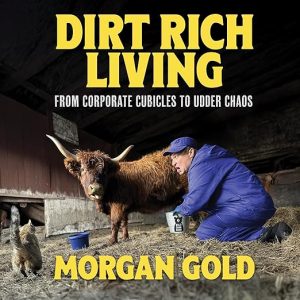
Ducks escape at midnight. Cows ignore fences. Winter, in the publisher's phrasing, freezes your soul. Those are the specifics the description leads with, and they set the register accurately. A burned-out six-figure executive with no farming experience buys land in Vermont on the assumption that animals plus acreage equals happily ever after, then finds out that mistakes cost real money or, worse, real animals. The full title, From Corporate Cubicles to Udder Chaos, tells you the tone before a single chapter does.
Two of the five accounts make the same point outright: this is not a manual. One five-star account puts it plainly: as Gold explains, the book is not about how to become a farmer, it is about how you deal with life and change. TopHatOwl reaches the same conclusion from the other direction, recommending it not just to people who aspire to a simpler life but to anybody looking for the courage to make a transition. That distinction is the single most important thing a buyer can know in advance.
Post Hill Press put the book out in February 2026, and the cover copy is worth reading for what it declines to promise. No expertise is claimed. No system is offered. What the publisher advertises instead is a man with no manual, no backup plan and no clue what he is doing, betting on himself and then reporting the results. Memoirs of competence are easy to sell. Memoirs of incompetence, told by the incompetent party, are considerably harder, and this one commits to the harder version.
Three Separate Reviewers Praise Gold's Candor
Candor is the word three separate accounts reach for, each in a different form. Needsmorenails names candor, humor and insight in one breath. Madilynn calls the book authentic, enjoyable and funny, and frames it as a joy for the countless people who daydream about quitting corporate work and returning to the land, or who simply daydream about taking a risk at all. The description promises the flubs alongside the breakthroughs and warns you will cringe as well as laugh, which is a rarer commitment than it sounds in a genre built on romanticizing the simple life.
Byline and reader credit belong to the same person, and for a memoir about self-inflicted disaster that is not a neutral arrangement. Gold has to say the embarrassing parts out loud in his own voice. He also arrives to an audience already trained on his delivery: two of the five accounts name his video channel outright, one dating the habit to the pandemic, and a third account describes following him for a while and buying a signed copy in person. The nearest thing on this page to a remark about the recording praises him as a storyteller across writing, narration and video without separating the three.
Seven hours is a well-judged size for this kind of story. Long enough to move through a full cycle of failures rather than a highlight reel, short enough that the joke never wears thin. One reader finished it in roughly three days and another had not managed to set it down since it arrived, which is the sort of pacing report that transfers to a recording without adjustment.
A Launch Audience and an Unexplained Average
Thirteen ratings is the number to sit with. Five of them come with written accounts, all five award the maximum, and all five were filed within three weeks of the February release. That is a launch audience, and for a creator with an established following a launch audience is not a neutral sample. One account states outright that the purchase was made to support the author. That disclosure does not make the praise false, and it does mean this average is measuring loyalty alongside quality.
Arithmetic offers the only counterweight. A 4.6 average across thirteen ratings cannot be produced by thirteen top marks, so assuming the five written accounts are counted among them, the eight silent votes were not all fives. Somebody scored this lower and did not explain why, and that unexplained fraction is currently the entire critical opposition on the page.
No Photos, and a Title the Search Misses
Photographs are the second thing to weigh, and they show most clearly what changes between formats. mtn wanted them distributed through the chapters rather than bunched into a plate section, and guessed the placement was a cost decision. In audio the question is settled by subtraction: a book about ducks, cows and a Vermont winter arrives with no images at all. Whether that costs you anything depends entirely on whether you came for the story or for the farm.
The listing is untidy in one findable way. The displayed title stops at Dirt Rich Living while the description carries the whole thing, so anybody searching on the subtitle will never reach this page. The genre placement is the same problem at one remove: home and garden with a house and home tag, the aisle somebody hunting seasonal advice walks down and the last place a memoir reader would think to try.
Daydreaming Escapees Get an Honest First Year
Anybody who has quietly drafted a resignation letter in their head is the target, and this pool says so in almost those terms: people who daydream about walking away from corporate work, and people who merely daydream about risk. Homestead-curious listeners wanting an honest account of what a first year costs emotionally will get one. So will anybody drawn to memoirs where the teller is the butt of the joke far more often than the hero of it.
A how-to for starting a farm is not what this is, and the reviewers say so before I do, so anyone shopping for practical instruction should keep looking. Readers who need distance between an author and their own promotional ecosystem will find these launch reviews hard to read neutrally. People who want the romantic version of country living should note that the publisher promises to make them rethink it. Weigh that before you press play, because the book is strongest exactly where it is least flattering.
In Brief
- Narration: Author and reader are the same name on this listing, which is the one production fact a buyer can actually verify here.
- Themes: leaving a corporate career, first-year homesteading failures, humility, Vermont winters
- Mood: Warm, self-deprecating and frequently muddy
- Verdict: A genuinely funny memoir about being bad at something new, provided you are not buying it for farming advice.
Common Questions
Do I need to follow Morgan Gold's videos first?
Not at all. The description introduces him from scratch as a burned-out executive with zero farming experience and starts at the land purchase, so nothing assumes prior knowledge of him. Existing viewers get the reasoning behind decisions they have already watched play out, which is a bonus rather than a requirement.
How much of this audiobook is actually about the animals?
Enough that they drive the comedy. The description names ducks escaping at midnight and cows ignoring fences as the running disasters, and warns that errors cost real animals as well as real money. The animals are the mechanism by which a confident newcomer keeps being proved wrong, rather than the subject in their own right.
Does it work in short listening sessions?
Yes. Seven hours of episodic memoir, assembled from discrete disasters rather than one continuous argument, tolerates being picked up and put down. Chapters are anchored to individual mishaps instead of to a building thesis, so nothing punishes you for forgetting where you stopped.
Is this audiobook grim or funny?
Funny first. The publisher bills it as hilarious and heartwarming and promises you will laugh and cringe in roughly equal measure. The harder material is present, including money lost, animals lost and some difficulty with locals, but the governing tone is a man telling stories against himself rather than a cautionary account.