Quick Take
- Narration: Author-narrated; Bush’s voice fits the intimate memoir sections naturally, though the recipe portions work better in print format.
- Themes: Baking as self-discovery, coming-of-age uncertainty, the relationship between pleasure and meaningful work
- Mood: Honest and a little melancholic, with warmth in the kitchen scenes
- Verdict: A genuinely literary food memoir with real baking credentials behind it, better experienced as a companion to the print book than as a standalone audio purchase.
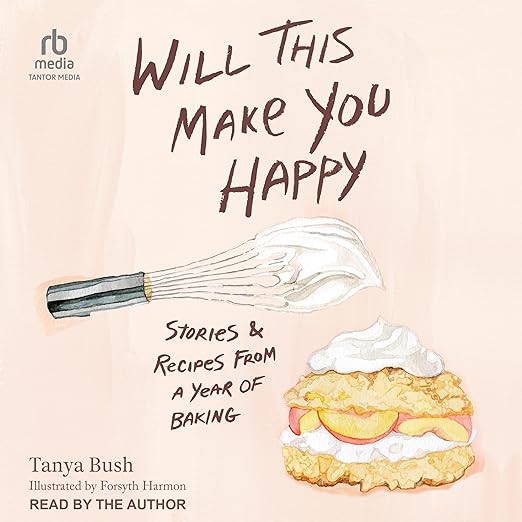
There’s a particular kind of audiobook that works better when you know what you’re getting into before you press play. Will This Make You Happy is one of them. Tanya Bush, co-founder of Cake Zine, pastry chef at Little Egg, has written something positioned for fans of Nora Ephron and Nigel Slater: a hybrid memoir and cookbook, structured in four seasons, carrying more than fifty baking recipes alongside a coming-of-age narrative. On the page, that sounds like a natural pairing. In audio, the ratio requires some adjustment.
I started this one on a rainy Saturday with tea and the genuine intention of baking something afterward. Bush’s narration of the memoir sections is warm and unfussy, she reads her own work with the authority of someone who lived it and the craft of someone who thinks carefully about language. The sections about her early twenties drift, her dead-end relationship, and the initial disastrous cake (gooey in the center, woefully underbaked, an absolute disaster, her words) land with the kind of honesty that earns its place on a bookshelf alongside Ephron.
Our Take on Will This Make You Happy
The memoir arc is the stronger half of the audio experience. Bush’s journey from a tiny apartment to the sunlit kitchens of an Italian agriturismo to a Brooklyn bakery basement has genuine momentum and specificity. She writes about the rediscovery of pleasure and meaningful work with clarity rather than sentimentality, and she doesn’t force the baking into a metaphor it can’t carry. When the kitchen scenes work, they work because she’s specific: sugar crystals under fingernails, flour in hair, the hard-earned satisfaction of following steps through to the end.
The recipe components are a different matter in audio. Bush narrates them with care, but recipes are inherently visual and spatial documents. Reviewer Rob noted the orange almond cake, raspberry lemon cheesecake, and blueberry lime hand pies as standouts he planned to bake, information he extracted from the print edition. The companion PDF included with the Audible purchase partially addresses this, but it requires stopping the audio, opening a separate document, and switching modes in a way that disrupts the listening experience.
Why Listen to Will This Make You Happy
If you come to this primarily for the memoir, the coming-of-age story, the Italian kitchens, the meditation on desire and work, the audio delivers it well. Bush’s voice is a natural fit for material this personal. Reviewer Teresa Starrett put it succinctly: “honest and heart…packed with beautiful prose.” That prose quality survives the audio format better than the recipe list does.
It’s worth acknowledging the dissenting review, which called the book a “challenge to read” due to “continued bitterness and depression.” That reads as a mismatch in expectation more than a flaw in the book, Bush is explicit that this is “messier, more experimental, and honest than the typical aspirational cookbook.” Listeners expecting uplift and cheerful kitchen energy should calibrate accordingly. The emotional register is honest about difficulty, not relentlessly warm.
What to Watch For in Will This Make You Happy
The four-season structure gives the book a natural rhythm, and Bush’s credentials, pastry chef, Cake Zine co-founder, mean the recipes are real and tested rather than decorative. Reviewer Laurie M. noted that “a good cookbook is also a snapshot of a period in time,” and that framing captures what this book does at its best: it makes the recipes feel like artifacts of a specific life rather than instructions from a magazine.
The audio rating of 4.0 across only 13 listeners reflects a genuinely mixed response. The book has enthusiasts and at least one reader who found it actively unpleasant. That range is more honest than a uniform five-star spread, and it suggests this one will resonate strongly with some listeners and fall flat for others depending on their tolerance for emotional ambiguity in what they expected to be kitchen-comfort listening.
Who Should Listen to Will This Make You Happy
Listeners who enjoy literary food writing in the Ephron and Slater tradition will find a lot to appreciate in the memoir sections. Food memoir readers comfortable with an honest, sometimes difficult emotional register will be at home here. If your primary interest is the recipes, this is better approached as a print or ebook purchase, the audio is a companion experience, not a substitute for a visual format when fifty baking recipes are involved.
Frequently Asked Questions
Can you actually follow the recipes from the audio version?
It’s difficult to do so in real time. The recipes are narrated, but the companion PDF available in your Audible Library is the more practical format for actual baking. Most listeners who want to cook from this will need the print edition or the PDF.
How does the memoir compare to the recipe content in terms of listening time?
The memoir narrative takes up the larger portion of the listening experience. The recipes appear as natural markers within each seasonal section rather than as dominant set pieces. This makes the audio work better as a memoir listen than a cooking resource.
Is this appropriate for listeners who don’t bake?
Yes. The baking is more metaphor and context than instruction in the memoir sections, and the coming-of-age story about desire, work, and identity stands on its own. Non-bakers who enjoy personal narrative writing will find the audio worthwhile.
How does Tanya Bush’s self-narration compare to professional audiobook narrators?
Bush narrates her own work with authority and intimacy, she clearly knows this material. The delivery is natural rather than polished in a studio-performance sense, which suits the book’s honest, personal tone.