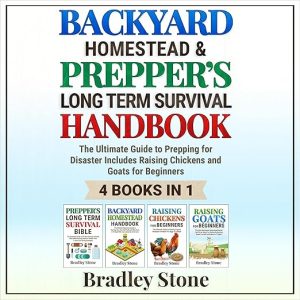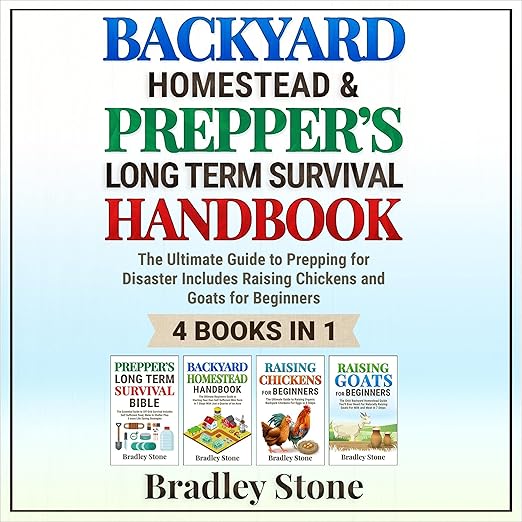
- Performance: Kayll Heath's clear delivery suits the instructional nature of this four-book collection, keeping a dense quantity of practical information easy to follow.
- What it covers: Self-sufficient homesteading, disaster preparedness, small-scale livestock and food production
- Feel: Purposeful and hands-on
- Our call: A substantial bundle that covers a lot of homesteading ground in a single ten-hour audiobook, best suited to listeners who want broad orientation rather than deep expertise in any one area.
Backyard preparedness and homesteading have generated an enormous amount of instructional content in recent years, ranging from deeply practical manuals to content that recycles the same basic information without much added value. Bradley Stone's Backyard Homestead and Prepper's Long Term Survival Handbook lands in more useful territory than most, primarily because it is an audiobook that bundles four distinct books covering complementary areas: long-term survival preparedness, small-farm setup, backyard chickens, and backyard goats. The collection format means listeners get genuine breadth across a subject area that benefits from being understood as a system rather than as isolated skills.
The four component books each address a distinct slice of the self-sufficient living project. The Prepper's Long Term Survival Bible covers the foundations of off-grid survival: food, water, shelter, and three additional life-saving strategies. The Backyard Homestead Handbook walks listeners through the seven-step process of setting up a small farm on as little as a quarter acre, which is a realistically sized plot for suburban listeners. Raising Chickens for Beginners handles egg production from backyard flocks in five steps. Raising Goats for Beginners covers both milk and meat production in seven steps. Together these four titles span the full arc from emergency preparedness through ongoing self-sufficient food production, which makes the collection more coherent than a random four-title bundle would be.
At ten hours and forty-one minutes, the collection gives each subject area enough time to be genuinely instructive without becoming exhaustive. Reviewer Julie H's description of the content as a wealth of information for beginners who want to prepare for disasters and live self-sufficiently is accurate. Reviewer James Lane's note that the book gives you enough information to take your preparations as far as you want reinforces that this is a framework resource rather than a final authority. The practical tips inside are designed to be immediately applicable, and the emphasis on working with whatever resources and location a listener has, on-grid or off-grid, suburban or rural, makes the advice more universally usable than guides that assume a specific setup.
Heath Paces Four Books Into One
Kayll Heath's narration handles the instructional register well. Step-by-step guides presented as audio can become tedious if the narrator does not vary pace and emphasis appropriately, and Heath keeps the material moving without rushing past details that listeners may want to absorb. For a collection this long, with this much practical content, that is not a small thing. The audiobook format suits the prepper and homesteading genre reasonably well for the conceptual and planning content; listeners who need precise measurements or technical specifications will want to take notes or supplement with print resources for implementation, but the broad framework content translates to audio without significant loss.
This is entry ten in the Self Sufficient Living series from Bradley Stone, and the collection structure reinforces that this is a series with clear continuity of approach and philosophy across titles. Listeners who find the bundled format useful will find more available in the same vein. The fact that this volume bundles four books rather than adding one incremental title suggests Stone designed it as a comprehensive entry point or a catch-up resource for readers who want broad coverage rather than sequential reading of individual titles. As a standalone purchase for someone new to the subject, it functions well without requiring familiarity with earlier series entries.
General Advice Needs Local Adjustment
The breadth of coverage across four distinct subject areas means that each area receives introductory-to-intermediate treatment rather than deep technical depth. Listeners who already have significant experience with homesteading, chicken-keeping, or goat husbandry will find the relevant sections cover familiar ground. The books are designed explicitly for beginners in each area, which is an important framing for anyone approaching the collection with prior expertise. The value is in the combination and the framework, not in advanced technique.
Reviewer James Lane notes that a lot of surviving and self-sufficient living depends on location and available resources, which Stone's approach acknowledges. The advice is deliberately general enough to apply across different geographic and climatic conditions, but this generality means listeners in specific climates, those dealing with harsh winters, arid conditions, or urban density restrictions, will need to adapt the guidance rather than apply it directly. The collection is a starting framework, not a location-specific manual, and listeners will get more from it if they approach it as orientation to the subject area rather than a complete operating guide.
Ten Hours to Cover Four Subjects
Listeners who are new to both preparedness and homesteading and want a single comprehensive audiobook that covers the conceptual foundations across both areas will find this collection well-designed for that purpose. The four-book structure delivers natural variation in the content, reducing the listening fatigue that a single long guide on one narrow subject can generate. Anyone considering small-scale livestock production, specifically chickens or goats, who wants an overview before committing to more technical resources will also find the relevant sections practical and encouraging.
Experienced homesteaders or serious preppers with established practices and specific skill gaps to fill will likely find the coverage too introductory to be useful. This is emphatically a beginner-to-intermediate resource, and it makes no pretense otherwise. Listeners in situations where local zoning or space constraints make backyard chickens, goats, or farming genuinely impossible should also adjust expectations: the book provides the information to implement these practices, but can only go as far as a listener's actual circumstances allow.
Do I need to have read earlier books in the Self Sufficient Living series before this audiobook?
No prior reading in the series is necessary. The collection is designed as a standalone comprehensive resource covering preparedness and homesteading fundamentals from the beginning, and the bundled format makes it work as an independent entry point.
Does this audiobook cover both on-grid and off-grid situations?
Yes, Stone explicitly addresses both scenarios. The practical tips are designed to be applicable whether a listener has access to standard utilities or is preparing for or already living without them, which broadens the audience considerably.
Is a ten-hour audiobook the right format for this kind of practical homesteading content?
The runtime works well for the conceptual and planning content across four subject areas. Listeners who need precise technical specifications for implementation will want to take notes or use print resources alongside the audio, but the broad instructional content translates well to the spoken format.
Does the collection cover food storage and preservation, or only production?
The Prepper's Long Term Survival Bible component addresses survival strategies including food, water, and shelter that encompass storage and emergency planning. The homesteading and livestock books focus more on ongoing production, so the collection covers both dimensions of the self-sufficient food question.