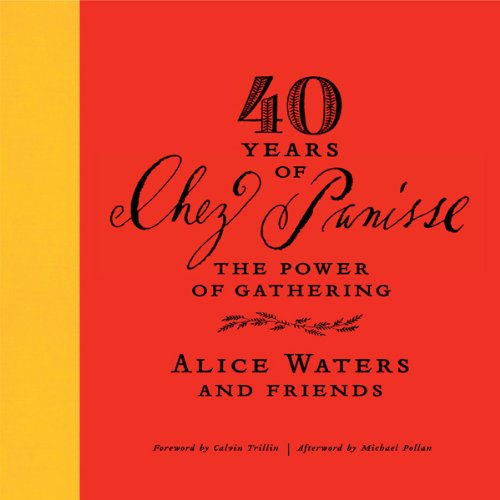
40 Years of Chez Panisse: The Power of Gathering was built for the ear in a way that few audiobooks genuinely are. The Kitchen Sisters, Peabody Award-winning radio producers known for their richly layered documentary work, collaborated with Alice Waters and NPR to create something that sits between memoir, oral history, and audio documentary. Waters narrates the saga of her trailblazing Berkeley restaurant decade by decade, but she is one of more than 50 voices in the recording, joined by Wendell Berry, Michael Pollan, Ruth Reichl, Calvin Trillin, Hillary Clinton, Slow Food president Carlo Petrini, and dozens more chefs, farmers, gardeners, artists, and writers who were part of the food movement Chez Panisse helped ignite.
Reviewer Bohemian makes the case directly: even if you own the print version, do not overlook this audiobook. Their argument is that hearing the people in the book come to life, including voices of collaborators who have since died, preserved in archival recordings captured by the Kitchen Sisters over decades, changes the experience in ways that no print companion can replicate. That argument is correct. The texture of Waters's voice when she speaks about the 1960s opening of the restaurant, the sound of archival interviews with people who have passed, the field recordings that evoke the farms and kitchens and tables that sustained the food movement, these are elements the production carries that a written account flattens entirely.
Radical in 1971, Mainstream Today
The framing across 40 years, organized decade by decade from the tumultuous 1960s through the restaurant's fortieth anniversary, gives the recording a historical shape that anchors the personal testimony. Chez Panisse opened in 1971 in Berkeley, at the intersection of the counterculture's communal values and a particular kind of French provincial cooking that Waters had encountered abroad. The early sections trace how that unlikely combination produced not just a restaurant but a sensibility: that food should be local, seasonal, organic, prepared simply, and shared in conditions that honor the relationship between the people who grew it and the people who eat it.
That sensibility sounds relatively mainstream now. In 1971 it was genuinely radical. The recording's historical arc makes that distance viscerally clear, documenting how ideas that were fringe positions in the early 1970s became the organizing principles of a national food movement through the work of Waters, her collaborators, and the network of farmers and suppliers she cultivated over four decades. Michael Pollan's voice in the recording, for example, is not incidental: his work in books like The Omnivore's Dilemma built directly on principles that Chez Panisse embodied in practice years before they were articulated at the scale of popular nonfiction.
Waters Narrates Like a Champagne Lunch With Friends
Reviewer RAND H. describes spending an afternoon with this as if whiling away the day lingering over a sparkling champagne lunch with Alice and friends, which captures the relaxed pleasure of the recording's conversational and genuinely communal texture. At just over 6 hours, it suits a full afternoon session or a leisurely spread across several evenings. The Kitchen Sisters' production is immersive in a way that rewards undivided attention rather than background listening. The archival audio and field recordings create a sonic atmosphere that pulls you into the decades the recording covers, and the variety of voices prevents the extended runtime from feeling repetitive.
Reviewer Beverly Sykes's reservation, that the original print edition is more of a browsing book than a reading book, is actually transformed by the audio format into a feature rather than a limitation. The episodic, anecdotal structure that makes the print version feel like a coffee table book becomes entirely appropriate for radio-style documentary listening, where you move from voice to voice and decade to decade in exactly the way the production intends. The audiobook solves the structural problem that the print edition poses.
Uniformly Warm, Missing Critical Engagement
The production leans into the celebratory. This is explicitly a commemorative work, not a critical assessment of Waters's influence or a balanced examination of the food movement's limitations and blind spots. The voices present are almost uniformly warm and admiring, which gives the recording a warmth and cohesion but also means listeners looking for critical engagement with, for example, the economic accessibility of the farm-to-table model or the racial politics of the organic food movement, will need to seek that conversation elsewhere. The participants gathered here are largely the movement's own practitioners and beneficiaries.
The production value occasionally creates a listening challenge in the sense that the richly layered audio, mixing narration, archival clips, ambient sound, and music, requires attentive listening to follow the thread when multiple elements are running simultaneously. This is a production characteristic of the Kitchen Sisters' work generally, and listeners familiar with their radio documentary style will find it immediately comfortable. Those who prefer clean, single-voice narration may need an adjustment period.
For Fans of Waters, Pollan, and Reichl
This audiobook is for people who care about the history of American food culture and want to experience that history as something lived and heard rather than analyzed. Fans of Waters's writing and advocacy, of Pollan's food journalism, of Ruth Reichl's culinary memoirs, or of the Kitchen Sisters' NPR documentary work will find this recording essential. Cooks and restaurateurs interested in the philosophical underpinnings of the farm-to-table movement, food educators who want a primary source document from the movement's central figures, and anyone who has ever eaten at Chez Panisse and wants to understand the decades of commitment that created that specific dining experience will find this audiobook repays its six hours generously. People looking for a recipe book or a practical guide to farm-to-table cooking should look elsewhere; this is the story of a vision, not its execution.
Key Details
- Narration: Alice Waters self-narrates her own story alongside 50 collaborators and friends, and the Kitchen Sisters' production weaves archival audio, field recordings, and music into something that functions more like documentary radio than conventional audiobook narration.
- Themes: Local and organic food movement, community-building through shared meals, food as political act
- Mood: Warm, celebratory, and quietly radical
- Verdict: An audio-native document of American food culture that rewards listeners who want to hear history rather than read it, and who feel the difference between a voice on a page and a voice in a room.
Frequently Asked Questions
Is this audiobook significantly different from the print edition, and is it worth getting even if you already own the book?
Reviewer Bohemian makes a strong case that yes, the audio version is worth getting even with the print book in hand. The archival recordings, field audio, and multi-voice production create an experience that the print edition's photos and text cannot replicate. Waters and the Kitchen Sisters designed this as an audio-native work, and the production reflects that intention throughout.
Does the audiobook require familiarity with Chez Panisse or Alice Waters to be rewarding?
No prior familiarity is needed. The recording builds its historical context from the opening decade forward, explaining who Waters is, what she was trying to achieve with the restaurant, and why it became significant. That said, listeners with existing interest in the American organic food movement or in the Bay Area food scene from the 1970s onward will find the references richer and more resonant.
How does the multi-voice production work in the audiobook format? Is it easy to follow who is speaking?
The Kitchen Sisters are experienced radio documentary producers and the production is professionally organized. Different voices are generally introduced by context, and the mix of narration, interview, and archival audio is layered with the craft the Kitchen Sisters are known for from their NPR work. Some passages require more attentive listening than single-voice narration, but the variety of voices is also part of what keeps the 6-hour runtime engaging.
Is this audiobook primarily about food, or does it cover the broader cultural and political dimensions of the food movement?
Both. Waters has always positioned Chez Panisse as a political act as much as a culinary one, and the recording reflects that framing throughout. The voices of Wendell Berry (sustainable agriculture), Eric Schlosser (food system criticism), and Carlo Petrini (Slow Food) alongside chefs and farmers give the production a scope that extends well beyond restaurant history into questions of land use, community, education, and the politics of what we eat and where it comes from.