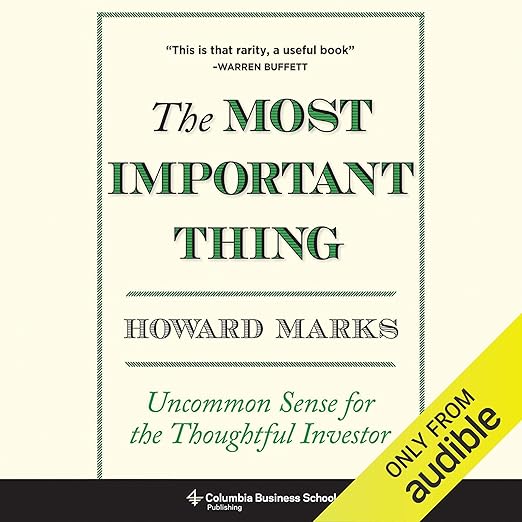
I listen to finance audiobooks while doing things that do not require my full attention: sorting through papers, walking in low-traffic areas, making dinner. The Most Important Thing broke that habit within the first twenty minutes. Howard Marks was saying things I had heard variations of before, but the way he was saying them, with a precision and a willingness to acknowledge his own errors that most finance writers avoid, forced me to stop and actually think.
John FitzGibbon narrates, and the choice is well-suited: a clear, authoritative delivery that does not editorialize or dramatize. This is intellectual content, and FitzGibbon gives it the presentation it deserves.
Is The Most Important Thing Worth Your Time?
Marks is the chairman and cofounder of Oaktree Capital Management and has spent four decades writing memos to clients that are now studied as carefully as any formal investment text. This book emerged from a July 2003 memo in which Marks listed everything he had called the most important thing about investing over the course of his career. The joke in the title is intentional and specific: every chapter isolates a different concept, from second-level thinking to the price/value relationship to patient opportunism to defensive investing, and argues that each is the most important thing, because it is. Successful investing requires simultaneous attention to multiple essential concepts. What distinguishes this book from most investment writing is that Marks does not pretend these concepts are simple or that following them is straightforward. He is honest about where he got things wrong. One reviewer who takes investing seriously described the book as showing just how wrong they were in their own investment strategy. That kind of correction, delivered clearly and without condescension, is valuable.
The Best Parts of The Most Important Thing
FitzGibbon's narration handles the conceptual density without rushing. Finance audiobooks are easy to ruin with narration that flattens the material into a stream of abstractions; FitzGibbon gives each chapter's core concept the pause and emphasis it needs to land. The memo extracts, which Marks uses throughout to illustrate his thinking in real time, are integrated smoothly into FitzGibbon's delivery rather than sounding like quoted documents dropped into the flow. The seven-hour runtime is appropriate for the content: long enough to build the philosophical framework fully, short enough to listen in three or four substantial sessions. Marks's writing style rewards listening because he constructs his arguments incrementally and the audio format prevents the skimming that can undercut the cumulative logic on the page.
Before You Commit to The Most Important Thing
This is not a book that will tell you which stocks to buy or when to sell. One reviewer gave it four stars specifically because of that framing: readers should not pick this up in search of investing tactics or mechanics. Marks is teaching a way of thinking, not a method of execution. Second-level thinking, which is the ability to consider not just whether something is good or bad but how other investors are thinking about it and whether that consensus is itself an exploitable error, is the book's central concept and requires some active mental engagement to absorb fully in audio. Listeners who prefer prescriptive investing books with specific actionable rules will find this frustrating. The contrarian philosophy Marks advocates is also not comfortable: it requires being wrong in ways the crowd is not wrong, which is psychologically demanding in ways the book acknowledges but cannot make easier.
Should You Listen to The Most Important Thing?
This is one of the essential investing audiobooks for listeners who have moved past the basics and want to understand how serious practitioners actually think about markets, risk, and value rather than what they recommend doing. Beginners who have not yet understood why diversification, time horizon, and valuation matter will find some of the concepts abstract without that foundation. Experienced investors or those who have read widely in investment literature will find Marks's framework both confirmatory of what works and corrective of common errors. Anyone who manages money, whether their own or others', and who operates on autopilot rather than through ongoing philosophical interrogation of their own assumptions, will find this useful enough to listen to more than once. The audio format accommodates that kind of repeated engagement well.
- Voice: John FitzGibbon delivers the conceptual density with authority and appropriate emphasis, making Marks's framework genuinely listenable.
- Big ideas: Second-level thinking and contrarian strategy, risk assessment, the psychology of investing
- Atmosphere: Rigorous and intellectually demanding, with an unusual frankness about failure
- Worth it?: The clearest articulation of how serious investors actually think: not a how-to guide, but a philosophy that challenges and corrects rather than confirms easy assumptions.
Is The Most Important Thing appropriate for beginning investors, or does it assume prior knowledge?
It assumes some baseline familiarity with investment concepts like risk, return, and market cycles. True beginners may find some chapters abstract. Marks explains his concepts clearly, but the book is most valuable to listeners who have existing investment experience to measure against his framework.
How does John FitzGibbon's narration handle the book's conceptual density?
FitzGibbon reads with clarity and appropriate emphasis, avoiding the flat delivery that can make finance audiobooks difficult to follow. He gives each chapter's key concepts the pause and weight they need without dramatizing material that does not call for it.
What is second-level thinking and why does Marks consider it the foundation of successful investing?
Second-level thinking means going beyond the obvious conclusion about an investment to consider what other investors are thinking, whether the consensus is wrong, and how to profit from that gap. Marks argues that first-level thinking produces average results because everyone doing it arrives at the same conclusions.
Does Marks discuss his own investment mistakes in this book?
Yes, and that honesty is one of the book's distinguishing features. Marks discusses specific cases where his judgment was wrong and what he learned from them. Most finance writers avoid this kind of self-assessment, which makes his frank accounting of missteps particularly valuable.