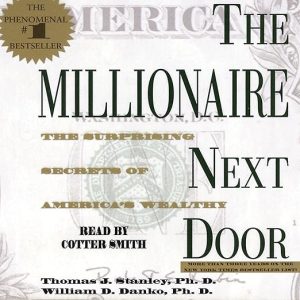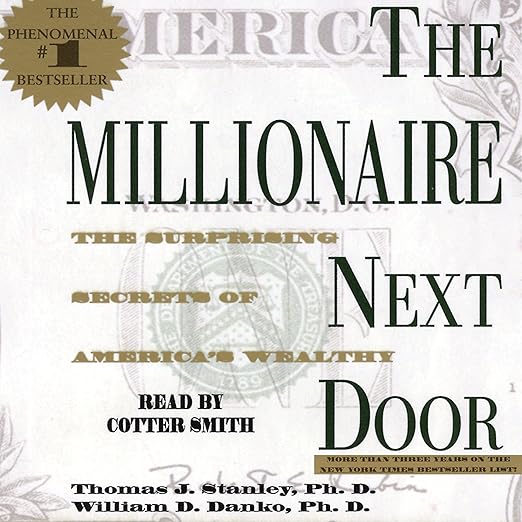
Two hours and twenty-four minutes is a short recording for a study of American wealth, and that number is the first thing to know about this audiobook. Simon & Schuster Audio released it on November 1, 2000, Cotter Smith reads it, and nowhere does the record state whether the recording is abridged. On a book whose reputation rests on the research behind its claims, that omission matters more than it would on a memoir, because the distance between an argument and the evidence for it is exactly what disappears when a study gets compressed.
Flashy Millionaires, Mundane Millionaires, and Where They Shop
Wealth, in the questions the copy asks, is a behavioral subject rather than a financial one. Who are the rich in this country? What do they do? Where do they shop? What do they drive? How did they get rich? Every one of those is a question about habits, not about returns. A five-star from February 2026 states the thesis in a line: two kinds of millionaire exist, the flashy and the mundane, and this book is what decades of studying the mundane produced. That was a genuinely new proposition when the copy first called it the never-before-told story of wealth in America.
Where they shop turns out to be the load-bearing question of the set. Once you accept that most wealth is accumulated rather than displayed, every visible marker of money becomes evidence of spending instead of evidence of having, and the whole cultural picture inverts. The book is not making a moral case for frugality either, which is what keeps it from curdling. It reports what a particular population does, and the reader is left to decide whether a life spent buying inconspicuous things in order to hold on to money is one they actually want.
Sears, Not Brooks Brothers, Is the Real Answer
Sears, not Brooks Brothers, is how a five-star from December 2015 titles its summary, and the body earns that headline. Most wealthy people, it says, do not drive Teslas and eat caviar, are not tech chief executives or Wall Street financiers, and are far more likely to be small business owners and self-employed professionals driving a three-year-old BMW or a pickup truck and wearing a Seiko rather than a Rolex. An entry doing the book's own work that fluently is a good sign: the finding transfers, and readers finish able to restate it in examples of their own.
Brevity suits a thesis this clean. The central claim can be stated in a sentence, and what a listener needs is not repetition but enough illustration to believe it, which is what the runtime delivers. Short financial audio is also the right shape for the audience most likely to benefit, since the people whose habits are still forming are rarely the people with hours to spare. Whatever this edition lost in compression, it kept the part that changes behavior, which is the portrait of who the wealthy actually turn out to be.
Two and a Half Hours of Unlabeled Abridgment
Nothing on the record settles the abridgment question, so the runtime has to serve as the clue. A book whose authority comes from research, delivered in under two and a half hours, is almost certainly handing over conclusions rather than the work that produced them. That is a legitimate product, and for many listeners it is the better one. It is not, however, what somebody expects when they buy a title famous for its data, and the listing leaves that expectation entirely unmanaged.
Fifteen Ratings and No Word on Cotter Smith
Age is the second consideration, and it cuts both ways. This recording is more than twenty-five years old, and questions like what the wealthy drive or where they shop have answers that expire, even though the behavior underneath them does not. The description shows some wear as well: it calls the book an incredible national bestseller and then misspells wealth in the same sentence that promises the never-before-told story about it, which is the kind of typo that survives because nobody has revisited the copy in years.
Fifteen ratings hold up the 4.6 badge, a thin base for a title with this much reputation, and the written column is thinner than the count suggests, since two of the five entries run to three words each and one of those was filed from the United Arab Emirates. Not one written entry mentions Cotter Smith or the recording in any form, so what a buyer can verify in advance is the argument and not the delivery. On a file this short the risk is smaller than usual, but on a record this old it is worth naming.
Great for Beginners, Thin on Real Tactics
Pick it up if you are early enough in a career that the picture of wealth in your head is still being assembled from television, or if you have money coming in and no framework for what to do with the part you do not spend. It also works well as a shared listen for a couple, since the arguments it starts are practical rather than abstract: not whether to invest, but whether the car in the driveway is a purchase or a statement.
Avoid it if you want tactics. Portfolio construction, tax structure, and anything more specific than living below your income are outside its scope. A four-star from February 2015 raises the sharper objection, arguing that the core idea of building wealth through investing assumes a reader in North America, Europe or a developed Asian economy, where investing is a genuine option, and not somebody living elsewhere. That caveat has aged better than the shopping habits have. Nobody should expect a program here, because the book supplies a portrait and leaves the arithmetic to you.
The Short Version
- Narrator: Cotter Smith carries a research book squeezed into a short runtime, so conclusions arrive quickly and the evidence behind them stays offstage.
- Subjects: Quiet wealth, spending behavior, self-employment
- Tone: Plain, data-minded, quietly contrarian
- Bottom line: The finding still holds up, but this edition is short, old and unlabeled, so establish what you are buying first.
Is this audiobook abridged?
The record never says, and a runtime this short on a research-driven study points toward a condensed edition. Anyone who wants the full text with the supporting material intact should confirm the edition on the product page before buying rather than assuming the file is complete.
Does a study published this long ago still apply?
The behavior does; the examples do not. Questions about where wealthy people shop and what they drive have era-specific answers, while the underlying finding, that most wealth accumulates quietly among people who spend well below their income, is not tied to any particular decade.
Does the audiobook explain how to invest?
Not in any practical sense. The copy asks how the rich invest, but the answer is descriptive rather than instructional, and no portfolios, products or allocations are offered to follow. Listeners looking for a method rather than a portrait will need a separate title alongside this one.