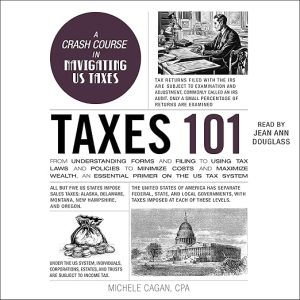
A tax primer has a shelf life, and nothing on this listing tells you when this one expires. That is the first thing to hold in mind about the Taxes 101 audiobook, which runs seven hours and sixteen minutes and promises to teach the structure of the US tax system, the kinds of taxes inside it, the laws that produce deductions and credits, and the forms attached to filing. Simon & Schuster Audio released it in November 2024. The copy names no tax year, no edition number, and no revision date, which on this particular subject is not a small omission.
Seven Hours of Financial Literacy, General to Particular
Cagan's approach is foundational by design, and the description is unusually honest about that. The pitch is financial literacy rather than tax strategy: understand your taxes in order to understand your finances, learn the basics of the system, then make better choices about your own financial wellness. Nothing here promises to find you money. It promises to explain what the machinery is doing while it takes yours. For a subject most people meet only through software prompts and a deadline, that framing is genuinely useful, and it sets expectations correctly for a listener who has never read a sentence of tax code in their life.
Seven hours and sixteen minutes is about the length of a working day, and the book uses it to move from structure to specifics: what kinds of taxes exist, how the laws that create deductions and credits are assembled, and which forms attach to which situation. The sequencing runs general to particular, which is the sensible direction, and it means the early hours carry the conceptual load. Stop partway and you will still leave with the frame. That is more than most introductions to any subject manage.
Sanchez's Boundary, and Forms That Resist Audio
Jerry Sanchez's five-star from September 2025 earns its place by drawing a boundary. That response calls the book a general summary of the US tax code and system, then warns against relying on it for your own tax scenario or future planning, notes that a lot of details are missing, and states outright that anyone wanting to take advantage of the complicated US system must work with a tax professional or do significantly more research. It then turns around and argues that every American should receive this basic knowledge and that this book makes it accessible and easy to understand. Praise and caveat in a single breath, which is the right shape for a 101.
Forms are where the audio format starts to strain, and the description walks into it by advertising itself as easy to navigate. Navigation is a print affordance. On a page you can flip to the section on credits, run a finger down a column of thresholds, and hold two numbers side by side. In a recording the numbers arrive one at a time, in a fixed order, with nothing to scan back to. A tax primer read aloud makes a good introduction and a poor reference, and knowing which of those you are buying matters more here than it would for a memoir.
Durable Concepts Over Numbers Bound to Expire
Deductions and credits are the part most listeners actually want, and the description promises the laws that produce them rather than a catalog of the deductions themselves. That distinction is the book's real value. Learning why a deduction and a credit behave differently is the kind of knowledge you keep for a decade; learning a specific dollar threshold is the kind that expires quietly while you are not looking. Material aimed at durability will still hold years from now. Material aimed at specifics ages, and the listing gives you no way to tell how much of each you are getting.
Two Reviews, Seventeen Ratings, an Unmentioned Narrator
Two written responses sit beneath a counter reporting seventeen ratings, and one of those two runs to three words. The 4.6 badge is perfectly reachable across seventeen votes, so the arithmetic holds; the evidence is what is thin. Both visible grades are five stars while the average lands at 4.6, meaning the fifteen ratings you cannot read are pulling the number down, and the page offers nothing at all about why. On a subject where accuracy matters more than enjoyment, that is a real gap.
Neither response says a word about the reading itself, so seven hours of Jean Ann Douglass go entirely undocumented on this page. Two other details deserve flagging while you are looking. The author field reads Michele Cagan CPA CPA, with the credential printed twice, which is what happens when two data sources are merged and nobody reads the output. And the series field says Adams 101 with no number attached, so the listing files the book inside a family without telling you where in it this volume sits.
Suited to First-Timers Tired of Guessing
First-time filers, and people who have always outsourced the whole business, are the right audience. If your relationship with taxes consists of uploading documents to software and hoping, seven hours of plain explanation will change how you read the result on the other side. The book aims squarely at that listener: somebody motivated to become financially literate who has never been handed the underlying structure. Parents wanting to give a teenager something better than a shrug will find it serves that purpose too, because the register stays patient the whole way through.
Professionals, and anybody facing a genuinely complicated year, should look elsewhere. Rental income, equity compensation, a small business, a move between states: none of that is what a 101 is built for, and treating an overview as a substitute for advice is how people get hurt. Come here for the vocabulary and the map, then take both to somebody who can see your actual documents and apply them. A primer that admits its own limits is worth more than one that pretends it has none.
How long is the audiobook, and how much of it is genuinely introductory?
Seven hours and sixteen minutes, and the description presents all of it as foundational: how the system is structured, what kinds of taxes exist, where credits and deductions come from, and which paperwork attaches to filing. Nothing in the copy promises advanced planning. Treat the runtime as a working day spent on vocabulary rather than on strategy.
Does the audiobook cover tax law for a specific year?
The listing does not say. No tax year, edition number, or revision date appears anywhere in the description, and the November 2024 release is the only chronological marker on the page. For a subject where thresholds move annually, that silence matters, so verify currency before acting on any figure you hear in the recording.
Can this replace an accountant?
No. The copy positions the book as a foundation for financial literacy rather than as guidance for an individual return, and a seven-hour overview cannot account for one person's situation. Use it to follow the vocabulary your preparer is using and to work out which questions are worth asking before the appointment.
Is Taxes 101 useful outside the United States?
Not really. Every element the description names is specific to the US system: its structure, its deductions and credits, and its filing forms. The general habit of understanding what you owe travels perfectly well; the content does not. Listeners filing elsewhere will come away with a clear explanation of a system they do not use.