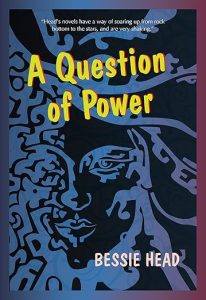
Two books are wearing one listing here, and only one of them can be the audiobook a buyer thinks is on offer. The title field reads A Question of Power. The byline reads Robert Bryce. The description underneath belongs to a semi-autobiographical novel by Bessie Head about a woman called Elizabeth whose waking life keeps dissolving into nightmare, issued by Waveland Press with a page count and an ISBN attached to it. A running time of eight hours and forty-one minutes sits on the same page. Before any judgment about the book itself, that contradiction is the thing a listener needs to see.
Waveland's Description Belongs to Bessie Head Alone
Waveland Press supplies the description, and that description is entirely unambiguous about whose work it is describing. It opens with a block quotation signed Bessie Head, then summarizes a novel in which Elizabeth, conceived out of wedlock to a white mother and a black father in a country where that union was outlawed, leaves for Botswana with her young son and finds a footing on an experimental farm. It closes with a backlist of other Waveland titles by African writers, each carrying its own ISBN. Not one line of it touches money, markets or finance.
Robert Bryce is the name in the author field, and the same name fills the reader field, which is the only slot on this page where a narrator credit could appear at all. The shelving has followed that name rather than the prose: the genre reads money and finance, and the topical tag reads International. Neither word occurs anywhere in the description. I cannot tell you which half of the record is the error, because the page never says, and guessing would be worse than useless to somebody about to pay for it. What I can tell you is that the thing described in full sentences here is a South African novel about a mind coming apart.
Elizabeth's story is told from inside a consciousness that cannot always identify what it is looking at. Two figures, Sello and Dan, occupy her nights and carry the weight of politics, sex, religion and individuality, along with a boundary between good and evil that the copy admits is blurred. Farm work is the counterweight: crops, colleagues, a project with something genuinely inventive in it. Hallucination alternating with day labor is the engine of the whole book, and it is also why the material asks more of a listener than of a reader, who can always stop at the end of a paragraph and look up.
Brave Rather Than Hopeless, Says the Lone Review
Head's sentences are the reason to bother, and the publisher prints one of them at the top of the page: a passage about a woman kept going not by any kind of physical stamina but by a vague, instinctive pattern of normal human decencies, and about how a person eventually becomes a replica of the inner demons he battles with. That is the register throughout. Plain, hard, unsentimental writing that manages to hold its diagnosis and its compassion inside the same clause.
Only one written response has ever been filed on this page. It arrived in December 2018, awards five stars, and reads the novel precisely as a book about illness. It asks what could be more terrifying than living in doubt of what is real and what is imagined, borrows the novel's own phrase about years in a nightmare world of no compassion, and lands on a formulation worth repeating: not a hopeless book but a brave one. Wanting to cheer for a character's survival in one chapter and to run for your life in the next is an accurate description of what the middle of this thing does to you.
Length works in its favor. Eight hours and forty-one minutes is short for a novel that circles one crisis this obsessively, and the Botswana chapters give the listening somewhere solid to stand while it circles: a village, an experimental farm, a project that actually produces something. Head wrote out of the same biography Elizabeth is given, which the publisher states outright rather than leaving to inference. Whatever the byline claims, the book on offer is serious African literary fiction, and the final stretch earns the phrase the copy reaches for, an unfettered discovery.
Eight Hours, and Every Field a Paperback's
Invisible formatting characters open three fields on this record: the publisher, the language and the ISBN. That is the fingerprint of a block pasted straight out of a printed product-details table, and the rest of the paste arrived with it. The paste brought an ISBN, a page count of 223, an identifier in the product-code slot that is simply the print catalog number, and a cover price of $17.95. Not one of those figures can describe a recording, and every one of them describes a paperback.
Sixteen ratings stand behind the 3.8 on this page, and as arithmetic that figure is perfectly sound: sixty whole stars across sixteen votes, or sixty-one, both display as 3.8. The sum is not the problem. The problem is that nobody can say what those sixteen people were grading, because the page presents two different products under one score. A number can be entirely real and still be fastened to the wrong object, which is exactly the situation on this listing.
Buy Bessie Head, Skip the Finance Label
Anybody who came for the novel described in this copy should go and get it, in whichever edition genuinely delivers Bessie Head's text. This is substantial work about exile, mixed-race identity under apartheid, and the collapse and slow reassembly of a mind, and it stands comfortably beside the African writers Waveland lists alongside it. Readers who want fiction that argues with itself, that refuses to make its demons decorative, and that finishes somewhere other than despair will not begrudge it the hours.
Until the byline is straightened out, though, anybody shopping for a book about markets, energy or international economics should keep walking, because the genre label is the least reliable thing on this record. The same warning applies to listeners who need a clearly credited reader before they commit any money, since the reader slot here simply repeats the disputed name from the author slot. My advice is to buy Bessie Head, confirm which edition you are actually being sold, and let the shelf label sort itself out afterwards.
Is this audiobook really about energy, economics or finance?
Nothing in the description supports that shelf. The copy summarizes a semi-autobiographical novel set in apartheid South Africa and Botswana, and the publisher's own backlist beside it is African literary fiction throughout. The money and finance label and the International tag appear to have travelled with the byline rather than with the book.
How hard is A Question of Power to follow without the printed page in front of you?
The narrative moves between Elizabeth's waking life on the experimental farm and hallucinated confrontations with Sello and Dan, and it does not signpost the transitions. Anyone who tends to lose the thread inside dream sequences should plan on shorter sittings rather than pushing through at speed.
Can I trust the running time given for this audiobook?
It is the only audio-specific figure anywhere on the page. Everything surrounding it, a 223-page count, an ISBN and a print cover price, was lifted from a paperback record. Treat the running time as unverified until the retailer confirms that a recording exists and names the person who reads it.