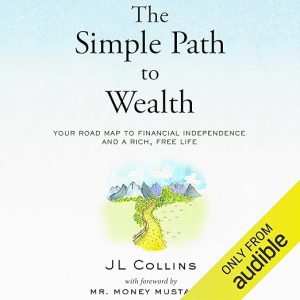
JL Collins wrote these chapters as letters to a daughter who did not particularly want them. Her objection is quoted in the description and it is the best sentence on the whole page: I know money is important, I just don't want to spend my life thinking about it. Everything after that is an answer. Six hours and thirty-eight minutes, read by Collins himself, on handling money in a way that leaves you free to think about something else entirely. The audiobook holds one obvious advantage over the paperback, and it is whose voice you get.
Collins Reads the Advice He Once Wrote
Author narration is always a trade. You give up some of the polish a trained reader brings and you gain the person who actually meant it. For a book built openly out of private correspondence, that trade costs almost nothing. Collins is not performing a character or staging a scene. He is repeating advice he first gave to somebody he loves, and receiving it in the voice that wrote it shifts the register from instruction toward counsel, which is a different thing to sit with for the length of an afternoon.
Collins states his thesis bluntly enough that you can check it. Complex investments exist to profit the people who create and sell them, which makes them costlier for the investor and less effective at the same time. Everything else follows from there: avoid debt, hold what he calls f-you money, use low-cost funds, and ignore the machinery built to make you feel out of your depth. Agree or not, the argument has the rare virtue of being short enough to state and specific enough to act on.
Concrete Chapters Instead of Vague Mindset
October 2024 supplied the plainest endorsement on the page: an invaluable guide for anybody wanting to take control of their finances and reach financial independence, written in a refreshingly straightforward and no-nonsense style that turns complex concepts into practical, actionable advice whatever the listener's experience. Strip the enthusiasm out and a real claim survives. This is a book people finish, which in a genre famous for being bought in January and abandoned by March counts as a meaningful distinction.
Contents back that up, and the list is unusually concrete for this shelf. Collins covers debt and what to do if you already have it; what the stock market actually is and why it rises; asset allocation across a wealth-building phase and a wealth-preservation phase that are not tied to your age; the practical differences between a 401(k), a 403(b), a TSP, an IRA and a Roth; target retirement funds, health savings accounts and required minimum distributions; and the Four Percent Rule for spending your money down safely. Most books here would fill the same span with mindset.
Six hours and thirty-eight minutes is the other argument for hearing this rather than reading it. Personal finance is one of the few subjects where hearing something a second time helps more than reading it once, because the material is procedural while the resistance to it is emotional. A recording this size can be replayed on a drive without becoming a project, and the closing case study showing how the whole approach works across a real life is precisely the part most people need twice.
Vanguard-Centric Advice Meets a Fidelity Account
One reservation on this page is worth more than all the praise surrounding it, and it arrives at four stars in July 2025. That response calls the book very Vanguard-centric, states no objection to Vanguard in principle, then explains the practical difficulty: a workplace retirement plan was already set up with Fidelity, so the specific recommendation does not transfer. Anybody whose money sits somewhere else meets the same wall, and it is a structural limit rather than a fault in the reasoning.
Read the contents list and the same problem surfaces before you have paid anything. One of its own lines promises to tell you what investment firm to use and why the one Collins recommends is so far superior to the competition, without naming it. That is a book organized around a single concrete recommendation, which is exactly what makes it useful and exactly what makes it narrow. If that firm is unavailable where you live, or where an employer has already placed your retirement account, a share of the practical value evaporates.
Smaller problems are worth flagging as well, and I count two. The description on this record is the print edition's table of contents pasted in whole, twenty lines of it, with nothing added about what the recording does differently or even that the author reads it. And the rating counter shows fifteen, against written responses running from 2016 to 2026 and filed from the United States and the United Arab Emirates. Fifteen is a very thin base for a book that plainly travels, which leaves the 4.7 badge measuring almost nothing at all.
Written for a Very Specific Beginner
A five-star from February 2026 produced the best description of the register this book writes in: a wise uncle sharing real-life advice without complicated jargon, filed from the United Arab Emirates by a reader who sums the core message up as investing in low-cost index funds. The uncle comparison is exact. Collins is neither a coach nor a guru. He is the relative who sits you down once, tells you the four things that actually matter, and never checks afterward whether you did them.
Beginners are the right audience, and it is worth saying that beginners are who this was written for, one specific beginner in particular. Anyone already running a portfolio and hunting for an edge will find the argument deliberately unsophisticated, which is the design rather than an oversight. Listeners outside the United States should expect account types and rules that do not map onto their own, and should treat the principles as portable and the plumbing as local. Collins gave this advice once to somebody he could not afford to get wrong, and that remains the best reason to hear it in his voice.
- Performance: JL Collins reads his own book, which for letters written to one specific person is about as close a fit as audio gets.
- What it covers: Index investing, avoiding debt, f-you money, financial independence, the Four Percent Rule
- Feel: Plain-spoken and calming
- Our call: A clear, short case for simple investing, provided the firm it keeps recommending is one you can actually use.
Common Questions
Does JL Collins narrate the audiobook himself?
He does, and on this shelf that is unusual enough to matter. The narrator field and the byline carry the same name, so you are hearing the author read advice he originally wrote as letters to his daughter. Author narration on a book of private correspondence fits more naturally than most, and it is the clearest reason to choose this edition.
One review is dated a year before the recording was released. How is that possible?
It describes an early copy. A five-star from June 2016 reports sitting down with an advance copy of the print book, and mentions following the author's blog and its Stock Series beforehand. So the column begins a full year before this audio edition existed, and its oldest entry is grading a manuscript rather than a recording.
Is this audiobook useful outside the United States?
Partly. The principles covering debt, low-cost index funds and spending down safely travel anywhere. The plumbing does not, because a substantial stretch of the material walks through tax-advantaged account types specific to the United States and the withdrawal rules attached to them. Treat that portion as illustration of a method rather than as instruction you can follow.
Is this audiobook long enough to cover investing properly?
Brevity is the argument here. Collins holds that complexity in investing exists mainly to profit the people selling it, so a short book demonstrates his thesis rather than cutting corners around it. Everything from debt through market behavior, account types and allocation to a closing worked example arrives with no padding whatsoever.