
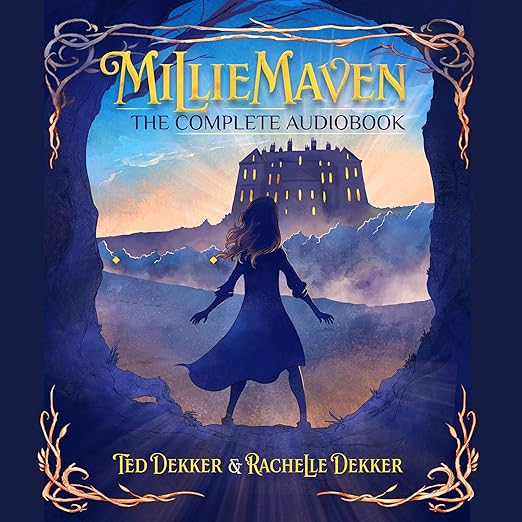
Parents shopping the children's shelf get almost no help from this listing, and the tag it carries points in entirely the wrong direction. Eleven hours and fifty-nine minutes covers the complete Millie Maven trilogy in one audiobook purchase: The Bronze Medallion, The Golden Vial and The White Sword. Millie is twelve, an orphan, and on her way to FIGS, the FarPointe Institute for Gifted Students, where she discovers more in herself than she had ever dared believe. Brittany Goodwin reads it. Scripturo released the recording in December 2021.
The Review
Buying three novels in a single purchase is the headline, and it is worth pausing over. Eleven hours and fifty-nine minutes covers a complete arc, start to finish, with no waiting for the next release and no separate decision about whether to continue. For a child who has just been hooked, that matters a great deal. The story runs on familiar young-reader machinery, an orphan, a distant institute, a discovery of significance, and the copy is straightforward about that shape rather than pretending to have reinvented anything.
Millie's discovery is the engine, and the phrasing around it is careful: more to her than she ever dared imagine or believe, and some truths that change everything. That describes a book about worth rather than a book about power, which is a meaningful distinction on this particular shelf. A great deal of children's fantasy hands a child abilities and lets the plot follow. This one appears to hand her a fact about herself instead, and the difference shows up in what the story then asks her to do.
The Best Parts of The Millie Maven Trilogy
August 2021 produced the response that explains what these books are actually for. A parent reading alongside a ten-year-old describes both of them unable to stop, wanting to keep going, and valuing the chance for a daughter to read about being loved and chosen and special. That account puts it starkly: with all the lies the world feeds our kids, being told not to believe those lies about yourself is refreshing. Whatever you make of the framing, it is an unusually clear statement of purpose.
Three of the five written responses describe reading these books with a child rather than handing them over, and that changes what an audio edition is for. A recording turns the shared-reading ritual into something a parent can join instead of perform, which matters most on the evenings when nobody has the energy left for doing voices. Eleven hours and fifty-nine minutes spread across bedtimes lasts a long while, and the format lets a tired adult keep the ritual alive without having to carry it alone.
Brittany Goodwin's assignment is a twelve-year-old and everybody around her, sustained across three books without the voice thinning out. Child protagonists rank among the hardest things an adult reader takes on, because the two failure modes sit uncomfortably close together: pitch it too young and it patronizes, pitch it too flat and the character vanishes. A trilogy compounds that, since one voice has to carry Millie through three complete arcs. It is the specific thing worth testing before you buy.
The Caveats
February 2024 carries the caution this page owes every buyer and never gives. A five-star response, entirely positive about the writing, states plainly that it would not hand this to a younger child, because the series does contain intense scenes and cruelty. The same account describes a fantasy world of supernatural persons and events teaching courage, friendship, trust, discernment and redemption. Both halves are useful. A book can teach precisely those things and still badly frighten a seven-year-old, and no age guidance appears anywhere on this record.
October 2021 raises the problem specific to buying a trilogy in one piece, at four stars. That household read all three together with a nine-year-old and a seven-year-old who kept asking for more chapters, loved the first book, enjoyed the second, and found the third good but a little repetitive at times. In a bundle you cannot act on that. Buying volume one alone lets a family stop when the energy runs out; buying all three commits you to the stretch where at least one reader felt the story circling.
Field problems sit on top of that, and I count three. The byline reads Ted Dekker alone, while the description credits the series to Dekker and his daughter Rachelle Dekker, named there as a Christy-award winner, so a co-creator with her own standing is missing from the record entirely. The series fields sit empty on a product called The Millie Maven Trilogy that names three volumes in its own copy. And the tag reads Growing Up and Facts of Life, a shelf parents visit for books about bodies and feelings, not for fantasy.
Should You Listen to The Millie Maven Trilogy?
Grandparents buying gifts are well represented here, and the shortest recommendation on the page arrived in March 2026: a grandchild loved these. That is the natural audience, a confident young reader around Millie's own age of twelve or somewhat below it, plus the adults buying on their behalf. Scripturo is the publisher, and the copy's language about truths that change everything sits in a devotional register, so families who want that will recognize it immediately and families who do not should know it is present.
Hold off if you are buying for a child much under eight, at least until you have sampled it, because nothing on this page marks where the frightening material falls. Hold off too if your household prefers stories that imply their lesson rather than state it, since this one states it. Everybody else gets a complete trilogy, one voice, and a bedtime project that will run for months. Millie Maven is a straightforward hero for children who need telling that they matter, and across three books she is told so without hedging.







