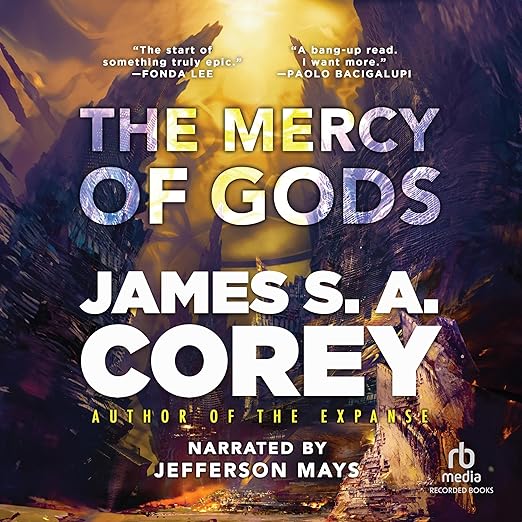
I had been cautious about this one. After nine books and a television adaptation with the Expanse, the bar James S. A. Corey set for themselves is genuinely high, and the move to a new universe always carries the risk of producing something that feels like familiar mechanics in unfamiliar clothes. I started listening on a Friday evening with some skepticism and ended up well past midnight, which tells you more than any careful critical framing I might offer.
The Mercy of Gods is the first book in the Captive's War series, and it begins in the wreckage of a world. The Carryx, described as part empire, part hive, have descended on the isolated human planet of Anjiin, slaughtered much of the population, and abducted the best and brightest to their world-palace, where prisoners from a thousand species compete under conditions designed to cull the useful from the expendable. Dafyd Alkhor, a research assistant rather than a scientist, survives on a combination of luck, perception, and a set of instincts he does not fully understand himself.
Where This One Lands
The comparison to the Expanse is inevitable, and the differences are instructive. Where the Expanse was grounded in near-future political realism, the Belt, Earth, Mars as recognizable extensions of human systems, the Captive's War operates at a genuinely alien scale. Corey has said this series is more ambitious, and the evidence is in the prose: the Carryx are not humanized, their logic is not decoded for easy comprehension, and the threat they represent is not reducible to a familiar antagonist structure. That takes getting used to in the early chapters, and several reviewers noted the opening sections require patience.
The patience pays off. John Scalzi's blurb calls the book wilder and weirder than you can imagine, which is promotional language, but it is not entirely wrong. The conceptual ambition here is real, and Corey earns most of it. Dafyd is a protagonist defined by his inadequacy to the situation, which is more interesting than a conventional hero, and the question of whether his peculiar insight will make him humanity's champion or its betrayer is threaded through the narrative with enough restraint that it never becomes a blunt dramatic engine.
The Best Parts of The Mercy of Gods
Jefferson Mays is the right narrator for this material. He has a range that allows him to inhabit multiple character registers, the frightened human scientist, the alien bureaucrat, the research team navigating politics under captivity, without the kind of cartoonish differentiation that undermines audiobook performances. His work on this series benefits from the same quality that made his narration of All the Light We Cannot See memorable: he understands how to carry emotional weight without overplaying it.
At nearly fifteen hours, The Mercy of Gods is a substantial listen, but the pacing justifies the length. The Carryx world-palace is built up gradually enough that when its full implications become clear, the reveal carries genuine force. Corey knows how to structure a series opener so that the first book is satisfying on its own terms while leaving enough open to make book two feel necessary rather than obligatory.
What Gives Us Pause
The early chapters are deliberately slow. One reviewer noted that a second read, done with patience rather than skimming the less interesting sections, was significantly more rewarding than the first. That is useful information for the audiobook listener in particular: this is not a book that hooks you in the first hour and then coasts. It builds, and it requires the listener to trust the build.
There is also the question of atmospheric consistency. Corey has created a genuinely alien environment and committed to not over-explaining it, which is the right artistic choice and also occasionally disorienting. The political structure of the Carryx, the mechanics of the world-palace competitions, the relationship between the captive species, all of this arrives in fragments rather than briefings. If you prefer your science fiction worldbuilding delivered in organized exposition, this series will test your patience. If you prefer it delivered through experience and inference, this is exactly right.
Who Should Listen to The Mercy of Gods
Fans of the Expanse are the obvious audience, and most will find this series opener a strong enough start to commit to the rest. Readers who enjoy science fiction with genuine moral complexity, where the protagonist's position is not heroic so much as precarious and compromised, will find Dafyd a more interesting character than most genre heroes. If you are new to James S. A. Corey, this is actually a reasonable entry point since it requires no prior knowledge of the Expanse. If you are looking for fast-paced action from the first chapter, you will need to invest some time before the book delivers what you want. It does deliver it, eventually, and with considerable force.
Common Questions
Do I need to have read the Expanse series before starting The Mercy of Gods?
No. The Captive's War is a completely separate universe with no continuity connections to the Expanse. You can start here with no prior exposure to Corey's work.
Is the slow start in the first few chapters worth pushing through?
Yes, based on multiple reviewer accounts including one who read the book twice and found the second reading significantly more rewarding. The opening setup pays off substantially once the world-palace sections begin.
Is this a standalone book or does it end on a cliffhanger?
It is the first book in a series, and while it provides a satisfying narrative arc of its own, the larger conflict and Dafyd's role within it are clearly not resolved. Expect to want book two by the time the credits roll.