Quick Take
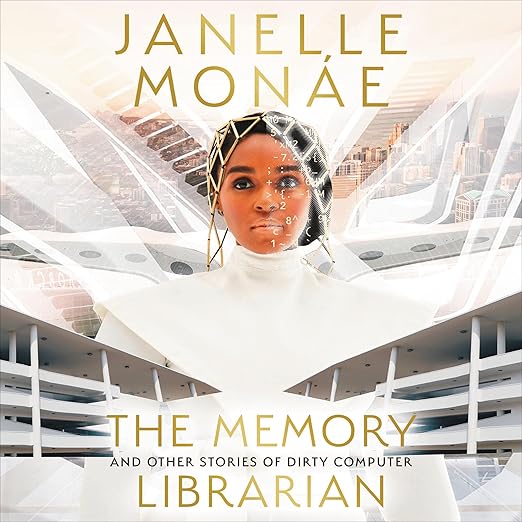
- Narration: Janelle Monae narrating her own Afrofuturist anthology is the defining feature of this audiobook, her voice and sensibility are inseparable from the material in a way that makes the listening experience genuinely different from reading.
- Themes: Memory as political territory, queer identity under surveillance, collective resistance to totalitarian erasure
- Mood: Urgent and imaginative, speculative fiction with an activist’s conviction beneath the world-building
- Verdict: An Afrofuturist short story collection that operates as both literary anthology and conceptual extension of a major artistic project, strongest for listeners who come with investment in the Dirty Computer universe or in queer speculative fiction broadly.
I finished The Memory Librarian on a Tuesday evening after working through the stories across several commutes and one long afternoon, and I found myself thinking about what it means for an artist to use fiction as a genuinely different channel rather than a promotional one. Janelle Monae is not here to recap her album. She and her co-authors, a different collaborator for each story, are using the Dirty Computer mythos as an infrastructure for speculative fiction that takes the implications of memory control seriously as both political idea and as narrative premise.
The collection establishes its world efficiently: thoughts as a means of self-conception can be controlled or erased by a select few. Whether human, AI, or otherwise, your life and sentience are dictated by those who have convinced themselves they have the right to decide your fate. That was until Jane 57821 decided to remember and break free. The stories that follow expand outward from that premise into territories the album could only gesture at.
Our Take on The Memory Librarian
The anthology form creates both the collection’s strength and its limitation. Each story is complete in itself but shares no characters with the others, only the world and its logic. One reviewer described this as stories that inform each other, that craft a creative and haunting vision of the future and the future’s future, which is accurate: the cumulative effect of five or six stories all operating within the same totalitarian architecture creates a sense of a world that extends in all directions rather than being bounded by any one narrative. The anthology gives the Dirty Computer universe depth that a single novel could not achieve with the same efficiency.
The diversity of voices, a different collaborating writer for each story, means the collection has genuine tonal range. Some stories are warmer, some colder, some more explicitly political, some more intimate. Monae’s selection of collaborators reflects both literary ambition and genre awareness: the Octavia Butler, Ted Chiang, Becky Chambers, and Nnedi Okorafor comparisons in the synopsis are aspirational but not dishonest, pointing at a tradition of speculative fiction that takes its ideas seriously.
Why Listen to The Memory Librarian
The decision to have Monae narrate her own collection is the right one, and not only for the obvious marketing reason. Monae’s vocal presence carries the political urgency of the material in a way that a conventional narrator, however skilled, could not replicate. She knows why these stories matter in a way that informs the phrasing rather than simply the delivery. Reviewers who are drawn to the Afrofuturist tradition specifically, and to LGBTQ speculative fiction as a category, respond to the combination of Monae’s voice and the material’s genuine conviction.
At just over twelve hours, the collection is substantial without overstaying its welcome. The short story format means individual stories can be engaged with across interrupted listening sessions without losing narrative thread, which is a practical advantage for anthology listeners who tend toward episodic rather than sustained engagement.
What to Watch For in The Memory Librarian
The anthology’s collaborative nature means the quality is not uniform. A collection with five or six co-authors will have stronger and weaker entries, and the Dirty Computer world carries some stories better than others depending on how tightly the individual story’s concerns map onto the world’s specific architecture. Listeners who move through short story collections looking for the strongest individual entries rather than the cumulative effect may find this uneven.
The cast of characters across the collection includes asexual and lesbian characters, non-binary and genderqueer individuals, which the synopsis describes as reflecting the rich tapestry of human experience. This is accurate, and it is also a meaningful statement of the collection’s agenda: the stories are not simply set in a queer-inclusive world but are actively interested in the political stakes of identity expression within a surveillance and erasure system.
Who Should Listen to The Memory Librarian
The audience for this collection is specific and well-served: listeners invested in Afrofuturist speculative fiction, readers of Octavia Butler and Nnedi Okorafor who want something in that tradition with an explicitly queer political frame, and Dirty Computer listeners who want to spend more time in the world the album created. Monae’s existing fan base will find the collection rewarding even without deep genre knowledge.
Skip it if you require narrative continuity across a collection’s full runtime, if short story anthology pacing does not suit how you listen, or if you come with no prior investment in either the Dirty Computer universe or Afrofuturist speculative fiction as a tradition.
Frequently Asked Questions
Do I need to be familiar with Janelle Monae’s Dirty Computer album to appreciate The Memory Librarian?
No, but prior familiarity enriches the experience significantly. The collection builds on the album’s mythos, including the figure of Jane 57821 and the premise of memory control as political tool, but each story is self-contained enough that a reader unfamiliar with the album can follow the world’s logic from the prose alone.
Who are the co-authors for the stories in this collection?
The collection was written collaboratively with different co-authors for each story, selected by Monae. The names are not listed in the available metadata, but reviewers specifically mention that the collaborations are credited and that one reader cites Sheree Thomas as a contributor she follows specifically. The editorial process was clearly curated rather than simply assembled.
Does Janelle Monae narrating her own work affect the listening experience compared to a professional audiobook narrator?
Reviewers do not raise this as a concern, and the narration’s reception has been strongly positive. Monae’s vocal presence is part of the artistic project rather than a celebrity vanity, and the political urgency of the material comes through in her delivery in ways that listener response confirms.
Is the LGBTQ representation in The Memory Librarian incidental or central to the stories’ concerns?
Central. The collection is not simply set in a world that includes queer characters; it is specifically interested in the political stakes of identity expression under a regime that controls memory and selfhood. One reviewer notes that the collection can educate on the use of labels in the LGBTQ community in a subtle way, which suggests the representation is embedded in the world-building rather than existing as character decoration.