The Short Version
- Narrator: Jonathan Keeble gives the Emperor himself a presence that is alien and immense without tipping into parody, one of his most demanding vocal performances in the Horus Heresy series.
- Subjects: The cost of godhood, sacrifice and its limits, what it means to be human when you have ceased to be one
- Tone: Intense and philosophically charged, with Webway battle sequences that rival anything in the Heresy for sustained dread
- Bottom line: Aaron Dembski-Bowden at his sharpest, delivering the Emperor's perspective with the weight the subject demands and the moral complexity it deserves.
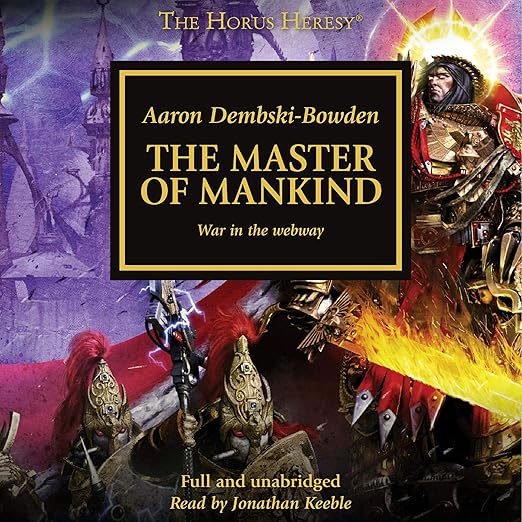
There are moments in a long reading life when a book earns genuine surprise, when it does something you did not think the author or the medium had permission to do. The Master of Mankind is that kind of book for the Horus Heresy series. Aaron Dembski-Bowden, who is arguably the finest prose writer working in the Black Library stable, was given the most dangerous possible assignment: write the Emperor of Mankind as a perspective character, and make him coherent. What he delivers is not a heroic godking. It is something stranger and more philosophically honest: a being who has made calculations across millennia that have required sacrifices so vast that the word sacrifice has lost its meaning for him, and who understands exactly what this has cost him in terms of his humanity.
The setting is the Webway, the ancient eldar transit network beneath the Imperial Palace that the Emperor has been secretly expanding for decades. Magnus the Red's psychic intrusion has ripped it open and allowed daemonic entities to pour in. The Custodian Guard, the Sisters of Silence, and the Mechanicum forces of Fabricator General Kane are fighting to hold the nexus points against an enemy that is simultaneously everywhere and unknowable. While Horus burns across the galaxy, this is where the Emperor is, and understanding why he cannot leave is central to understanding the tragedy that is about to unfold across the Siege of Terra.
The Emperor does not appear often in this book, and ADB is deliberate about that scarcity. Reviewer Jetpack, writing in 2017, catalogued the revelations with the precision of someone who had been waiting for them: the Emperor as a child, the moment his path was set, his real opinion of the Primarchs, the first sacrifice of the Psykers to the Golden Throne. These disclosures are handled with extreme care. ADB does not flatten the Emperor into either a sympathetic father figure or a cold utilitarian god. He is both, simultaneously, and the moral weight of that simultaneity is what makes the book more than genre fiction.
Reviewer Brown Hornet noted that the exchanges involving the Emperor are worth reading multiple times, and that the book leaves no doubt that this being is no man but a celestial figure. The restraint required to achieve that impression is considerable: it would be easy to make the Emperor either too human or too abstract, and ADB threads the needle with a precision that represents the best of what literary technique can do within commercial tie-in fiction.
What Aaron Dembski-Bowden Gets Right
The eldar Webway is one of the most visually distinctive settings in the Warhammer 40,000 universe, and the battle being fought within it is deliberately disorienting. Space and time behave differently. The enemy has no fixed form. The Custodians, who are among the finest warriors in the universe, are fighting for their lives against an enemy that cannot be killed in any conventional sense. Keeble's narration renders this spatial strangeness with genuine commitment: the Webway sequences have a different sonic texture from the palace-surface battles in the Siege of Terra series, and that tonal differentiation is part of what makes this book feel distinct from its neighbors.
Where Aaron Dembski-Bowden Loses Some Ground
Reviewer Great! positioned this as Siege of Terra 1.5, reading it between books one and two of that subseries. That is a structurally sound recommendation. The events of The Master of Mankind, the Emperor's full commitment to the Webway defense and what that commitment forecloses, cast a different light on everything that happens during the Siege. Reading it in this sequence turns retrospective reveals into prospective dread, which is the more interesting experience of the two. The book is also simply among the best things ADB has written, and he has written many very good things in this universe.
Who Should Pick Up The Master of Mankind
Horus Heresy readers who have progressed at least through the series' middle section and want to understand the Emperor's perspective on the war he is losing. New readers should not start here: the revelations require the weight of the series behind them to land properly. This is ADB at his most ambitious, and it is worth the investment of having earned your way to it through the books that precede it.
Is this book accessible to readers who are only familiar with Warhammer 40,000 lore through games rather than novels?
Somewhat. If you have extensive 40K lore knowledge from games and associated media, many of the revelations will connect meaningfully. However, the emotional weight of the Emperor's scenes depends partly on the novel-established dynamics of the Horus Heresy, particularly Magnus's betrayal and its consequences for the Webway project.
How does Aaron Dembski-Bowden's prose style differ from other Black Library authors in this series?
ADB is widely considered the finest prose stylist in the Black Library stable. He writes with more psychological depth, more moral ambiguity, and more control of sentence-level craft than most of his colleagues in the Horus Heresy series. The Emperor's scenes in this book are frequently cited as examples of what literary technique can do within commercial tie-in fiction.