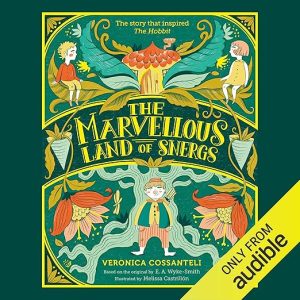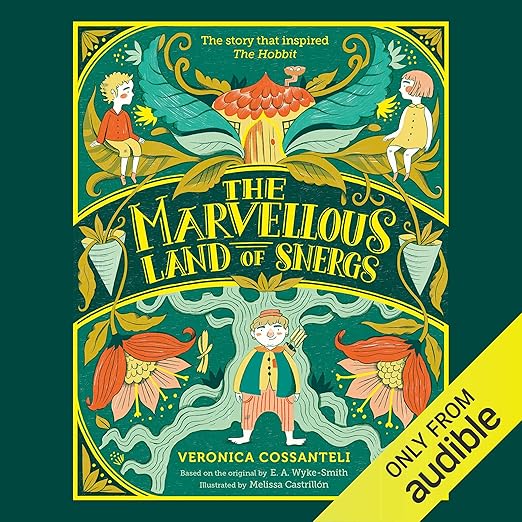
Who gets credit when a lost children's classic gets a new storyteller? That question sits right at the center of The Marvellous Land of Snergs, an audiobook credited to E. A. Wyke-Smith and narrated by Stephen Fry, and one listener's review suggests the credit picture here is more complicated than the byline alone lets on. At six hours and ten minutes, this is a fuller, updated telling rather than a quick children's read-along, built around orphans, a magical land, and a forgetful guide trying to get them home.
The Verdict, Briefly
Pip and Flora, two children at the Sunny Bay Home for Superfluous and Accidentally Parentless Children, run away with their dog and stumble into the Marvellous Land of Snergs, a world the synopsis fills with cinnamon bears, scrumptious feasts, vegan ogres, disgraced jesters, and 'dastardly Kelps,' plus a villain dressed entirely in purple. Their guide home is Gorbo, described as 'forgetful but lovable,' who can lead them back only if the children first decide where home actually is and if Gorbo can remember the way there at all.
J.Rumschlag's five-star review is short and enthusiastic, calling it the 'Best adventure ever! For fans of Harry Potter and, of course, The Hobbit!' A four-star Kindle Customer review goes further into genre placement, recommending it to 'lovers of tales such as the hobbit, narnia, roald dahl books and other such wonderful fantasy books,' and praising the story's 'rich worldbuilding' alongside characters that feel like real friends by the story's end.
Pausing on the institution's own name pays off: the 'Sunny Bay Home for Superfluous and Accidentally Parentless Children' is doing real comic work before the plot even starts, stacking bureaucratic-sounding qualifiers, 'superfluous,' 'accidentally parentless,' onto what is really just an orphanage, and signaling the story's tone early. A world that also contains 'vegan ogres' and 'disgraced jesters' alongside its more traditional dastardly Kelps is clearly more interested in inventive, slightly absurd specificity than in stock fantasy-creature default settings.
Real and specific, not marketing shorthand, is what the literary history angle here turns out to be: the synopsis states plainly that the original Wyke-Smith story was 'the inspiration for J.R.R. Tolkien's The Hobbit,' which gives this audiobook a genuine claim on any listener's attention beyond its own plot. J.Boon's five-star review, titled 'A TREEmendous read!,' leans into that world specifically, naming creatures like the Wobsers and the 'Crocopotamus' alongside the more familiar Kelps and cinnamon bears, and crediting a reworking of the tale for its 'wry humour' shining through page after page.
That same review is worth quoting a bit further, since it names something the byline itself does not: it credits 'Cossanteli's wry humour' and 'her re-working of the story' as central to why the book works as well as it does. Nothing else in this listing's credited fields names a Cossanteli anywhere, which is worth sitting with rather than glossing over.
What to Watch For in The Marvellous Land of Snergs
This is the most important thing to know before buying: despite E. A. Wyke-Smith being the only credited author, the synopsis itself describes this as 'a brand new, funny and quirky story based on E.A. Wyke-Smith's classic,' 'a lost classic, updated in a more contemporary voice,' not the unaltered 1927 original. B Foreman's three-star review is direct evidence of how easy that distinction is to miss: bought as a gift for a Tolkien-loving daughter, only discovered partway through that 'the book is NOT original,' and that review closes with a plain warning to anyone who does not want an abridged, adapted, or rewritten edition to skip this particular copy. Combined with J.Boon's review naming an uncredited 'Cossanteli' as the one behind the reworking, the actual authorship picture here is genuinely unclear from the listing alone.
Separately, Luiz's review, from Brazil, is written in Portuguese and describes fast delivery and an undamaged, attractive physical copy, matters that belong to a print edition rather than anything about the audio production itself. Weigh that one differently than the other four when deciding how much stock to put in the overall reception.
Best Suited For
Released through Audible Studios in July 2021, the listing shows 4.6 stars across fifty total ratings, which gives this particular audio edition several years of listener feedback to draw on, more than a recent release typically accumulates. That volume of ratings is worth weighing against the specific authorship confusion raised above; a book this widely rated has clearly reached plenty of listeners even without the byline fully clarifying who wrote the version they heard.
Families introducing kids to the world behind Tolkien's influences are a strong fit, especially listeners who already know The Hobbit, Narnia, or Harry Potter and want to trace one of the threads those stories pull from. The Kindle Customer review specifically credits 'the wonderful narration chops of Stephen Fry' as part of what makes the world come alive, a detail worth weighing for anyone choosing between audio and print specifically because of who is reading it.
Parents specifically wanting the unaltered, original 1927 Wyke-Smith text, rather than what the synopsis itself calls an updated, contemporary-voiced retelling, should look for a different edition entirely and read B Foreman's review closely first. Anyone who wants full clarity on exactly who wrote the version they are about to hear should also go in aware that the listing's own credits do not fully answer that question. Given how directly the Hobbit connection is marketed here, families hoping to use this as a stepping stone toward Tolkien specifically should also know they are getting a reworked version of that stepping stone, not a preserved historical artifact.