Quick Take
- Narration: Michael Kramer is Sanderson’s own preferred narrator for Mistborn, and his performance here carries both the Western-fantasy blend and the Cosmere scope with equal command.
- Themes: Faith and doubt in a world with a real but unreliable God, the tension between frontier law and cosmic destiny, Cosmere convergence
- Mood: Epic and emotionally satisfying, with the weight of a decade’s worth of character investment
- Verdict: The Lost Metal is the conclusion the Wax and Wayne era deserves, even if the Cosmere elements occasionally compete with the series’ own rhythm.
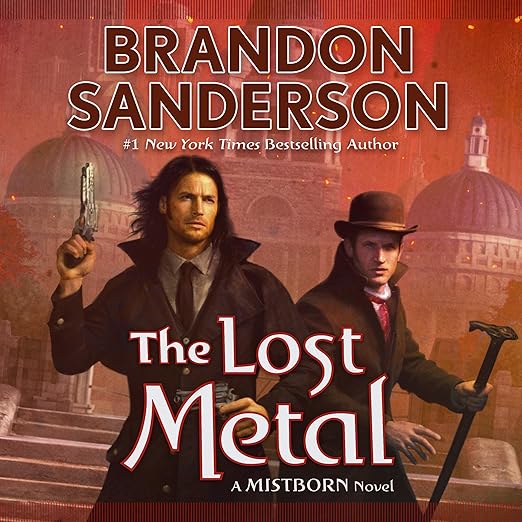
I was halfway through my morning commute when the climax of The Lost Metal landed. I had to sit in the parking lot for another twenty minutes to finish the chapter, which is about the highest compliment I can give a nearly nineteen-hour audiobook. Brandon Sanderson closes out Mistborn Era 2 here, and for anyone who has followed Waxillium Ladrian from The Alloy of Law through Shadows of Self and Bands of Mourning, the weight of this finale is considerable. These are not the same characters they were when we met them on the frontier.
The setup is characteristic Sanderson: stockpiled weapons, a corrupt Senate, the shadowy organization the Set, and a new explosive that can unleash unprecedented destruction. Wax has been hunting the Set for years, with his late uncle and his sister among their leaders, and now the threads pull tight around Bilming and the Outer Cities. Marasi Colms and Wayne carry their own storylines, and the introduction of offworlders from the larger Cosmere signals that this finale is also doing work for Sanderson’s broader connected universe. That dual purpose is both the book’s greatest asset for longtime Cosmere readers and its most noted friction point for everyone else.
Our Take on The Lost Metal
Multiple reviewers, including the four- and five-star voices represented here, note the same tension: Wax and Wayne at their best is a Western-fantasy hybrid with specific pleasures, the dry humor, the partnership dynamics, the moral texture of frontier law transplanted to a growing city. When Cosmere elements enter the frame, they bring different pleasures but also different pacing demands. One reviewer describes these as narrative speed bumps. That is an honest critique. The book earns its Cosmere ambitions by the end, but the middle section requires patience from readers who came primarily for Wax, Steris, Marasi, and Wayne doing their specific things. Sanderson is one of the few authors who can actually pull off a multi-series connected universe at this scale, and The Lost Metal is genuinely interesting as an example of how that project gets executed at the level of a single book, even if it creates friction for readers who have not signed up for the full Cosmere project.
Why Listen to The Lost Metal
Michael Kramer is the reason to listen to this over reading the print edition. Sanderson himself says as much in the synopsis: he cannot imagine anyone else voicing these characters. Kramer has been with Mistborn from the beginning, and his performance in The Lost Metal carries that accumulated history. He knows who these people are. The Wayne scenes in particular benefit from Kramer’s timing, because Wayne’s humor is rhythmically dependent and a beat-perfect reader makes it land differently than prose on a page. At nearly nineteen hours, this is a substantial listen, but Kramer makes every hour count.
What to Watch For in The Lost Metal
Watch for how Sanderson handles Wax’s relationship with Harmony. This has been the series’ most unresolved philosophical thread: a man who operates with a strong moral code in a universe where God is real but unreliable, and who has been shaped as a tool without quite consenting to that role. The Lost Metal forces that question to a head, and whether you find the resolution satisfying will determine your relationship with the book’s final act. Also watch for the offworlder sequences: they are doing heavy lifting for the broader Cosmere and reward readers who have engaged with that larger project.
Who Should Listen to The Lost Metal
Start with The Alloy of Law if you have not already. The Wax and Wayne era is a self-contained story within the larger Mistborn saga, and while prior knowledge of Era 1 enriches it, the Era 2 books can be listened to in sequence on their own. If you are current on Mistborn and have followed Wax through three previous books, this is the finish line you have been moving toward. Readers new to Sanderson should start with Mistborn: The Final Empire. Cosmere completionists will find The Lost Metal particularly rewarding. Those sensitive to pacing shifts when inter-series elements intrude may want to read reviews for Bands of Mourning first to gauge their tolerance.
Frequently Asked Questions
Does The Lost Metal require reading Mistborn Era 1 first?
Not strictly, but it enriches the experience significantly. The Lost Metal is the finale of Era 2, which begins with The Alloy of Law. You can start there without Era 1, though Era 1 adds Cosmere context that becomes relevant in this finale.
How disruptive are the Cosmere crossover elements for readers who have not read other Sanderson series?
Multiple reviewers note that the Cosmere elements affect pacing in the middle section. They are more explicitly woven in here than in earlier Wax and Wayne books, but Sanderson provides enough context that they are followable without reading Elantris or Warbreaker first.
Why does Sanderson specifically recommend Michael Kramer as the narrator?
Kramer has narrated the Mistborn series from the beginning, and Sanderson credits him with creating the definitive audio version of these characters. His familiarity with the world and character voices is unmatched for this series.
Is The Lost Metal a satisfying conclusion for the Wax and Wayne era?
Based on reader reviews, yes. Multiple reviewers describe it as a fitting conclusion, noting strong character closure for Wax, Wayne, Marasi, and Steris. The Cosmere integration is the main point of debate, not the character arcs themselves.