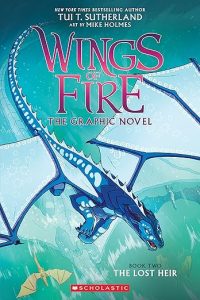
Tsunami has been waiting her entire life to return to the SeaWing kingdom, and Tui T. Sutherland's audiobook The Lost Heir, the second volume of Wings of Fire Graphix narrated by Shannon McManus, makes that return the central dramatic engine across seven hours and twenty-three minutes. The New York Times bestselling series continues underwater here, shifting the landscape entirely from the land-based action of book one: the SeaWing palace, the tidal caves, the political dynamics of Queen Coral's court replace the open skies of the earlier volume. That shift in setting is what gives this installment its distinct identity within the series arc and makes it a meaningful second step rather than a repetition of the first book's framework.
Bridging the Gap That Mike Holmes's Art Left
The tension Sutherland builds in this volume is not between the dragonets and an external enemy but between Tsunami's expectations and the reality of the kingdom she has idealized. Queen Coral welcomes her with apparent warmth, but a pattern of dead heirs - killed before reaching maturity - hangs over the reunion. Tsunami arrived expecting to find belonging and finds instead a court where the question of who is killing the queen's children remains unanswered and urgently dangerous. The dragonets came to the SeaWings for protection; they discover that protection is not guaranteed even at the source, and that belonging to a place does not automatically mean the place belongs to you.
For listeners who entered the Wings of Fire series through the prose novels rather than the graphic novel adaptations, it is worth noting that this audiobook is based on the graphic novel edition adapted from Sutherland's original prose. The narrative content follows the same events but the adaptation process compresses certain sequences in ways that prose readers will notice. Shannon McManus's narration works to bridge that gap, providing vocal texture that compensates for the absence of Mike Holmes's visual storytelling. The result is an audiobook that serves its primary target - middle-grade listeners already invested in the series - considerably better than it serves listeners encountering Wings of Fire for the first time without prior context for the dragonets' prophecy or the seating of the various dragon queens.
McManus's Spatial Descriptions Carry the Underwater World
Shannon McManus's performance across the ensemble cast is the primary reason to choose the audio format for this particular volume. The SeaWing court introduces several significant new characters - Queen Coral herself, Anemone and Auklet as royal daughters, Webs and the other guardian dragonets - and McManus gives each a distinct enough vocal signature that the court politics remain legible even without the visual character identification that the graphic novel's illustrations provide. Tsunami's voice carries a specific quality of determined optimism slowly deflating as the kingdom fails to match her expectations, and McManus tracks that emotional arc across the running time without losing the forward momentum that middle-grade listeners need from their adventure fiction.
The seven-hour-and-twenty-three-minute runtime is appropriate for the series's intended audience, long enough to be immersive without exceeding the attention range of middle-grade listeners who may be encountering longer audio formats for the first time. For the children in the target demographic - readers roughly eight through twelve who have already listened to or read book one - the audiobook format works particularly well because the underwater world-building translates into audio through McManus's spatial descriptions and the specific energy she brings to the SeaWing dialogue, which has a different rhythmic quality than the dragonets' earlier land-based conversations.
The Captivity of Family Loyalty and Obligation
The assassin subplot, which drives the central danger of the volume, is structured as a slow reveal rather than an immediate action sequence. Sutherland plants her clues across the narrative in ways that reward the attentive listener, and the resolution recontextualizes several earlier scenes that seem routine on first pass. For younger listeners who want to engage with the mystery dimension of the series alongside the adventure, this volume is more tightly plotted in its investigative logic than book one, and the mystery resolves with a specificity that respects the listener's ability to have noticed the clues that were offered.
Pay attention to Tsunami's relationship with her mother, Queen Coral, which Sutherland writes with genuine ambivalence. The queen is neither clearly loving nor clearly dangerous, and Tsunami's attempts to read her accurately are frustrated at each turn in ways that feel true to how power and affection interact in complicated family structures. This ambiguity is one of the series's consistent strengths and is more prominently featured in this second volume than in the opening, where the dragonets' collective situation as prophecy-bound prisoners provided the central pressure. The shift from external captivity to the more complicated captivity of family loyalty and royal obligation is what makes The Lost Heir a genuine progression in the series arc.
Adults May Prefer the Original Novel Format
Wings of Fire readers who have finished book one and are following the series will find this a direct continuation with a distinct enough setting and cast to feel like genuine progression rather than repetition. The dragonets-of-destiny arc advances, the SeaWing world is well-developed, and the mystery element is more prominent here than in the opening volume. New listeners should start with book one of either the graphic novel series or the original prose novels rather than entering here - the character relationships and the broader prophecy context are established in the first volume and assumed here throughout. Listeners aged eight through twelve are the target; adult listeners coming to Wings of Fire for the first time will find the premise engaging but may prefer the original novel format over the graphic novel audiobook adaptation.
Common Questions
Does the audiobook of The Lost Heir require reading the first Wings of Fire Graphix volume, or can it stand alone?
Starting with book one is strongly recommended. The Lost Heir assumes familiarity with the dragonets-of-destiny prophecy, Tsunami's background as a stolen SeaWing royal egg, and the relationships established in the first volume. New listeners will follow the immediate plot but miss significant context that shapes the emotional stakes.
Is this audiobook based on the graphic novel adaptation or the original Wings of Fire prose novel?
This audiobook adapts the graphic novel edition of The Lost Heir, which was itself adapted from Tui T. Sutherland's original prose novel. The core story follows the same events, but the graphic novel adaptation compresses certain sequences that appear in full in the prose version.
How does Shannon McManus handle the large cast of SeaWing characters introduced in this audiobook?
McManus differentiates the SeaWing court characters through distinct vocal signatures - Queen Coral, the dragonets, and the court figures all register as individual presences rather than interchangeable voices. This vocal differentiation is especially important in an audiobook where the graphic novel's visual character design is absent.
What age range is the Wings of Fire Graphix audiobook series best suited for?
The series targets middle-grade readers roughly eight through twelve years old, though dedicated young readers of seven and enthusiastic older middle-schoolers both engage with it. The themes of loyalty, betrayal, and identity under pressure have enough complexity to reward listeners across that range without becoming inappropriate for the younger end.