November 2010 Marks the Inflection Point
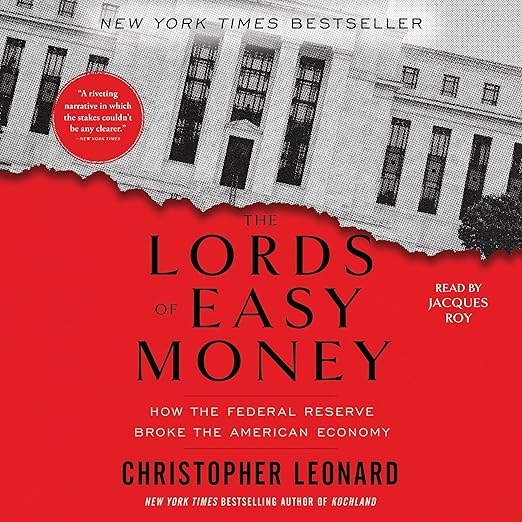
Picture the moment when Federal Reserve officials, gathered in private, decide to do something they know carries extraordinary risk: flood the financial system with money created from nothing, at a scale and duration no central bank has attempted before. Christopher Leonard's audiobook reconstructs that decision and its decade-long aftermath with the precision of a documentary journalist and the storytelling instincts of someone who understands that financial policy only matters when it lands on real people. Jacques Roy narrates the ten-hour runtime with the composed authority this material demands, moving between macroeconomic explanation and intimate human consequence without losing the thread of either.
Leonard identifies November 3, 2010, as the inflection point: the date the Fed began what it called quantitative easing, printing money to push banks and investors toward riskier debt. What follows in the book is not just an account of what happened but an investigation into why intelligent people at every level of the financial system either endorsed or failed to resist a policy whose long-term risks were, as Leonard documents, openly acknowledged within the Fed itself. That internal tension, between knowing something is dangerous and doing it anyway, is what gives the book its narrative engine.
Roy Turns Abstract Fed Policy Into Urgency
The structural achievement here is making the Federal Reserve's monetary policy decisions feel urgent rather than abstract. Leonard builds the argument through a series of concrete human anchors: the one man inside the system who consistently tried to warn that quantitative easing was creating dangerous distortions, and the political and institutional forces that consistently isolated that warning. This approach gives the audiobook an almost thriller-like quality during its most tightly constructed sections, particularly the passages dealing with the Fed's repeated attempts to unwind the money supply only to reverse course when markets began to destabilize.
Roy's narration serves the material well. The book moves between explanatory passages on how the Fed's mechanisms actually work and narrative passages tracking the real-world consequences, specifically the growing gap between wealthy asset holders and everyone else trapped in credit-card and student-loan debt. Roy maintains consistent tone through both registers, which is important when the subject matter requires the listener to hold complex financial logic while also processing the human stakes attached to it.
Reviewers consistently flag the book's accessibility as one of its strengths. One notes that the authors 'did a fantastic job of explaining key financial concepts,' and another describes the experience as 'very eye opening' even for a reader without specialist economics training. Leonard writes with the Wall Street Journal background that shapes his instinct for explaining financial mechanics to a general audience without stripping the complexity that makes those mechanics consequential.
Leonard's specific focus on Jerome Powell's tenure as Fed Chairman gives the book a more pointed argument than a broader institutional history would allow. The book is not simply a critique of quantitative easing as a theoretical tool; it is a critique of specific decisions made by specific people under conditions where the information and the warning signs were available if they had been attended to. That specificity is what separates The Lords of Easy Money from more abstract treatments of monetary policy, and Jacques Roy's narration keeps that personal dimension visible even when the material becomes technically complex.
Leonard's Thesis Is Argument Rather Than Consensus
The book's central thesis, that quantitative easing has structurally worsened income inequality while leaving the economy dependent on permanently loose monetary policy, is an argument, not an established consensus. Readers and listeners who follow Federal Reserve scholarship will know that mainstream economists hold a range of views on QE's net effects, and Leonard's framing assigns more blame to the Fed's specific decisions than some analysts would. The book presents a coherent and well-sourced case, but it should be read as advocacy within an ongoing debate rather than settled history.
The focus on the US Federal Reserve also means that comparable decisions by the European Central Bank, the Bank of Japan, and the Bank of England, all of which pursued similar quantitative easing programs over the same period, receive little sustained attention. Listeners interested in the global dimensions of the post-2008 monetary experiment will find Leonard's account thorough within its American frame but limited in its international reach.
The audiobook's treatment of ordinary Americans' experience under quantitative easing is where Leonard's argument lands most concretely. While the book spends significant time inside the Federal Reserve and the boardrooms of major banks, it repeatedly returns to the ground-level consequences: the middle-class American buried in credit-card debt and student loans while watching asset prices rise beyond reach, the saver punished by near-zero interest rates designed to push money into riskier investments, the worker whose wage gains are consistently erased by inflation. Roy's narration handles those passages with the same measured authority he brings to the more technical financial sections, ensuring that the human cost does not feel like rhetorical ornament but like the actual point of the exercise.
Investment Advice Seekers Should Look Elsewhere
Listeners who have felt the effects of inflation, stagnant wages, or the gap between stock market performance and economic reality in their own lives will find Leonard's account a clarifying frame for those experiences. Business and finance readers who want to understand the Federal Reserve's actual mechanics rather than just its reputation will get a detailed and accessible account. Economists and financial professionals will find the argument substantive even if they push back on aspects of Leonard's thesis. Listeners looking for an investment guide or practical financial advice should look elsewhere; this is policy history and structural analysis rather than personal finance instruction.
- Narrator: Jacques Roy delivers the complex financial policy material with composed authority, balancing explanatory passages and narrative consequence without losing either register.
- Subjects: Federal Reserve policy, quantitative easing, income inequality and economic instability
- Tone: Investigative and urgent, with the pacing of a well-constructed documentary
- Bottom line: A rigorously reported account of how the Fed's post-2008 decisions reshaped the American economy, accessible to general listeners without sacrificing analytical depth.
Do I need a background in economics to follow this audiobook?
No specialist knowledge required. Leonard built his career explaining financial systems to general readers, and the audiobook is structured to introduce each concept before deploying it narratively. Multiple reviewers without economics training describe the book as clear and accessible.
Who is the 'one man who tried to warn us' referenced in the synopsis, and how central is he to the audiobook?
The book centers significantly on this insider figure as a narrative anchor, using his warnings and the Fed's institutional response to them as a lens for the broader policy story. Leonard uses this personal thread to keep the abstract policy stakes grounded in a specific human perspective across the ten-hour runtime.