Quick Take
- Narration: Lessa Lamb handles a large ensemble cast with skill, differentiating the rotating point-of-view characters clearly; the medieval atmosphere is sustained throughout without becoming stagey.
- Themes: Dual identity and belonging, loyalty tested by conflicting allegiances, slow-burn political intrigue with queer romance
- Mood: Atmospheric and deliberate, with political tension underlying the romantic slow burn
- Verdict: A solid LGBTQ fantasy series opener with a compelling central character and a world that needs more pages to reach its potential.
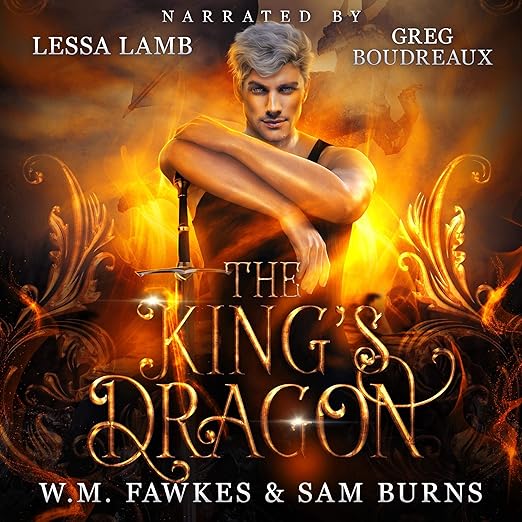
I have a weakness for fantasy novels built around a character who is hiding in plain sight. The tension of watching someone navigate a world that would reject them if it knew the truth, the social performance, the calculated intimacy, the way every relationship becomes a risk calculation, is one of the genre’s most reliable engines. The King’s Dragon takes that structure and gives it a dragon. Lord Tristram Radcliffe is the only dragon at the king’s court in Llangard, presenting as human among the knights he fights beside, keeping his real nature from the prince he loves as a friend. It is a setup with obvious allegorical resonance, and W. M. Fawkes uses it thoughtfully.
I started this one on a rainy afternoon, which was the right call. The book wants a certain atmospheric patience from the listener: it is not a plot-driven thriller but a character study set inside a fantasy court, and the pleasures it offers are the slow ones. Lessa Lamb’s narration is a substantial part of what makes those pleasures accessible.
The Shape of Tristram’s Secret
Fawkes’s central invention is smart: by making Tristram a dragon who has grown up entirely within human society, she creates a character whose allegiances are genuinely divided rather than artificially so. He is not a dragon pretending to be human; he is something that does not quite fit either category, and the court politics of Llangard, which pivot on exactly this ancient conflict between dragons and men, place him in an impossible position when the old king dies and the conflict escalates.
Reviewer TXbaritone27 described devouring the book in two days and praised Fawkes and Burns for creating “distinct, compelling characters in a familiar world.” The co-author credit is worth noting: the book was developed with Sam Burns, whose influence is most visible in the romantic thread, particularly in the character of Bet Kyston, the king’s shadow and assassin whose interest in Tristram complicates his careful self-concealment. Lessa Lamb gives Bet a slightly cooler, more dangerous register that distinguishes the character clearly from Tristram’s more conflicted interiority.
The Multi-POV Structure and Its Demands
The book cycles through six or more point-of-view characters across alternating chapters, which is ambitious for an opening volume and creates both strengths and problems. Reviewer TXbaritone27 found the switching rewarding; reviewer Madison W. described it as coming with “traces of romance beginnings” that feel gestural rather than developed. Both are right. The multi-POV structure lets Fawkes show the same political situation from different vantage points, the human knights, the dragon emissaries from the north, Bet’s detached professionalism, but at the cost of depth for each individual character.
In audio, Lessa Lamb’s ability to differentiate the cast becomes crucial. She earns the trust required for a six-character ensemble: each POV character has a consistent vocal identity, and listeners who might lose track of a rotating cast in print will find the audio version easier to follow. The audiobook format is genuinely advantageous here, because Lamb can signal the shift in perspective through voice where the text simply marks a chapter break.
The Romance That Is Not Yet a Romance
One thing listeners should know going in: the Tristram/Bet relationship in Book 1 is a slow burn in the most literal sense. Reviewer coho noted that “the book cried out for more development,” and specifically called out the romantic tension as underdeveloped. This is accurate for a first volume, and readers who came to the book expecting a completed romantic arc will be frustrated. What the book delivers instead is the establishment of a connection with considerable potential: Bet’s oscillation between wanting Tristram dead and wanting something else entirely is rendered with enough complexity to sustain anticipation across a series.
The broader world of Llangard and the northern dragon territories is sketched rather than drawn in full. This is structurally appropriate for a series opener, but it means the worldbuilding functions as atmosphere rather than as an inhabited reality. Fawkes has clearly thought carefully about the political and cultural architecture of the conflict between humans and dragons, and the later volumes presumably give that architecture more space.
Who Should Listen and Who Should Skip
Listen if you enjoy LGBTQ fantasy with a court intrigue focus and have patience for a slow-burn romantic thread that will develop across multiple books. Listen if you enjoy ensemble casts and multiple perspectives on a shared political crisis. Skip if you need a self-contained story rather than a series opener; the book ends mid-development rather than at a satisfying resolution. Skip if you want intensive romantic payoff in Book 1; the chemistry is established here but not fulfilled.
Frequently Asked Questions
Is The King’s Dragon primarily a romance or primarily a fantasy novel?
It is primarily a fantasy novel with a significant romantic thread rather than a romance with fantasy elements. The political intrigue, the court dynamics, and Tristram’s dual identity are the structural focus. The romantic relationship between Tristram and Bet is a slow burn that develops across the series rather than resolving in Book 1.
How does Lessa Lamb handle the six-plus POV characters in narration?
Lamb gives each perspective a distinct vocal register and maintains those distinctions consistently throughout. Reviewers who found the multi-POV structure disorienting in print generally found it easier to follow in audio because Lamb’s voice is a clearer guide than a chapter heading.
Does The King’s Dragon end on a cliffhanger, or does it reach a reasonable stopping point?
The main threat introduced in Book 1 reaches a temporary resolution, but the larger political conflict and the developing relationships are deliberately left open for continuation. It is a series opener rather than a standalone, and the ending signals clearly that significant story remains.
Is W. M. Fawkes the same author as the W.M. Fawkes and Sam Burns writing partnership?
Yes. The Fire and Valor series is co-written by W. M. Fawkes and Sam Burns, and the audiobook retains that co-author credit. Their collaboration is well-regarded within the LGBTQ fantasy space, and The King’s Dragon is generally considered a strong entry point into their work.