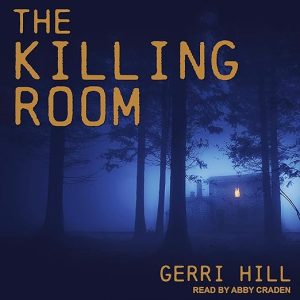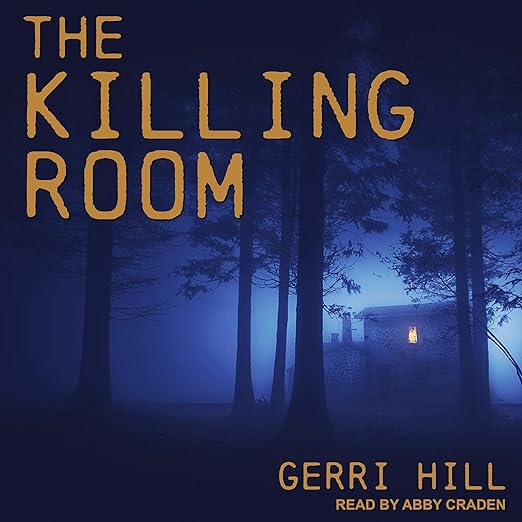
Jake McCoy is recovering at a mountain cabin in Colorado when The Killing Room audiobook opens, and Gerri Hill establishes her protagonist's situation with the efficiency that marks a writer who has spent considerable time in this genre: a Denver detective injured in the line of duty after the shooting death of a young boy, physically healing but not close to emotionally resolved, soaking in remote natural springs and trying to find some distance from the case that is still with her. The meeting with psychologist Nicole Westbrook happens the way these things happen in Hill's fiction, unplanned and immediate, with two women knowing almost nothing about each other by the time they become lovers. That compressed timeline is a genre convention, but Hill uses it with enough character detail that the speed does not feel implausible. The dynamic between Jake's out-and-comfortable identity and Nicole's deeply closeted professional life is where the real tension lives, and the audiobook spends its best time there.
Is The Killing Room Worth Your Time?
The novel was first published in 2006, and a reviewer who picked it up from a 2022 TBR pile flagged something worth acknowledging: the context of professional lesbians hiding their preferences belongs to a specific historical moment in LGBTQ+ visibility in professional environments. Nicole's closet is not a character flaw; it is a structural reality of her professional environment in that era, and Hill writes it with understanding rather than judgment. This historical texture gives the romance its central conflict rather than inventing artificial obstacles. Jake, as an out detective who has built her professional identity around who she is, simply does not occupy the same world that Nicole does, and what pulls them together keeps threatening what could sustain them together. The serial murder investigation that forms the procedural spine is genuinely constructed. A reviewer noted being convinced they knew who committed the crimes until the resolution revealed otherwise, which is the right kind of misdirection for a genre that too often telegraphs its ending. Hill earns the mystery and the romance in roughly equal measure, which is harder to achieve than it sounds and rarer in genre fiction than readers might expect.
The Best Parts of The Killing Room
Abby Craden's narration is a significant part of why this audiobook works as well as it does. She does not flatten the two tones, the procedural and the romantic, into a single register. Jake's voice as Craden delivers it carries the competence and directness of an experienced detective, while the scenes with Nicole have a different quality of attention, more careful, more uncertain in places that feel honest rather than performed. The physical attraction that the synopsis describes as threatening to compromise the investigation is not merely a plot device in Craden's reading; it is something you can hear shifting in the pacing of certain scenes, in the careful handling of transitions between the investigative and the personal. At ten hours and eleven minutes, the audiobook has room to develop both threads without rushing either. Hill's prose is not complex, which in this context is a genuine compliment: the writing does not draw attention to itself, and the audiobook format rewards that transparency because the story moves steadily forward without friction between the words and the listener's attention.
Before You Commit to The Killing Room
Readers approaching this as primarily a procedural should know that the mystery, while genuinely plotted, serves the emotional arc rather than the other way around. Hill is more interested in what the investigation does to Jake and Nicole's relationship than in the forensic architecture of the case itself. The investigation is credible and the resolution is satisfying, but the book's priorities are clear from early on. The romantic and identity-related content is central throughout; listeners who prefer their crime fiction with romance as a secondary thread will need to adjust expectations. The 2006 setting and sensibility around LGBTQ+ professional identity also means that some of the dynamics feel period-specific in a way that is worth noting for listeners who have read Hill's more recent work and found the social landscape different. This is not a weakness but a context: understanding where the tension comes from requires understanding the professional climate the characters inhabit, and Hill provides that context clearly enough that listeners unfamiliar with that era can follow its logic.
Should You Listen to The Killing Room?
Listeners who enjoy LGBTQ+ romantic mystery fiction and appreciate a protagonist whose identity is neither a problem to be solved nor a mere backdrop detail will find Jake McCoy well-drawn and Gerri Hill's construction of the Colorado setting careful and affectionate. Craden's narration adds real value to the listening experience over reading the print edition, and is worth factoring into the format choice. Skip it if procedural depth is your primary interest and romance feels like genre friction; this audiobook integrates the two deliberately and with evident care. For listeners new to Gerri Hill's work, this is a standalone novel that does not require prior knowledge of any series, making it a reasonable entry point for exploring her catalog. The Colorado setting is rendered with enough specificity to feel like a genuine location rather than a generic backdrop, which adds to the sense that these characters are inhabiting a real world rather than a genre set. Hill's attention to place, from the remote natural springs where Jake recovers to the Denver procedural environment where the investigation develops, gives the audiobook a geographical grounding that many genre hybrids skip in favor of plot momentum. The ten-hour runtime is generous enough to let the characters develop without feeling padded, which is the right balance for a story that needs the reader to care about both the investigation and what happens between the two women after it concludes.
Does this audiobook work as a standalone, or is it part of a series that needs to be followed in order?
The Killing Room is a standalone novel. Jake McCoy does not appear in a continuing series that requires prior context. New listeners can begin here without any background in Hill's other work.
How does Abby Craden's narration handle the balance between mystery and romance in the audiobook?
Craden differentiates the two registers noticeably. The procedural scenes carry the pacing and register of crime fiction, while the romantic sections have a softer, more careful quality. Listeners who enjoy narrators who modulate tone rather than delivering everything at the same pitch will find her work here particularly effective.
Does the audiobook reflect the 2006 publication date in its portrayal of LGBTQ+ professional identity?
Yes, in ways that are historically specific rather than dated in quality. Nicole's professional closet makes sense in the context of the era, and Hill writes it with understanding. Listeners familiar with how LGBTQ+ professional visibility has changed since 2006 will read this as period-accurate rather than anachronistic.