Quick Take
- Narration: Natalie Naudus brings warmth and light comedic timing to Certainty and Aurelia, an ideal casting for cozy fantasy with genuine emotional stakes.
- Themes: Found community, sapphic romance, the ethics of hoarded power
- Mood: Warm, gently funny, and unexpectedly tender
- Verdict: A cozy fantasy that earns its charm through character and craft, Julie Leong’s second novel confirms she is doing something specific and good in this space.
I finished The Keeper of Magical Things late on a Friday night after a week that had ground me down in the way weeks sometimes do, and I am not embarrassed to say I was smiling by the time I put my headphones away. That is not a small thing. Julie Leong’s novel, her follow-up to The Teller of Small Fortunes, which I had loved, does exactly what good cozy fantasy is supposed to do: it creates a world warm enough to inhabit, characters whose company you want to keep, and emotional stakes real enough to matter without ever tipping into despair.
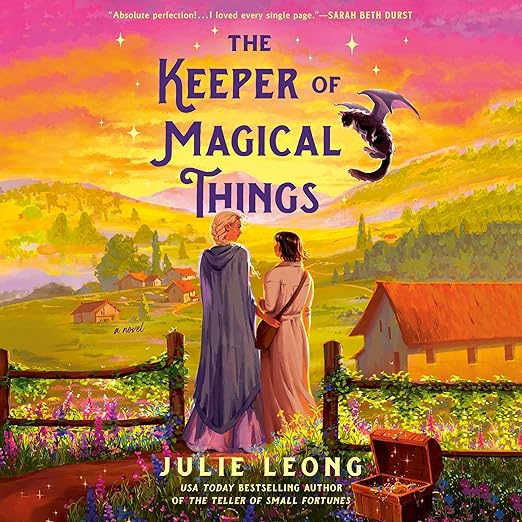
The premise is delightful. Certainty Bulrush is a novice mage whose magic is, charitably, tepid at best. When given the chance to earn her magehood through a seemingly uncomplicated assignment, she jumps at it, even if it means working alongside Mage Aurelia, who is brilliant, overachieving, and has managed to alienate practically everyone around her. Together, they must transport a collection of minorly magical artifacts to Shpelling, a village so thoroughly unremarkable that nothing dangerous could possibly happen there. Gossip-prone teapots, a catdragon of uncertain temperament, and kind-of-flaming swords complicate matters considerably. At just under eleven hours, narrated by Natalie Naudus for Penguin Audio, the audiobook is a satisfying full listen, long enough to develop real depth, short enough to avoid the pacing problems that plague longer fantasy series.
Our Take on The Keeper of Magical Things
What Leong does particularly well is make the romance feel earned. Certainty and Aurelia begin at genuine friction and move toward each other through shared work, observed vulnerability, and a growing understanding of what the other person actually needs. The sapphic romance here is not the whole story, it is one thread in a fabric that also includes questions about institutional power, what magic is actually for, and the ethics of a Guild that hoards its resources while ordinary villages go without. That political undertone gives the book more weight than the premise initially suggests, without ever becoming preachy.
Naudus is the right narrator for this material. She brings warmth to Certainty’s earnest determination, gives Aurelia’s carefully maintained competence a brittle quality that slowly softens, and handles the ensemble of Shpelling residents, gossipy, particular, fully themselves, with easy differentiation. Several reviewers noted that the book’s kindness shines through, and Naudus is a significant reason for that: she reads the emotional moments with genuine care rather than sentimentality, which is a harder balance to strike than it sounds.
Why Listen to The Keeper of Magical Things
Cozy fantasy has become a crowded space in recent years, and the genre can tip into blandness when it prioritizes comfort over craft. Leong avoids that. The characters in this novel have interiority, they carry specific histories, specific wants, specific fears, and Leong trusts those details to do the emotional work rather than relying on genre conventions alone. One reviewer called it “required reading for all of us who wish for magic to be real,” which is a bit hyperbolic, but the impulse behind the comment is accurate: this is a book that makes you believe in the world it has built, which is the foundational requirement of any fantasy worth recommending.
The audiobook running time of nearly eleven hours is well-distributed across the story’s arc. The first half establishes the world and the central relationship with patience; the second half accelerates in a way that feels earned rather than rushed. For listeners who found The Teller of Small Fortunes too brief, this installment offers more breathing room.
What to Watch For in The Keeper of Magical Things
If you have not read The Teller of Small Fortunes, this novel stands entirely on its own, the settings and general world overlap, but the characters and plot are independent. New readers will have no trouble locating themselves in the story. However, those who are particularly attached to the first book’s characters may find themselves briefly impatient to spend time with a new set of people before Leong wins them over, which she reliably does within the first few chapters.
Listeners who want high-tension plotting or dark stakes will want to look elsewhere. The conflict here is real but never brutal, the danger genuine but never harrowing. If that is a constraint rather than a feature for you, the book will not change your mind about cozy fantasy as a genre, but for those already inclined toward it, Leong represents the best of what it can do.
Who Should Listen to The Keeper of Magical Things
Anyone who loved The Teller of Small Fortunes should move directly to this. Cozy fantasy listeners who appreciate character-driven sapphic romance will find this especially satisfying. Also recommended for listeners exhausted by grimdark or high-stakes epic fantasy who want the imaginative world without the weight. Readers who have enjoyed T. Kingfisher’s lighter work or Becky Chambers’s Monk and Robot series will likely find Leong operating in a similar register. A warm, well-crafted listen.
Frequently Asked Questions
Do I need to have read The Teller of Small Fortunes to enjoy this book?
No. Leong has confirmed that each book set in this world stands independently. Characters and some world-building elements carry over, but the story of Certainty and Aurelia is entirely self-contained. New readers can start here without confusion.
How prominent is the romance compared to the fantasy plot?
The romance between Certainty and Aurelia is central but develops gradually alongside the main plot. Leong builds the relationship through shared work and slowly revealed vulnerability rather than accelerating it artificially. Listeners who want their romance to take over the narrative may wish the book went further; those who prefer the balance will find it satisfying.
Is Natalie Naudus’s narration consistent with how she performed The Teller of Small Fortunes?
Yes. Naudus returns for this installment and brings the same warmth and characterization. She handles an ensemble of distinct personalities without the voices blurring, and her timing with the lighter comic moments is notably effective.
Does the catdragon character get significant page time, or is it more of a background detail?
The catdragon, which tags along on the journey to Shpelling uninvited, is a recurring presence with its own personality and causes real complications. It is not merely decorative; it contributes to both the comedy and several plot developments throughout the second half of the book.