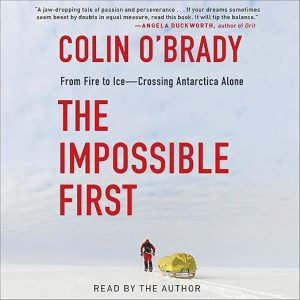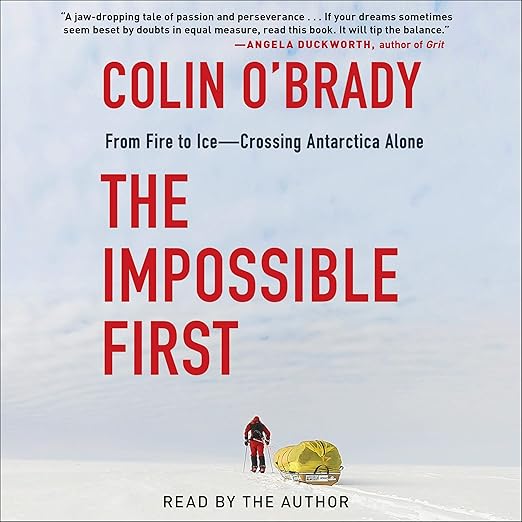
Before You Press Play
- Voice: O'Brady narrates his own memoir with an unforced, unhurried quality that matches the physical reality of what he endured; the emotional passages carry genuine weight.
- Big ideas: Human endurance limits, recovery and reinvention, competitive drive
- Atmosphere: Spare and intense, occasionally tender
- Worth it?: A self-narrated adventure memoir that earns its inspirational reputation through honesty about doubt and failure, not just triumph.
Antarctica as an audiobook subject carries an immediate problem: the silence, the scale, the cold that kills in hours rather than days. These are things that resist language. Colin O'Brady's self-narrated account of his 932-mile solo crossing of the continent, The Impossible First, is remarkable precisely because it finds a way through that problem. When you hear O'Brady read his own story, the flatness of exhaustion in his voice during the hardest passages is not a performance. It is a man who actually remembers what it felt like to drag a 375-pound sled across Antarctica alone for 54 days.
I started listening to this audiobook on a January morning with the heating turned up and a coffee in hand, which felt almost obscenely comfortable given what was unfolding in my earbuds. That contrast is one of the strange pleasures of adventure memoir in audio form: the listener's physical ease throws the subject's physical extremity into sharper relief.
A Closer Look at The Impossible First
The autobiography of an athlete narrating his own book is a gamble. Memoir narration requires a different skill set than public speaking, and not every accomplished storyteller translates fluently to audio performance. O'Brady is the exception. His pacing is unhurried in a way that suits the material. The Antarctic crossing was not fast. It was methodical, brutal, and repetitive in the way that only extreme endurance challenges can be, and O'Brady's narration matches that rhythm without losing the listener. Some passages slow to describe a whiteout or a moment of near-collapse, and the deliberateness carries genuine weight.
What makes this audiobook unusual in the adventure memoir category is the dual structure. O'Brady weaves the crossing itself with a backstory that begins ten years earlier in Thailand, where a fire accident left him with severe burns on both feet and genuine doubt about whether he would walk normally again. That backstory is not filler. It establishes the emotional architecture the crossing requires to land as more than a record-setting stunt.
What Makes The Impossible First Worth Hearing
The competitive element sets this memoir apart from solo-challenge accounts that measure only the protagonist against the environment. O'Brady was not alone in attempting this crossing. British polar explorer Captain Louis Rudd was also on the ice, pursuing the same 'first,' and the two men communicated periodically via satellite phone during their parallel journeys. That dynamic gives the narrative a human dimension that pure man-versus-nature stories sometimes lack.
O'Brady is honest about the psychological crisis in the middle of the crossing. He does not present himself as someone who never doubted. The passages where fear and doubt genuinely threaten to stop him are rendered with specificity rather than abstraction, and hearing O'Brady voice those passages himself gives them a credibility that a hired narrator simply cannot replicate. Reviewers who flagged this book as 'one part inspirational story' are not overstating it, but the inspiration here is earned through the admission of fragility rather than a relentless projection of confidence.
The love story woven through the book also earns its place. O'Brady's wife Jenna supported the crossing from outside, and their satellite phone conversations during his final days on the ice are among the most emotionally direct sequences in the audiobook. For listeners who approach adventure memoir primarily for the physical drama, these sections might feel like a detour. For most listeners, they are what transform the book from an impressive achievement into an actual story.
Things to Know Before Starting The Impossible First
At 8 hours and 38 minutes, this is a lean production for the subject matter. The backstory sections, the childhood context, and the motivational framework around O'Brady's philosophy of the 'Impossible First' mindset are compressed. Readers who want a more granular technical account of the preparation, the nutrition planning, or the equipment decisions may find the coverage lighter than expected. O'Brady is a memoirist, not a logistics journalist, and the book stays closest to the emotional rather than the tactical.
The book's philosophical overlay can occasionally feel schematic. O'Brady is clearly a man who has thought hard about the story he wants to tell, and at moments the narrative is organized around lessons rather than allowed to breathe as raw experience. That is a minor friction point in a book that otherwise stays present and specific.
It is also worth noting how O'Brady uses the book's structure to honor Jenna's role in the crossing. The periodic satellite calls home are not sentimentalized. They are depicted as operational necessities that happened to carry emotional freight, which makes the love story feel organic to the experience rather than imposed upon it for audience appeal.
Who Colin O'Brady Is Writing For
Listeners who respond to endurance memoir in audio form will find O'Brady's self-narration adds a dimension that reading cannot deliver. If you have followed the adventure biography category through works like Endurance or Into Thin Air, this book occupies a similar space with the additional layer of a contemporary first-person voice reading his own account. The Wall Street Journal called it 'incredibly engaging and well-written,' and Booklist gave it a starred review. Those assessments hold.
If extreme physical challenge is not a subject you gravitate toward, the motivational framework may not compensate. But for listeners who want to spend 8 hours inside one of the most extreme solo journeys ever completed, narrated by the person who actually made it, this audiobook is worth every minute.
Does Colin O'Brady's self-narration add to the audiobook experience compared to a professional narrator?
Yes, significantly. The exhaustion and emotion in his voice during the hardest passages cannot be faked, and it gives the psychological crisis sections a credibility that hired narration rarely achieves for first-person accounts of lived extremity.
Is this audiobook primarily an adventure story or a motivational book?
Both threads are present, but the adventure and memoir elements dominate. The motivational framing is there, but it is earned through narrative rather than imposed as a self-help overlay.
How does the audiobook handle the head-to-head race with Captain Louis Rudd?
Rudd's parallel journey is woven throughout rather than treated as a subplot. The satellite phone conversations between the two men during the crossing give the competition a human texture rather than a simple rivalry narrative.