- Performance: One voice handling a dialogue-heavy fable and an instructional framework in turn, with a hard tonal switch built into the middle of the book.
- What it covers: Team dynamics, hiring and development, humility and hunger, workplace culture.
- Feel: Brisk, conversational, unfussy.
- Our call: A genuinely usable hiring model wrapped in a readable fable, though the star badge here is not a number anybody can trust.
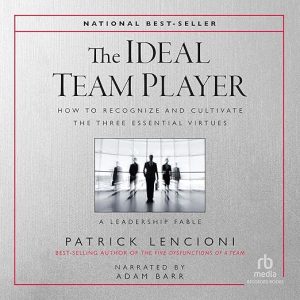
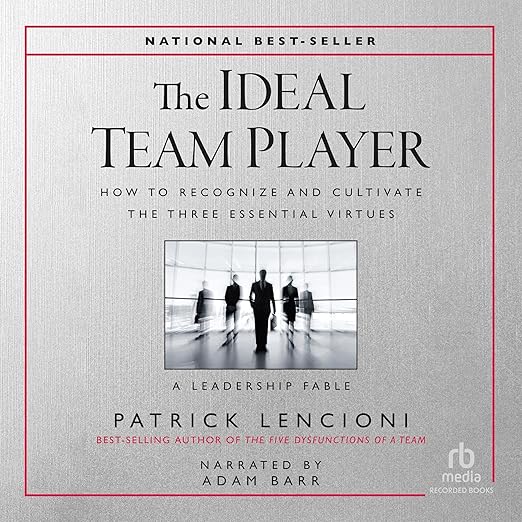
Can a business book earn the fable it opens with? Patrick Lencioni has built a career on that gamble, and this audiobook runs the experiment again: a story about a construction firm in trouble, then a framework you are meant to take to work with you. Recorded Books put this reading out in January 2025, with Adam Barr voicing a script that has to move from boardroom argument into instructional prose without leaving a visible seam in the middle.
The Whole Definition Is Not Being a Jackass
The fable is the load-bearing part. Jeff Shanley inherits his family's locally revered construction firm and discovers that the two largest projects in its history are about to be delivered by people who cannot work together. He has to build a hiring and development culture in a hurry, which means confronting talented employees who are bad on teams and talking a fiery VP of operations out of dropping the standard just to fill seats quickly. Each of those is a genuine management problem rather than an invented one. The construction setting helps more than it ought to, because a building site makes coordination failures visible in a way that an office almost never does.
The excerpt on the listing tells you the register immediately. Jeff accuses two colleagues of dropping the ball, then observes that their one clear definition of a team player is that a person cannot be a jackass. They laugh, guiltily. Garrett Maroon, five stars in September 2017, described the shape exactly: it starts as a fable, makes the beginning very real and insightful, and only afterward gets into the details of the three virtues, which that account names as hungry, humble and smart.
Then the fiction stops and the tools arrive. What follows is a framework for identifying, hiring and developing the people the story has been describing, pitched at leaders, at human resources professionals, and at anyone trying to become one of these players themselves. In audio that transition is the risk point, because a listener who has settled comfortably into a story has to be reoriented into a checklist without losing the thread, and Lencioni gives the switch no ceremony whatsoever.
A Compliment Wearing a Complaint's Clothing, Under Five Hours
Under five hours is brief for a book with a working framework attached, and the brevity earns its keep. A fable is a natural audio form to begin with: dialogue, one protagonist under pressure, a problem stated early and resolved late. That is a shape a listener can hold in mind without notes, which is more than most management titles can honestly claim, and it means the story half survives being heard while your hands are busy with something else. The cost is that you get no room to argue with the framework while it is being delivered, which is the standing price of any book built this compact.
Matthew Morine, four stars in September 2016, made the sharpest observation anybody has made about the whole output: Lencioni struggles to match The Five Dysfunctions of a Team, and that earlier book was so good that everything after it reads as a disappointment. It is a compliment wearing a complaint's clothing. Judged on its own, the same response continues, this one is always engaging, practical and helpful, and leaves you with actionable thoughts.
The framework half also holds up in audio better than most business writing does. It amounts to a set of named qualities and a way to test for them in an interview, which is exactly the kind of content that sticks after a single pass. Where audio usually loses to print in this category is with charts, matrices and worksheets, and almost nothing here depends on one, so the running time stays honest rather than becoming an advertisement for a book you still have to go and buy.
No Six Whole Stars Produce This 4.6
Arithmetic first. The page shows 4.6 from six ratings, and no six whole-star votes produce that figure. Twenty-seven stars across six votes displays as 4.5, and twenty-eight displays as 4.7. The five visible grades total twenty-three, so whatever the missing sixth vote turns out to be, the only possible averages are 4.0, 4.2, 4.3, 4.5 and 4.7. The number printed on the page is not one a buyer can reconstruct from the evidence shown.
Every one of those responses also predates the recording. Recorded Books released this reading in January 2025; the most recent visible response is dated May 2024 and the oldest September 2016. The entire pool is therefore grading a text that had been circulating for the better part of a decade before anybody read it aloud, and an explicit reading verb turns up in three of the five bodies. The badge and the responses are measuring two different products.
Sonal Gupta, writing in May 2024 and closest of anyone to the recording date, still describes finishing the book by reading it. That response is also the most useful thing in the pool, since it names the virtues a second time and in different words: humility, hunger and people smarts. Two accounts, two phrasings, and a description that promises three indispensable virtues and then names not one. The central claim of the book has to be taken entirely on trust before anyone presses play.
Neither Half Outstays a Single Afternoon
The obvious audience is anybody who hires. The framework is built for interviews and development conversations, and the fable exists to hand a manager language for a problem they already recognize but cannot articulate. It also travels unusually well: two of the five come from outside the United States, one from Italy in 2017 finding the reflections worth having, one from Germany in 2020 reporting that the respondent now gives copies away and staffs open positions against the criteria. A management fable that survives translation into two other languages is usually one whose ideas do not depend on a single national office culture.
Managers looking for the book that made Lencioni's name should start with the other one. This is explicitly a follow-up to The Five Dysfunctions of a Team, aimed at the individual rather than at the group, and it is genuinely hard to hear on its own terms once you know the earlier title. Anyone allergic to the business fable as a form should also stay away, because the story is not a wrapper around the argument here. It is half of it.
The framework is the reason to press play, the fable is the reason any of it is still with you a week later, and neither half outstays a single working afternoon.
Frequently Asked Questions
Do you need to read The Five Dysfunctions of a Team before this audiobook?
No, but the comparison is unavoidable. This one narrows the focus from the group to the individual team member, and the framework stands perfectly well alone. Anyone who knows the earlier title will hear this as a sequel and grade it that way, while anyone who does not simply gets a usable hiring model in under five hours.
Is this audiobook useful if you are not a manager?
Yes, and the description says so outright. One of its three stated audiences is the employee who wants to become invaluable on a team. Heard that way, the virtues work as a self-assessment rather than a hiring filter, and the fable turns into a portrait of the colleagues who quietly make projects difficult.
Does the audiobook reward a second listen, or is once enough?
Once is enough for the fable and probably not enough for the framework. The story resolves cleanly and holds no surprises on a second pass, but the virtue definitions and the interview approach are the kind of material people return to before a hiring round. Anyone planning to use it that way should bookmark the back half.