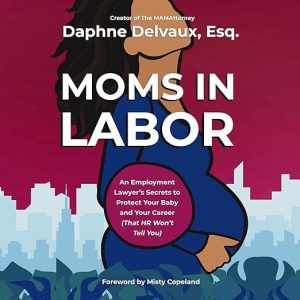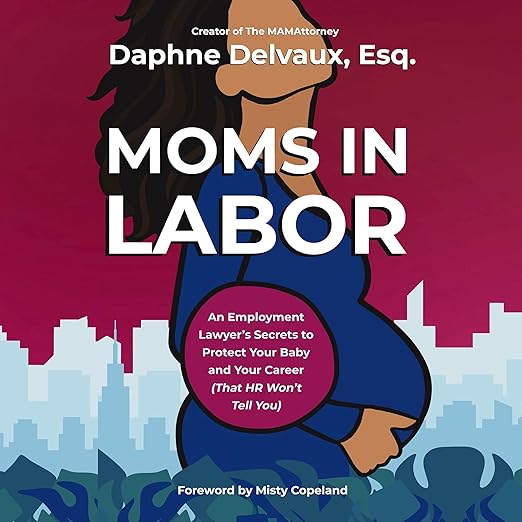
Employment law read aloud by the lawyer who argued it gives this audiobook a case for the format that most practical guides cannot make. Daphne Delvaux has spent fifteen years representing women pushed out, passed over or punished at work for having a baby, and the description's opening line, ahead of any pitch at all, is the announcement that she reads it herself. HarperCollins Leadership released it in March 2026 at twelve hours and fifty-seven minutes, which is long for a book of this kind and, once you understand what it holds, defensible.
Scripts for Holding a Position, Three Weeks From Due
Two halves work differently in this book. One is legal: what the statutes actually say about pregnancy, leave, accommodations and telework, as opposed to the version printed in a company handbook. The other is script writing, word for word, for the conversations nobody rehearses, including announcing a pregnancy, requesting leave, negotiating a schedule, and managing a boss who has already decided how this will go. The second half is where the audio earns its price, and it is the half most competing books skip entirely.
Lauren Brody's response, filed one day after release, names the thing precisely. It frames new working motherhood as the first negotiation many women enter with the highest possible stakes waiting at home, and credits the book with supplying not only the words but the conviction to deliver them. That is the correct reading of what Delvaux built. These are not scripts for transferring information. They are scripts for holding a position while exhausted, outnumbered and three weeks from a due date.
Delvaux's own framing is blunter still. Her argument is that a pregnant employee walks into a negotiation where the other side has an HR department, a legal team and decades of policy written to protect itself, and where the baby's only representation is the mother. Whether that reads as inspiring or alarming depends entirely on your employer. Either way it is an accurate description of the asymmetry, and it explains why the register stays closer to litigation prep than to encouragement or reassurance.
Delvaux Delivers Words Already Used Against Counsel
Hearing a script spoken is not the same as reading one. Anyone who has rehearsed a difficult sentence knows the distance between words on a page and words in the mouth, and this is a book composed almost entirely of difficult sentences you will have to say to someone holding power over your income. Delivered by the lawyer who wrote them rather than by a hired reader, they come from the person who has already used them against opposing counsel.
Michelle's March 2026 entry is the most concrete piece of evidence on the page. Written by someone who joined Delvaux's online program before the book existed, it describes staying up late trying to untangle the difference between legal job protection, state leave pay and employer-provided benefits, and finding that distinction finally laid out. That three-way confusion is the exact problem this book exists to solve, and it is not a problem anybody searches their way out of, because the three systems are administered by three different bodies and none of them explains the other two.
Length makes sense once the structure comes into view. Nearly thirteen hours is a lot for a workplace guide, but a good part of that is case material drawn from clients Delvaux represented and from losses she took, and another part is statutory detail that a shorter treatment would have flattened into bullet points. The narrative passages keep the legal material listenable across a week of commuting, and they also stop the book reading like a pamphlet from a benefits office.
A Title Pun That Collides With Childbirth Searches
Reception numbers here are close to useless, and worth understanding before anyone reads meaning into them. Six ratings produce a 5.0 average, and all five written responses landed between March 4 and March 16, 2026, inside two weeks of a March 3 release. That is a launch window sample rather than a verdict, and it says nothing about how the book holds up in month six or year two, which on a legal title is exactly the question that matters.
Jurisdiction is the substantive limit. Penelope B's March 2026 entry spends its opening on a wish that the United States had statutory maternity leave and the social supports most other countries provide, which is precisely the frame the whole book operates inside. The laws Delvaux teaches are American laws, and the scripts assume an American employer with an American HR department behind it. A listener in a country with mandated leave will find the strategy interesting and the statutes beside the point.
One more thing about the packaging. The title puns on two meanings of labor, which is neat and also collides with childbirth content in any search a buyer might run. It sits under business and careers with a Women in Business tag, which is where it belongs, but a browser hunting for a legal guide is unlikely to arrive by typing these three words. Word of mouth will do more work here than the catalog ever will, which is a shame on a book whose whole value lies in reaching somebody before their first difficult meeting.
A Compliance Briefing With Unusually Good Stories
The obvious audience is a pregnant employee or a new parent heading back to work, and for that listener the book sits close to essential. Erica D Bailey's March 2026 response calls it the resource wanted years earlier and frames it as required reading for a mother trying to hold a career together while raising a family. That is a fair summary of the ambition. The scripts alone justify the purchase for anyone about to announce a pregnancy to a manager they do not entirely trust.
The less obvious audience is the manager on the other side of that conversation, and the HR professional who has been handing out the watered-down version without knowing it. Delvaux writes that most bosses and HR departments do not know the law either, which is stated as an accusation but functions just as well as an invitation. Read from that side, this is a compliance briefing with unusually good stories attached, and considerably cheaper than the litigation it describes.
A book this specific about statute and script will date the day the law changes, and until then nothing else covers the ground with the same combination of legal precision, script writing and plain nerve.