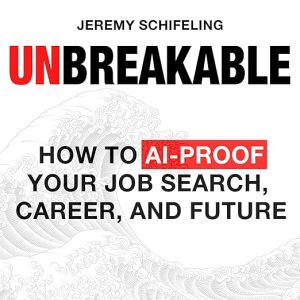
The career advice market around artificial intelligence has, in a very short period, divided into two loud camps: those who insist everything is fine and those who insist the robots have already won. Jeremy Schifeling, who spent years at LinkedIn and Khan Academy watching how hiring actually works at scale, takes a different position in Unbreakable: How to AI-Proof Your Job Search, Career, and Future, an audiobook that acknowledges the disruption is real without concluding that human workers are obsolete. Narrated by Rose Ngo across six hours and thirty-nine minutes, it is markedly better than the category average, partly because Schifeling has the insider credibility to back his claims and partly because he chose to be specific where others are vague.
Computer Science Graduates Now Face Higher Unemployment
Schifeling opens with a provocation that earns its place: the old answer to every career disruption question was learn to code, and now AI codes better than most humans. Computer science graduates face higher unemployment than philosophy majors. If that sounds like a setup for despair, Schifeling pivots quickly. His argument is not that technical skills are worthless but that the specific human capacities AI cannot replicate, or cannot replicate cheaply, are now more valuable than they have ever been. The question the book spends most of its time answering is which capacities those are, and how to demonstrate them to employers who are themselves figuring out what they need in a world where job descriptions are being rewritten in real time.
The four human and AI skills Schifeling identifies as central to long-term career resilience are introduced with enough specificity to be genuinely useful. He avoids the habit, common in books of this type, of defining key skills so broadly that they describe everyone and therefore no one. The technique he calls the 20X advantage over other job seekers is explained concretely and grounded in the mechanics of how modern hiring filters work, which is exactly where Schifeling's LinkedIn experience becomes relevant. He understands the system from inside, and that insider knowledge gives the advice texture that generalists in the career coaching space cannot provide.
One reviewer, a project manager with fourteen years of experience who had been dismissive of the AI career advice genre, said the book won them over by being tactical where others are vague. Another reported landing two interviews within a week of applying the book's strategies. A third, writing from a position of professional seniority, called it essential reading for professionals at every level and recommended it for recent graduates as well. The consistency of that feedback across different career stages suggests the framework translates beyond the specific circumstances any one reader brings to it.
Ngo Keeps the Pace Crisp Without Rushing
The audiobook format works well here because Schifeling writes in a register that is genuinely listenable. He has a sense of humor about the material, which defuses some of the anxiety the subject naturally generates. Ngo's narration keeps the pace crisp without rushing through the actionable sections, and the balance between conceptual argument and concrete tactical guidance translates efficiently to audio. At just under seven hours, the book does not overstay its welcome, which matters in a genre prone to padding a single strong idea across twice the necessary length.
The book is also honest about what it cannot do. Schifeling does not promise that following his advice makes a career immune to further disruption. The title says AI-proof but the content says resilient, which is a meaningful distinction. No career is fully insulated from technological change. What the book offers is a framework for positioning yourself to ride the next wave rather than being pulled under by it.
The Title Says AI-Proof, the Content Says Resilient
Listeners already deep in the literature on automation, labor markets, and AI will recognize some of the framing. Schifeling draws on ideas that have circulated in the economics and education spaces for several years. His contribution is less theoretical originality than practical synthesis and application to immediate job search challenges. If you have read extensively in this area and are looking for new scholarly arguments, the book may cover familiar territory. If you want specific tactics for a job search happening right now, under current hiring conditions, the book is more directly useful than most of its competitors.
The coverage of AI as a skill rather than a threat is one of the book's more useful passages. Schifeling is not arguing that you should ignore AI tools but that you should learn to use them in ways that amplify specifically human judgment. The distinction between using AI to automate tasks and using it to extend genuinely human capabilities is one the book draws clearly, and it is a distinction worth sitting with regardless of where you are in your career.
Technical Roles May Find the Framing Basic
This audiobook suits professionals at any career stage who are genuinely uncertain about how AI is changing their field and want specific rather than vague guidance. Recent graduates facing a disrupted entry-level market and mid-career professionals wondering whether their skills will remain valued in five years are both well-served. Those already working in AI or technical roles may find the framing somewhat basic, but the hiring strategy sections are valuable regardless of technical background. Listeners wanting deep economic or philosophical treatment of automation will want to look elsewhere, but anyone facing an active job search in a market shaped by AI hiring tools should find the six-plus hours well spent.