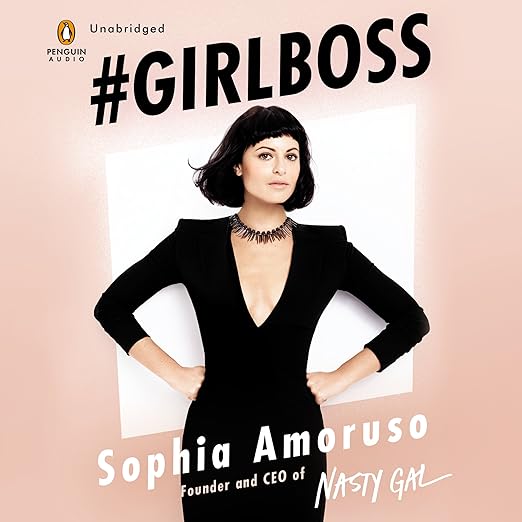
I remember when this book landed in 2014. The hashtag was everywhere, the Nasty Gal story was everywhere, and there was a particular strain of millennial ambition that this book seemed to crystallize and validate. I read it at the time and found it energizing. Returning to it now, via audio, is a slightly different experience, more interesting, in some ways, because the distance in time lets you evaluate the story with more texture.
The audiobook is short at four hours and forty-one minutes, and Sara Jes Austell's narration moves at pace, which suits Amoruso's voice. The writing has the quality of someone talking directly at you from across a table, blunt, informal, occasionally profane, and Austell handles that register capably. The most quoted reviewers call it Lean In for misfits, which captures something true about the positioning but undersells the fact that Amoruso is actually telling a stranger, messier story than Sheryl Sandberg was.
Sophia Amoruso's origin story is genuinely unusual for business memoir: dumpster diving, petty theft, hitchhiking, a job checking IDs at an art school taken purely for the health insurance. The founding of Nasty Gal on eBay, a vintage clothing shop that grew to a $250 million retailer, begins not with a business plan but with an instinct for what looks good and who wants it. This gives the early sections of the book an authenticity that more polished entrepreneurship memoirs lack.
The book does not pretend to offer a transferable framework. Amoruso is explicit that she is writing about her own specific path, not prescribing one. Reviewer B. Woon, who notes he is probably not the target demographic, found this honesty refreshing, and it is. The absence of generic productivity advice and the presence of actual, specific experience, the eBay listings, the photography decisions, the hiring instincts, makes this more readable than most business memoirs aimed at a broad aspirational audience.
The Strengths
The audio format works particularly well for the book's conversational structure. Chapters tend to be short, with Amoruso moving between memoir and direct address, and Austell's delivery keeps this rhythm from feeling choppy. For a listener commuting or doing something else with their hands, this is exactly the right length and texture, absorbing without demanding the kind of sustained analytical focus that a Cialdini or a Gladwell requires.
International readers should note that the book attracted fans far beyond its intended US market. Reviews in French, Portuguese, and Spanish all cite the book's directness and lack of sugarcoating as its strongest quality. This is not a book that pretends success is easy or inevitable. It is a book about someone who got lucky in specific ways and worked hard in specific ways, and it does not confuse the two.
Things to Know Before Starting #GIRLBOSS
The chapter on money is worth taking seriously, even if the rest of the book feels light. Amoruso is unusually direct about the experience of being broke, the psychology of spending when you have nothing, and the practical decisions she made to keep Nasty Gal solvent in its early years. This section has more useful texture than many dedicated personal finance audiobooks aimed at younger audiences.
Listeners who know that Nasty Gal eventually filed for bankruptcy in 2016, two years after this book's publication, will hear certain passages with a different register. The book does not, obviously, anticipate this. Whether that context enriches or undermines the narrative depends on what you are listening for. As a portrait of a moment, and a mindset, it remains accurate. As a model to replicate, it is more complicated.
Recommended For
Early-career listeners who feel alienated by the polish and pedigree of conventional business success stories will find something genuinely useful here. The book is also valuable for listeners interested in the specific mechanics of building an e-commerce business from scratch in the pre-Shopify era, the eBay optimization, the vintage sourcing, the photography instincts are documented in real, usable detail.
Those looking for a structured management or leadership framework should look elsewhere. This is memoir with entrepreneurial lessons threaded through it, not a strategic guide.
At a Glance
- Narrator: Sara Jes Austell captures Amoruso's defiant energy convincingly, though listeners who prefer self-narrated memoirs may notice occasional tonal distance from the most personal passages.
- Subjects: Unconventional entrepreneurship, self-trust, outsider paths to success
- Tone: Scrappy and energetic, occasionally preachy but mostly fun
- Bottom line: Under five hours of candid, anti-corporate business memoir, best understood as a snapshot of a specific moment in startup culture rather than a timeless playbook.
Before You Listen
Does the audiobook address the later bankruptcy of Nasty Gal, or does it end at the company's peak?
The audiobook was published in 2014 and ends when Nasty Gal is still a major success story. It does not address the 2016 bankruptcy filing. Listeners who know the later history will find some passages bittersweet, but the book functions as a genuine document of a specific moment rather than a sanitized retrospective.
How does Sara Jes Austell's narration compare to Amoruso's own voice in interviews?
Austell captures the energy and informality of Amoruso's written voice effectively. Listeners familiar with Amoruso's actual speaking voice from interviews or the Netflix show may notice the narration as a performance rather than the real article, but the gap is not distracting enough to undermine the material.