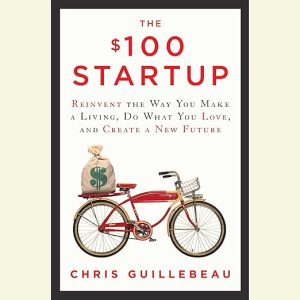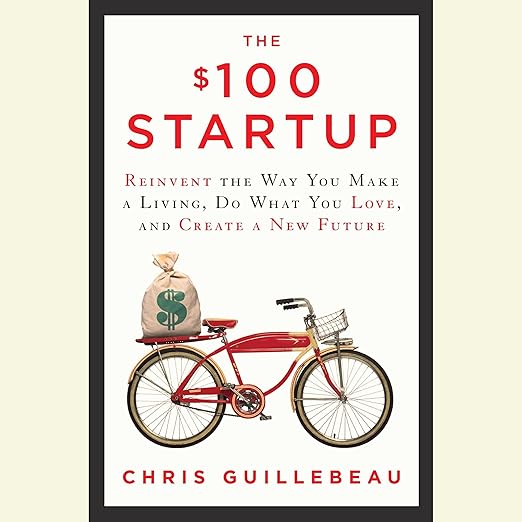
Chris Guillebeau narrates his own book in The $100 Startup audiobook, and that choice matters more than it might initially seem. You are hearing the framework for low-investment entrepreneurship from someone who completed a personal mission to visit every country on earth without holding a conventional job, which gives the content biographical credibility that is difficult to manufacture. The book is rooted in something most business titles avoid: specific numbers. How much did it cost to start? How many dollars did these people make in the first weeks? What mistakes did they make, and what happened after? Those specifics are what set this apart in a genre that often trades in vague inspiration.
A Closer Look at The $100 Startup
The research base is more substantial than the casual, conversational tone might suggest. Guillebeau identified 1,500 people who had built businesses generating $50,000 or more from an initial investment of $100 or less, then narrowed the field to the 50 most instructive case studies. The 8 hours and 14 minutes of the audiobook move through those stories with efficient purpose, extracting the patterns that recur across different industries, demographics, and starting points.
The central pattern is the one Guillebeau identifies as the convergence: the point where your skill or knowledge intersects with what other people will pay for. That framework is simple but useful because Guillebeau illustrates it with enough varied examples that the principle becomes genuinely applicable rather than abstract. He finds the convergence for a photographer who started teaching workshops, a cyclist who began designing bike infrastructure, a life coach who packaged her methodology into a digital course. The specificity across very different examples is the book's real service to the reader.
Guillebeau's voice on the recording is measured and slightly wry. He has the ease of someone who has delivered this material many times in public settings and has refined which examples land and which explanations need more space. The self-narration works particularly well for the personal anecdotes, where hearing the author describe his own decision-making process carries a directness that professional narrators typically cannot replicate. One reviewer describes finishing the book and immediately beginning to build a plan, which suggests the actionability of the content transfers to audio format effectively.
What Makes The $100 Startup Worth Hearing
The audiobook rewards listeners who are already employed or otherwise stable and are thinking about how to build something on the side, rather than listeners who need to generate income immediately. The case studies skew toward people who had an existing skill or hobby they converted into a business rather than people who built entirely new competencies from scratch, which is an accurate representation of how most successful micro-entrepreneurship actually works in practice.
Guillebeau's principles, including never teach a man to fish when you can sell him the fish and action wins over planning, are presented without moralizing, which keeps the pacing brisk and the message uncluttered. The book was published originally in 2012, and some specific platform and tool recommendations in the case studies reflect that era. But the strategic framework applies across a much wider range of current contexts than any of the specific examples from 2012. Find the convergence, validate it quickly, start for less than you think you need. Those principles hold regardless of which platforms currently dominate.
Things to Know Before Starting The $100 Startup
Experienced entrepreneurs or listeners who have already absorbed several books in the indie business space may find the material familiar. The book is clearly positioned toward people who have not yet started a business rather than people who are scaling an existing one. If you have already read Seth Godin extensively or have direct experience running a small independent business, the conceptual ground will not feel new, though the specific case study selection offers different examples than the obvious references in this genre.
The book also deliberately sidesteps the complexity of businesses that require significant capital, employees, regulatory approval, or sophisticated operations. The $100 framing is both a literal and a philosophical statement. Guillebeau is interested in the subset of entrepreneurship that is achievable with minimal resources and no external funding. Listeners whose ideas require investment rounds, technical development teams, or complex supply chains will find the framework less applicable to their specific situations, and should look elsewhere for guidance on those operational questions.
Guillebeau's Key Principles section, which he distills from the case studies rather than simply presenting as advice, is the most condensed and useful part of the audiobook for listeners who want a portable framework rather than a collection of stories. The principles include formulations like finding the "product-market fit" without using that terminology, identifying convergence between passion and value, and understanding why the perceived risk of starting is almost always larger than the actual risk of failure. Hearing these principles after the case studies that generated them makes the framework feel earned rather than asserted, which is the structural advantage of the book's evidence-first organization.
Who It's For
People who have an existing skill, area of knowledge, or passion and have wondered whether it could generate income will find the audiobook both reassuring and practically oriented. Guillebeau's case studies are diverse enough in subject matter that most listeners will find at least one example that resembles their own starting position. The self-narration makes the 8-hour runtime feel conversational rather than instructional, which suits the content's ethos and makes it a comfortable listen during commutes, walks, or other activities that allow divided attention. Listeners who want detailed financial modeling, legal structure guidance, or technical business planning will need to supplement this with more operationally specific resources. The book does what it says it will do: lower the perceived barrier to starting.
Quick Take
- Read by: Chris Guillebeau self-narrates, which transforms the audiobook into something closer to a conversation with the author. His traveled, unhurried delivery matches the book's ethos of deliberate choices over hustle.
- At its heart: Passion-to-profit conversion, low-investment entrepreneurship, lifestyle design through independent business
- Vibe: Optimistic and case-study driven, with a grounded honesty about what actually works
- Short version: Guillebeau's combination of 1,500 examples distilled to 50 case studies and his own unconventional life makes The $100 Startup one of the more substantive books in the micro-entrepreneurship genre.