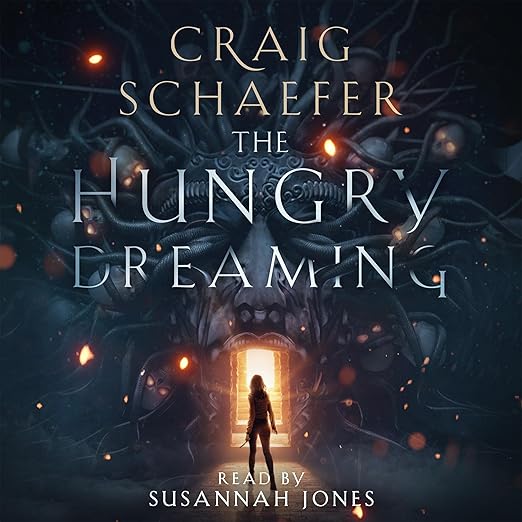
Quick Take
- Narration: Susannah Jones gives a sharp, propulsive performance that suits the thriller pacing, handling the genre-blending material with consistency and energy.
- Themes: Historical conspiracy and the control of narrative, transgender identity and belonging, journalism as witness
- Mood: Fast and layered, with the texture of a thriller that keeps adding rooms to itself
- Verdict: A surprisingly ambitious genre blend that earns its complexity, though it demands full attention from page one.
I picked up The Hungry Dreaming on a Wednesday evening with no particular expectations, knowing only that it was the first book in Craig Schaefer’s Midnight Scoop series and that it had been sitting in my library queue for longer than it should have. By midnight I was still listening. By the following evening I had finished it. Schaefer writes with a velocity that makes attentiveness feel effortless, which is a trick that sounds simple and is not.
The premise announces its ambitions immediately. Nell Bluth, a Brooklyn reporter, is investigating two apparently unconnected stories: the appearance of forged letters between Alexander Hamilton and George Washington describing historical events that never occurred, and a citywide surveillance program in New York built on a groundswell of dirty money and unexplained deaths. Between those two threads, a transgender teenage runaway named Seelie Rose carries a secret that links both, and an assassin who wants that secret eliminated before it can surface. What the synopsis does not quite convey is the third layer beneath these two: a centuries-old society of witches whose war to control the official record of history has been running since the Revolutionary War.
Our Take on The Hungry Dreaming
Schaefer’s signal talent is managing complexity without losing forward momentum. A less confident writer would let the multiple plot threads slow each other down, pausing to explain connections as they emerge. Schaefer trusts his readers, allows the convergences to happen at their own pace, and consistently prioritizes kinetic energy over architectural tidiness. The result is a book that feels genuinely surprising even when its genre elements are familiar. The Culper Ring, the Revolutionary War spy network that provides the book’s historical backbone, is used with specific knowledge rather than decorative gesture, and the way Schaefer connects its legacy to a contemporary surveillance state has real thematic coherence.
Seelie Rose is the book’s most carefully drawn character and the element that is likely to determine how much you invest in the series going forward. She is sixteen, transgender, on the run from a wealthy father who refuses to acknowledge her identity, and in possession of a secret she barely understands. What Schaefer does well here, noted by several reviewers, is that Seelie’s gender identity is part of who she is without being the entirety of what she is. She has her own specific voice, her own way of moving through the world, and the book’s treatment of her dignity is consistent and respectful without being sanctimonious.
Why Listen to The Hungry Dreaming
Susannah Jones’s narration is well-matched to Schaefer’s prose. She handles the ensemble cast clearly, differentiating Nell’s sardonic reporter voice from Tyler’s more guarded quality, from Seelie’s careful wariness, without resorting to exaggerated character voices. The thriller pacing Schaefer maintains requires a narrator who can sustain urgency across a nearly 20-hour runtime, and Jones does. The action sequences, of which there are several, are delivered with the right controlled energy, fast enough to feel dangerous, clear enough to follow spatially.
One reviewer described the book as several stories that slowly start meshing together, which is accurate and captures both the book’s appeal and its potential friction. The first few hours require trust that the threads will connect. They do, but Schaefer takes his time with the reveal of how, which rewards patient listening and frustrates impatient listening in roughly equal measure. At 19 hours and 41 minutes, this is not a book that delivers its pleasures quickly.
What to Watch For in The Hungry Dreaming
The book is part of a larger shared world Schaefer has been building across multiple series. Reviewers familiar with his other work noted glimpses of characters from his Daniel Faust and Revanche Cycle series appearing briefly in the margins. These cameos do not require prior knowledge of those series, but they reward it, and they suggest that The Hungry Dreaming is partly an exercise in expanding a fictional universe as much as it is a standalone thriller. New readers lose nothing essential by starting here.
Schaefer’s prose has been described as mean and fast, which is accurate. His characters do not regularly find easy solutions or comfortable emotional resolutions. The villains in this book are not cartoonish, and the heroes make compromises that cost them. If you come to genre fiction for reassuring narrative safety nets, this is not that. The victories are earned and partial, which is realistic and satisfying in the way that only honest genre fiction can be.
Who Should Listen to The Hungry Dreaming
Readers who enjoy historical conspiracy thrillers with supernatural elements, the kind of book where the Revolutionary War era and modern New York occupy the same moral landscape, will find this deeply satisfying. Those who have wanted to read Craig Schaefer but are not sure where to start can begin here without prior series knowledge. The listener who should probably look elsewhere is one seeking a straightforward linear thriller; the three-genre blend of journalism procedural, historical conspiracy, and urban fantasy requires a tolerance for complexity that not all thriller readers share.
Frequently Asked Questions
Do you need to have read other Craig Schaefer series before starting The Hungry Dreaming?
No. The Hungry Dreaming is designed as a series opener in its own right, and all necessary context is provided within the book. Readers familiar with Schaefer’s Daniel Faust series may spot crossover characters, but those appearances are brief and the main narrative works fully without that background.
How does The Hungry Dreaming handle its transgender character Seelie Rose?
With consistent care. Seelie’s gender identity is part of who she is rather than her entire characterization, and the book treats her dignity as a baseline assumption rather than a debate. Several reviewers noted that this treatment felt natural and integrated rather than handled with the self-consciousness that can undermine such characters in less confident fiction.
The synopsis mentions witchcraft alongside journalism and historical conspiracy. How does the supernatural element integrate with the thriller material?
Gradually and credibly. Schaefer introduces the supernatural as the third layer of a multi-layer plot, and by the time the witchcraft is made explicit, the thriller and historical conspiracy elements are established enough that it feels like revelation rather than left turn. The integration is one of the book’s structural achievements.
At nearly 20 hours, does The Hungry Dreaming justify its runtime or does it feel padded?
The length reflects genuine story complexity rather than padding. Schaefer is running three plot threads simultaneously and the convergence of all three requires time to develop properly. Listeners willing to commit to the full runtime will find the pacing appropriate; those who prefer tighter, shorter thrillers may find the middle sections test their patience.