At a Glance
- Performance: Andrea Parsneau is a LitRPG specialist who brings Popper's voice to life with comic precision, the ensemble cast separations are handled cleanly across the epistolary structure.
- What it covers: Tower defense survival, found family under pressure, VR as lived reality
- Feel: Chaotic fun with emotional heft underneath
- Our call: Dinniman fans will find everything they loved in book one expanded and complicated, the structural shift to multiple perspectives is a genuine improvement, not a detour.
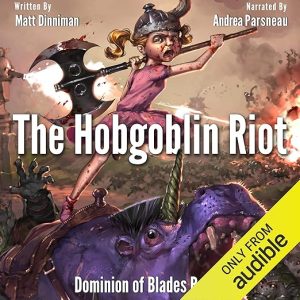
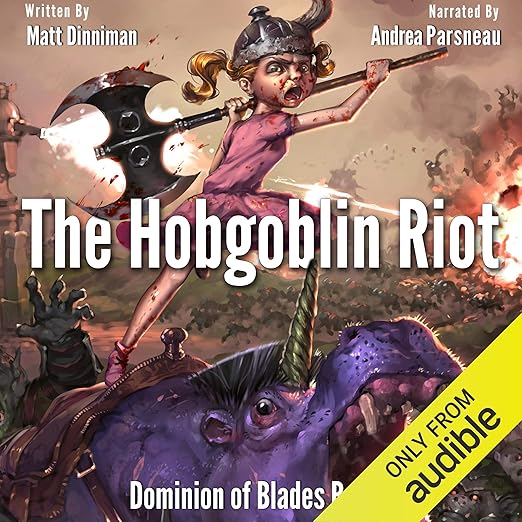
I listened to The Hobgoblin Riot on a week when everything around me felt slightly out of control, and it turned out to be the right book for that mood. Matt Dinniman writes chaos with a specific kind of authority, the chaos is always legible, always has internal logic, always has consequences that matter, and underneath it there is genuine care for the people living inside it. Book two of the Dominion of Blades series expands the narrative technique from book one in ways that could have been distracting and instead turn out to be the smartest structural choice Dinniman has made.
The premise of book two should not work as well as it does. Popper's supposedly simple scouting mission into Castellane's Spiral, a tower-defense run protecting the hobgoblin capital from invaders, goes immediately wrong in the way that all supposedly simple missions in this genre do. That is not a surprise. What is a surprise is the way Dinniman handles the fallout: the team splits up, and the book becomes a collection of recovered notes, historical documents, and chapter-length first-person accounts from different members of the group. An epistolary structure applied to a LitRPG tower defense novel, and it should not be as emotionally involving as it is.
The key observation from one reviewer is worth dwelling on: the book is told through recovered documents and notes rather than a single narrator's perspective. This means Dinniman can introduce information from outside the game, real-world context that illuminates what is happening inside the VR environment, without breaking the fourth wall of the primary narrative. He uses it carefully, dropping out-of-game events into the epistolary structure in ways that deepen the stakes without undercutting the immersion.
The NPCs are worth discussing specifically. One reviewer noted that we really care about the NPCs, fully featured and not simply throwaways. That is Dinniman's signature and it is what separates his LitRPG from the genre baseline. In the Dominion of Blades universe, non-player characters have inner lives that the protagonists have to reckon with, which means moral stakes beyond just surviving the dungeon run. The hobgoblin defense sequence is not just a puzzle to solve. It has people in it.
What Makes The Hobgoblin Riot Worth Hearing
Andrea Parsneau is one of the most reliable narrators in the LitRPG genre, and her work on the Dominion of Blades series is among her better performances. She has Popper's voice locked in from book one, and the epistolary structure of book two gives her additional texture to work with, each recovered document is from a different character, which means she is essentially performing a full-cast audiobook within a single-narrator format. She handles the transitions cleanly without overdoing the character distinctions.
At eighteen hours and twenty-four minutes, this is a substantial listen, but reviewers consistently describe the pace as fast despite the page count. Even though it is a massive book at 587 pages, it all goes by pretty quickly, a sign of an engaging story, as one reviewer noted. That matches the listening experience. Dinniman's plotting does not allow for much settling.
Things to Know Before Starting The Hobgoblin Riot
This is not a good entry point for the Dominion of Blades series. Book two is built on the character relationships, world-building, and backstory established in book one, and several of its emotional beats land only if you already care about Popper, Alice, Jonah, and Gretchen. Starting here would be like watching the second season of a character-driven show, technically possible, but working against yourself.
The tower defense mechanics are a genuine part of the narrative, not just background flavor. One reviewer who loved the book specifically invoked Bloons TD and Orcs Must Die as reference points, calling this a LitRPG adaptation of a tower defense game. If that framing sounds interesting, you are the right reader. If you want your LitRPG to be primarily character-drama with occasional dungeon encounters, the tower defense focus may feel gamey in ways that push against your preferences.
Who It's For
Readers of Dominion of Blades book one who want to continue, this is the obvious and best answer. LitRPG fans interested in how the genre can accommodate epistolary structure and multi-perspective storytelling without losing its mechanics. Andrea Parsneau listeners who want a long, well-paced performance. Dungeon Crawler Carl fans who want something with similar emotional investment in non-heroic characters but with more explicit tower-defense gaming mechanics.