Quick Take
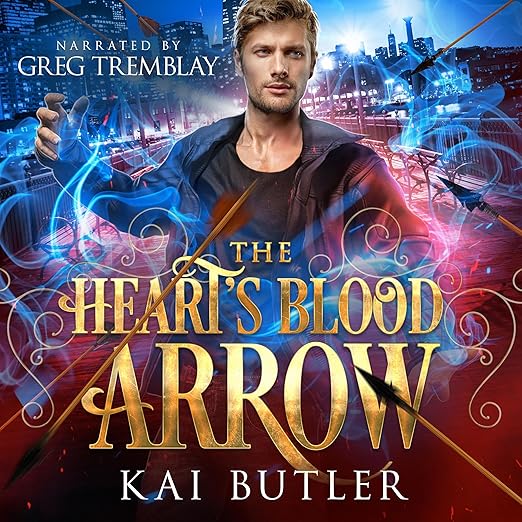
- Narration: Greg Tremblay brings Parker Ferro’s first-person voice to life with confident energy, keeping the pacing sharp across a dense, multi-threaded plot.
- Themes: Urban paranormal politics, MM romance under pressure, found family tested by outside threats
- Mood: Fast and kinetic, with enough warmth between the leads to keep the tension from overwhelming
- Verdict: Readers already invested in the San Amaro Investigations series will find this fifth installment rewards the long haul, but newcomers should absolutely start at book one.
I came to The Heart’s Blood Arrow mid-series, which is exactly what Kai Butler warns against. The book’s own description states plainly that it cannot be listened to as a stand-alone, and after sitting with it for a weekend, I started it Saturday morning while making coffee and finished it late Sunday night, I understand why. This is a story built on accumulated weight. Parker Ferro’s history with Nick, the Bureau of Paranormal Threats, the fae, the demons, the ongoing consequences of earlier choices: none of it is re-explained for newcomers. Butler trusts that you’ve been there from the beginning, and that trust shapes everything about how the narrative moves.
For those who have followed the San Amaro Investigations series since book one, that accumulation is precisely the point. The Heart’s Blood Arrow picks up immediately after A Shattered Silver Crown, and the emotional continuity is seamless. The threat that opens the story, Parker’s mother’s killer breaking out of prison, is personal in a way that only five books of backstory can make it. It doesn’t feel manufactured. It feels earned.
A City That Keeps Adding Complications
What distinguishes Butler’s world-building across this series is how New San Amaro operates as a living system rather than a painted backdrop. Parker’s problems in The Heart’s Blood Arrow aren’t isolated: succubae going missing, an old god operating in the open, the Bureau watching his every move, and Nick’s mother in town at the worst possible moment. These threads don’t feel like a checklist of conflicts. They feel like the actual texture of living in a city where paranormal threats are real and politically inconvenient.
Several reviewers point to the worldbuilding as a standout, one calls it “phenomenal and intricate”, and that’s an accurate reading. Butler has constructed something that rewards sustained attention. At 130,000 words, The Heart’s Blood Arrow is a substantial listen at thirteen hours and sixteen minutes, and there are stretches where the density of ongoing storylines requires you to stay focused. But the payoff is a story that feels genuinely consequential. When Parker finds himself in the crosshairs of federal agents while simultaneously tracking his mother’s killer, the stakes aren’t abstract. They’re personal and institutional at the same time.
Where the Relationship Work Earns Its Keep
The marriage proposal thread running through this book is one of the more interesting structural choices Butler makes here. It’s not resolved quickly, and it’s not treated as a subplot you can set aside. Parker can’t quite figure out how to answer, and that uncertainty is drawn with more psychological honesty than the genre often allows. The romance elements, the spicy moments, the family friction with Nick’s mother, the quieter scenes between the two leads, don’t feel like they’ve been inserted to satisfy a checklist. They’re woven into the same fabric as the paranormal investigation.
One reviewer noted that their only complaint was wanting more intimate scenes between Parker and Nick, which tells you something about how well Butler has built the relationship over five books. When readers are hungry for more time with a couple, it usually means the author has done the harder work of making you care about them as people first. That care is evident here. Even with the federal investigation closing in and an old god on the loose, the moments between Parker and Nick feel grounded.
Greg Tremblay and the First-Person Challenge
First-person narration is a particular challenge in the MM urban fantasy space, and Greg Tremblay is one of the narrators best suited to it. His performance here is controlled without being flat, bringing Parker’s dry humor and genuine anxiety into balance. One extended reader review covering all seven San Amaro books notes that the series overcame their strong resistance to first-person storytelling, which is meaningful praise for both Butler’s writing and Tremblay’s execution. The voice feels inhabited rather than performed. Tremblay handles the action sequences with appropriate intensity and the quieter character moments without letting them slow the momentum.
At this point in the series, Tremblay has inhabited Parker long enough that the relationship between narrator and character reads as genuine. There’s no audible gap between performance and text. For listeners already familiar with the series, that consistency is part of what makes returning to San Amaro feel like coming home.
Who Will Get the Most from This One
If you’re already four books deep into San Amaro Investigations, The Heart’s Blood Arrow is the installment you’ve been building toward. The threads from A Shattered Silver Crown are resolved and complicated in equal measure, the relationship between Parker and Nick takes meaningful steps forward, and the series mythology expands in directions that set up the next several books. If you’re new to the series, this is not where you start. Go back to book one and let the world accumulate properly around you. That investment pays off in exactly the kind of chapter this fifth book represents: busy, layered, emotionally honest, and impossible to put down once you’re in.
Frequently Asked Questions
Can I start the San Amaro Investigations series with The Heart’s Blood Arrow?
No. The book itself states it cannot be listened to as a stand-alone, and that warning is accurate. The emotional stakes, character relationships, and ongoing paranormal politics only carry weight if you’ve followed the series from book one.
Does the marriage proposal subplot get resolved in this book?
It’s addressed and develops significantly, but the series maintains an ongoing storyline structure with an HFN rather than HEA ending, so not every thread is tied off cleanly. Resolution accumulates across volumes.
How does Greg Tremblay handle the multiple plotlines running simultaneously?
Tremblay’s strength is keeping Parker’s voice consistent across tonal shifts. He doesn’t over-dramatize the transitions between action sequences and quieter emotional moments, which helps the dense multi-thread structure feel manageable rather than chaotic.
Is The Heart’s Blood Arrow appropriate for readers who don’t usually like first-person urban fantasy?
At least one extended review notes that the series converted a reader with a strong aversion to first-person narration. Butler’s writing and Tremblay’s performance together make the POV feel natural rather than limiting, but it remains first-person throughout.