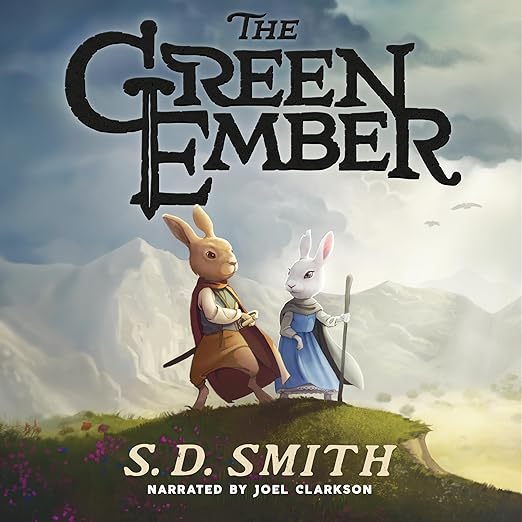
Only one voice on this page mentions the recording at all, and it gets there sideways. A family that read the book with their homeschool group ended up buying all of the audiobooks from the Story Warren store and converting them into Yoto cards, and reports that those cards are now the only thing their oldest, aged six, wants to listen to. That is a note about how a household uses audio, not about how Joel Clarkson reads it, but on a listing where the description runs to five short sentences and two questions, it is the most concrete piece of information anyone has volunteered about this seven hour and fifty-five minute edition.
More Hobbit Than Watership Down
Heather and Picket are rabbits with ordinary lives until, in the description's phrasing, calamitous events spill them into a cauldron of misadventures. From there the copy abandons plot entirely and switches to cadence: kings fall and kingdoms totter, tyrants ascend and terrors threaten, betrayal beckons and loyalty is a broken road with peril around every bend. It closes on two questions where a summary should be. Where will Heather and Picket land, and how will they make their stand. S. D. Smith is clearly writing in an older register on purpose, and the marketing copy has decided to match it, which leaves a buyer with atmosphere and almost no specifics.
Five people have filled that gap in very different directions, and the most useful of them belongs to the joint account of Greg and Sara Masarik. Their entry places the book precisely: a hero story, more Hobbit than Watership Down, more Narnia than Beatrix Potter. The same response reports being reminded, powerfully, of Edith Nesbit, C. S. Lewis, and George MacDonald while reading something completely different, and admits to prior skepticism about talking animals. If you want one sentence to decide by, that is the sentence, and it is doing work the publisher's copy never attempts. The distinction matters more than it looks: Watership Down and Beatrix Potter sit at opposite ends of what a talking-rabbit book can be, and this entry is telling you the answer lies with swords and kingdoms rather than with burrows and gardens.
Clarkson Alone, No Cast, No Abridgement
Joel Clarkson holds the narration credit alone, and no line anywhere indicates a second reader, a full cast, or an abridgement. Story Warren Books issued this edition in February 2015 and has kept it in catalog since. Seven hours and fifty-five minutes for a first volume aimed at fourth grade and up is a substantial but not punishing commitment, roughly a week of bedtimes or two long trips. A solo credit on this particular book means one voice carrying rabbits, tyrants, and the hawks that turn up later, which is the traditional shape for a family read-aloud and matches what the entry titled Wonderful read-aloud for the whole family describes.
Debbie, writing in May 2015, supplies the age floor the description omits: fourth grade and up should manage it easily. That entry also records something the listing does not, namely that the book was picked up free from the children's section on Kindle in February 2015 and liked well enough to prompt a wish for a hardback. It is a print and ebook account attached to an audio page, so take its enthusiasm as a judgment of the writing and nothing more.
Viha, in September 2021, gives the one piece of pacing intelligence available: starts slow but ends well, and sets up the next book. On a nearly eight-hour recording, a slow start is a real consideration, because a listener cannot skim the way a reader can. Budget the first hour or so as setup and expect the momentum to arrive later, particularly if you are trying to hold a young listener's attention on a first outing with the series. The same entry, posted from India, is one of two here written outside the United States, and the only one here framing this volume as a lead-in to the next.
Same Week, Opposite Conclusions About Violence
Chris Mitchell, writing from Mexico in August 2025, gave this book one star and a title reading Disgusting. The complaint comes with specifics attached: the series is described as very gory, with evil hawks carrying sickles killing rabbits, animal characters who walk upright and talk and therefore read as human, and an uncle who stabs his niece. The entry says the reading aloud stopped partway and ends with a direct plea to other parents. Whatever you make of the conclusion, the details are checkable and the response is the only one on the page that gives you a content warning.
Six days after that entry appeared, the homeschool family posted the opposite verdict: rabbits with swords, character development, and just enough action and conflict to keep the plot moving without being too much for younger readers or listeners. Two households, the same week, reading the same violence and reaching opposite conclusions about who can handle it. The page presents both at equal weight and offers no editorial guidance between them.
Age guidance is therefore something you have to assemble yourself out of scattered claims: fourth grade and up from one entry, a six-year-old listening happily from another, and a flat refusal from a third. The description helps not at all, since it never names an audience. The safest reading of the column is that this is a story of exile, war, and usurpation dressed in animal form, and that families vary enormously in how they respond to that once the hawks arrive. A child who has already met battlefield deaths in other series will not blink; a child meeting them for the first time might.
Betrayal Beckoning Is Not Just Decoration
Households that have already worked through the obvious classics, and want something in the same key that is not one of them, will find this lands well. The appeal is a long-form adventure with an old-fashioned moral spine. The comparisons volunteered by reviewers point at exactly the right shelf, and a first volume of eight hours gives a family plenty of runway before committing to the series. Listeners who enjoy a slow build and a payoff at the end will find the structure suits them.
The one-star entry deserves a straight answer. This is a book in which animals fight, kill, and betray one another, and the description's own line about betrayal beckoning is not decoration. That entry is worth reading in full before anyone presses play expecting a gentle talking-animal story.
Is the audiobook of The Green Ember too violent for young listeners?
The page disagrees with itself. One entry calls the series very gory, citing hawks with sickles and an uncle who stabs his niece, and stopped reading it aloud. Another, posted six days later, calls the action just enough for younger readers and listeners. Both are describing the same book, so preview it yourself.
Does The Green Ember audiobook end its story or open a series?
It leads on. The record files it as the first title in The Green Ember Series, and one reviewer describes it as a setup for the next volume, saying it starts slow but ends well. The description closes on two open questions about where the rabbits land, which is not the phrasing of a self-contained tale.