Quick Take
- Narration: Saskia Maarleveld brings a clean, emotionally grounded performance to the dual perspectives of Princess Aerity and hunter Paxton, she handles the romantic tension without tipping into melodrama.
- Themes: Duty versus desire, the mysteriousness that both attracts and warns, a kingdom’s survival as personal sacrifice
- Mood: Atmospheric and romantic, with genuine moments of dread around the beast hunt
- Verdict: A Brothers Grimm retelling that invests more in its central romance than its monster, which works if your expectations are calibrated accordingly.
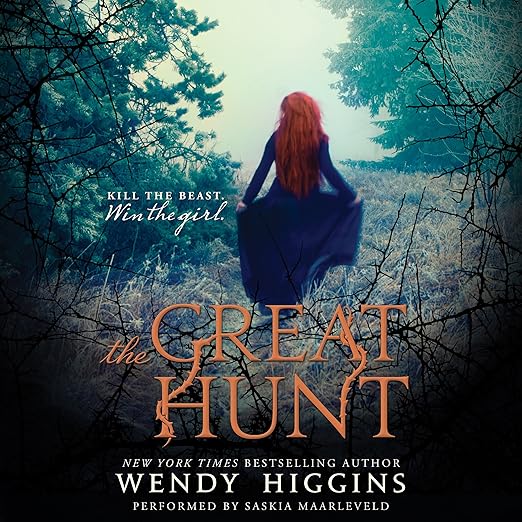
There is a particular pleasure in listening to a fairy tale retelling on a dark afternoon when the weather is doing something ominous outside. I came to Wendy Higgins’s The Great Hunt on exactly one of those afternoons, and the atmospheric opening, a kingdom terrorized by a creature many had assumed mythical, bodies piling up before anyone takes the threat seriously, did exactly what it needed to do. Higgins, known for her Sweet Evil series, is working in a reimagined Brothers Grimm register here, which means the beast is more symbol than creature and the real story is about who gets to decide a princess’s fate.
The setup is efficient and morally clear-eyed: King Charles decrees that whoever kills the beast terrorizing Eurona will win Princess Aerity’s hand. Aerity recognizes the transaction for what it is. She was meant to marry for love, and the proclamation removes that possibility entirely. But then Paxton Seabolt walks in. Brooding, not interested in royalty, carrying secrets he would prefer stayed buried, he is a type the genre knows well, and Higgins is self-aware enough to use that familiarity rather than fight it.
Our Take on The Great Hunt
Saskia Maarleveld’s narration is a genuine asset here. She has a range that serves the shifting perspectives well, Aerity’s internal conflict between acceptance and resistance lands differently than Paxton’s more guarded interiority, and Maarleveld distinguishes between them without exaggeration. Reviewer Kaitlyn Abshire noted that the book wastes no time, which is accurate: the pacing in the first half is brisk, the world of Eurona is sketched with enough specificity to feel real without demanding extensive exposition, and the multiple viewpoints, which reviewer Jacqueline found slightly excessive, serve the story’s interest in showing how the same events look different from inside the castle and outside it.
Why Listen to The Great Hunt
This is a romantasy that earns its romance through tension rather than heat. The chemistry between Aerity and Paxton is built on withholding rather than on proximity, what he is hiding matters more than what he says, and Aerity’s refusal to be simply decorative gives her real agency within a story that has structurally stripped most of it away. Reviewer Jacqueline put it well: if you can connect to the characters, the rest follows. Higgins makes that connection easy, which is not as simple a craft achievement as it sounds.
What to Watch For in The Great Hunt
The beast itself is more atmospheric threat than fully realized creature, which is a deliberate choice in the fairy tale tradition, the monster is what forces the human drama into focus, not the point in itself. Listeners expecting an intricate monster-hunting plot with extensive creature mythology will want to adjust expectations. The book’s real investment is in Aerity’s interior life and in the slow erosion of Paxton’s certainty that he does not care about any of this. The multiple viewpoints and large cast of named characters in the first half require some attention, but the story rewards that patience.
The romantic tension between Aerity and Paxton is the book’s real engine, and Higgins earns it by making both characters hold back for genuine reasons rather than manufactured misunderstanding. Aerity cannot afford to trust someone who might simply be after the prize. Paxton cannot afford to want something he has spent his life refusing to want. These are real barriers, not arbitrary ones, and the story respects both characters enough not to dissolve them cheaply. Reviewer Kaitlyn Abshire noted that the narrative opens with immediate death, a beast killing Lady Wyneth’s betrothed before the first chapter ends, and that violence gives the romance a shadow it would not otherwise have. You understand, listening, that the world these two are standing in is genuinely dangerous, which makes the question of who to trust genuinely matter.
Who Should Listen to The Great Hunt
Readers who enjoy YA romantasy with a fairy tale framework and genuine romantic tension will find this one satisfying. The nine-hour runtime keeps things from dragging, and Maarleveld’s narration makes the dual perspective format work. Listeners who need their monster to be the primary driver of the plot, or who prefer romantasy with more explicit heat, may find the pacing and restraint slightly frustrating. This is the first book of the Eurona Duology, so be prepared for the story to continue in The Great Fall.
Frequently Asked Questions
Is The Great Hunt connected to Robert Jordan’s Wheel of Time series of the same name?
No. Despite sharing a title, this is an entirely separate book by Wendy Higgins, the first installment in the Eurona Duology. It is a standalone Brothers Grimm fairy tale retelling with no connection to Robert Jordan’s work.
How does Saskia Maarleveld handle the multiple viewpoint structure in the audio format?
Maarleveld distinguishes between the perspectives effectively, Aerity’s more formal interiority versus the rougher, more guarded register of the hunters, without relying on exaggerated character voices. The transitions are clean.
Is this appropriate for younger YA listeners, or does it skew older?
The content is appropriate for older YA readers, there is violence related to the beast attacks and romantic tension, but nothing explicit. The emotional complexity of Aerity’s situation (being bargained away as a prize) is handled with enough seriousness that younger readers will benefit from some emotional maturity.
Does The Great Hunt end on a cliffhanger, or does it resolve the main conflict?
As book one of a duology, it resolves the immediate beast hunt while leaving the larger narrative open. Listeners who prefer standalone audiobooks should note that the story continues in The Great Fall.