Quick Take
- Narration: A. C. Fellner delivers a technically precise performance that suits the density of Friedman and Schwartz’s economic analysis.
- Themes: Monetary policy and the Great Depression, the Federal Reserve’s failures in crisis management, the origins of monetarism
- Mood: Dense and analytical, this is primary economic scholarship, not popular history, and it reads accordingly
- Verdict: Friedman and Schwartz’s foundational argument about the Fed’s role in deepening the Depression remains essential reading for anyone serious about economic history, though listeners should know they are signing up for the scholarly original rather than a popular adaptation.
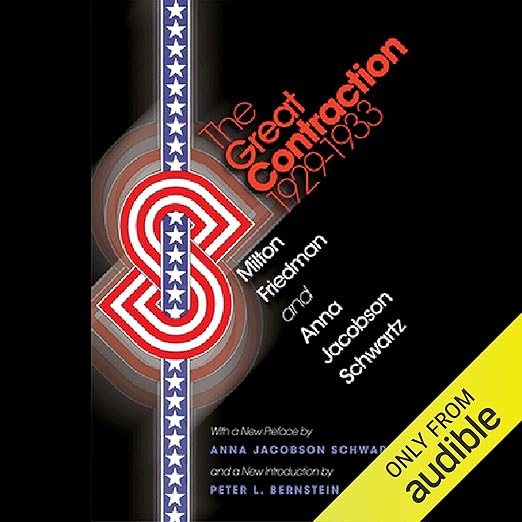
I listened to The Great Contraction, 1929-1933 during a period when I had been thinking about central banking and financial crises, partly because the news cycle had been full of Federal Reserve decisions and partly because I had been rereading Bagehot. The Friedman-Schwartz argument about the Depression felt like the essential context for understanding what it means for a central bank to either act or fail to act during a systemic crisis. I came to it having read some of the surrounding literature but without having read the original text, and it is more demanding in audio form than I anticipated.
A few points of context: this is a chapter extracted from Friedman and Schwartz’s 1963 masterwork, A Monetary History of the United States, 1867-1960, and published separately since 1965. It is primary economic scholarship, not a popular account of the Depression for general readers. One listener describes the experience candidly: this was great reading even though I did not understand a lot of it. That honesty is useful. The argument is genuinely important, but the vocabulary and the analytical framework assume familiarity with monetary economics that the casual listener may not bring to the text.
Our Take on The Great Contraction, 1929-1933
The core argument is now so influential that it has been absorbed into mainstream economic thinking to the point where it can feel obvious, which is a measure of how thoroughly Friedman and Schwartz won the argument rather than a sign that the argument was simple. The Federal Reserve, they contend, failed to exercise its role as lender of last resort during the banking panics of the early 1930s, and actively contracted the money supply at a moment when expansion was required. This failure transformed a significant recession into a catastrophic depression.
The immediate historical implication, that the Depression was not inevitable, that policy choices made it as severe as it was, remained controversial for decades. The edition available here includes new framing material: a preface by Anna Jacobson Schwartz, an introduction by economist Peter Bernstein, and the famous remarks Ben Bernanke made on the occasion of Milton Friedman’s 90th birthday, in which Bernanke effectively acknowledged on behalf of the Federal Reserve that Friedman and Schwartz were right. That acknowledgment, delivered years before Bernanke would face his own financial crisis, carries its own historical weight.
Why Listen to The Great Contraction, 1929-1933
A. C. Fellner’s narration is technically precise, which is exactly what this material requires. There are no passages in this text that call for emotional register or theatrical variation, the prose is analytical and data-dense, and Fellner reads it with consistent clarity. Listeners who have struggled with economic audiobooks where narrators seemed unfamiliar with the technical vocabulary will appreciate that Fellner handles the monetary economics terminology without stumbles.
The supplementary material, Schwartz’s preface, Bernstein’s introduction, and the Bernanke remarks, is well-integrated into the audio and provides useful orientation. Bernanke’s comments in particular offer a rare moment of institutional self-reckoning that makes the dry historical analysis feel suddenly contemporary. Any listener who has watched a central bank navigate a financial crisis in the decades since the Depression will hear those remarks differently than they did in 2002, when they were delivered.
What to Watch For in The Great Contraction, 1929-1933
The review that describes needing to stop frequently to look up definitions is a reliable guide to what this audiobook demands. Monetary contraction, open market operations, banking panics, reserve requirements, these terms appear with frequency and Friedman and Schwartz do not define them. If you encounter this text without prior exposure to monetary economics, you will either need to pause often or accept that you are getting the shape of the argument without its full texture.
The analytical density also means this is not suitable for distracted listening. One reviewer found they needed to read the full Monetary History to properly contextualize this chapter, which is fair, this is an extracted chapter from a much larger work, and some of its references assume you have the surrounding material in mind. The Bernstein introduction helps, but it cannot substitute for the broader work.
Who Should Listen to The Great Contraction, 1929-1933
Listeners with some background in economics or economic history who want to engage directly with one of the most influential arguments in 20th century economics will find this audiobook valuable. If you’ve read popular histories of the Depression, or Adam Tooze’s Crashed for the later crisis, and want to go back to the primary source that shaped how policymakers understand financial crises, this is it. Students of monetary policy, financial history, or Fed policy decisions in particular owe themselves a direct encounter with the Friedman-Schwartz argument.
Skip it if you want a narrative account of the Depression, accessible popular economic history, or an audiobook that meets you where you are rather than assuming prior expertise. For that kind of experience, better entry points exist. This audiobook is for listeners who already know why the argument matters and want to hear it directly from the economists who made it.
Frequently Asked Questions
Is this the full Monetary History of the United States or just a chapter?
Just a chapter, the one titled The Great Contraction, 1929-1933, extracted from Friedman and Schwartz’s larger 1963 work and published as a standalone since 1965. It covers the Depression years specifically. The full Monetary History spans 1867-1960.
Do I need a background in economics to follow the argument?
Some background helps considerably. The text uses monetary economics vocabulary without defining terms, and a listener unfamiliar with concepts like open market operations, reserve requirements, and banking panics will need to pause frequently or accept some analytical opacity. The Bernstein introduction provides useful framing.
What does the Bernanke material add to this edition of the audiobook?
Bernanke’s birthday remarks for Friedman, included in this edition, effectively constitute a formal Federal Reserve acknowledgment that Friedman and Schwartz were right about the Fed’s failures during the Depression. They give the historical argument a contemporary institutional endorsement that carries weight, and a certain irony, given what Bernanke would face as Fed chair six years later.
How does this audiobook relate to understanding the 2008 financial crisis?
Directly. The Friedman-Schwartz argument about lender of last resort failures shaped how Bernanke and the Federal Reserve responded to the 2008 crisis, aggressively expanding the money supply and intervening in banking panics rather than contracting. Understanding this text is useful context for understanding why the Fed acted as it did in 2008.