Quick Take
- Narration: Natalie Naudus is ideally suited to this material, bringing warmth and distinct vocal textures to a cast heavy on emotional complexity and queer romance.
- Themes: Queer identity and belonging, political power and sacrifice, the cost of chosen destiny
- Mood: Epic and emotionally urgent, with a demanding midsection
- Verdict: A worthy third installment for series devotees, though the midpoint pacing will test listeners who have not yet earned their investment in Nox and Amaris.
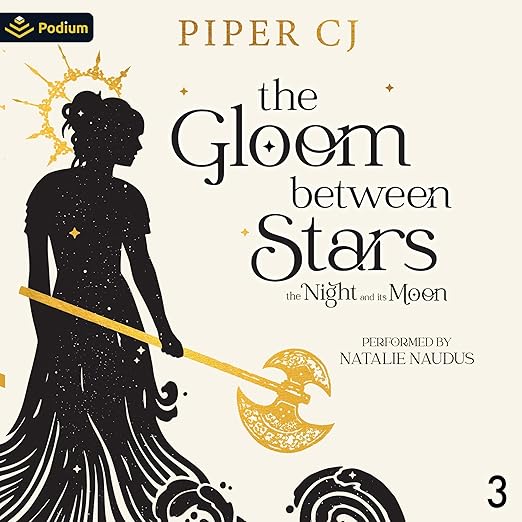
I set aside a Friday evening specifically to finish the Night and Its Moon series, holding off on The Gloom Between Stars until the fourth book was available. One reviewer described the exact same strategy and the exact same reason: waiting for the conclusion of something this emotionally invested would have been genuinely difficult. Natalie Naudus was already in my head from the previous installments, and there is something specific about returning to a narrator’s voice after a break, the way it immediately drops you back into a world you had been keeping in holding.
Piper CJ writes with an investment in her characters that is unusual even within romantasy, a genre where emotional stakes are generally high. What distinguishes the Night and Its Moon series from its neighbors on the shelf is the specificity of its queer representation. A reviewer named Christina R. noted that she had never seen such varied and thoughtful representation of bisexuality in fantasy fiction, and having listened through the series I find that observation accurate. The representation is not decorative. It is woven into how the characters understand power, loyalty, and what they owe each other, which makes it feel integral to the story rather than an add-on.
What Reunions Cost in Raascot
The central emotional engine of The Gloom Between Stars is the reunion of Nox and Amaris, which the synopsis describes as coming at an unspeakable cost. What the book does with this is structurally smart: it refuses to let the romance be a straightforward resolution. New titles, new political obligations, and the looming war between humans, fae, and monsters keep forcing the two protagonists apart even when they are physically in the same room. The curse on Raascot’s fae provides the plot’s most urgent thread, and it is woven through the political maneuvering well enough that it never feels like a simple obstacle inserted for drama.
The new character Tanith generates genuine reader response, with one listener specifically hoping to see more of her in the next installment. Piper CJ is good at creating antagonists and secondary characters who complicate rather than simply oppose, and Tanith fits that pattern. She enters the story with her own coherent logic rather than functioning as a pure foil, which is the sign of a writer who is thinking about her world more carefully than the genre requires her to.
The Middle Section Problem
I want to be honest about the pacing because the reviews are genuinely split on this and for good reason. The book begins with momentum and ends with it, but the middle section sprawls in ways that will test patience. A reviewer who gave five stars still described feeling like they would never finish it, that the middle slogged on. This is not a minority opinion. It is an accurate description of a book doing a great deal of political world-building during its center stretch, establishing alliances and threat landscapes that pay off later but require real commitment to sit through in the moment.
Listeners who are deeply invested in Nox and Amaris as characters will have enough goodwill to carry them through. Those who are newer to the series or whose attachment is more casual will feel the drag more acutely. This is book three of four and it reads that way: a bridge installment doing necessary work, not the most dynamically paced volume in the series. The honest listener who goes in with that expectation will be less frustrated than one expecting the momentum of book one to sustain throughout.
Natalie Naudus and the Sound of This World
Naudus is excellent in this material. Her ability to differentiate characters in a large cast while maintaining emotional authenticity in the romantic scenes is exactly what the Night and Its Moon series requires, and she delivers it consistently across fifteen hours. The intimate scenes between Nox and Amaris require a narrator who can sustain tenderness without drifting into either clinical distance or over-performance, and Naudus navigates that balance precisely. She also handles the political council scenes and battle-adjacent tension without flattening either into the other’s register, which is a specific skill that ensemble fantasy demands.
Piper CJ includes a listen-along song list for this installment, which some readers use actively while others ignore entirely. The audiobook does not require it, but for listeners who like to set the emotional tone of a reading session with music, it is a thoughtful addition that reflects how seriously the author takes the atmosphere of her own world.
Who This Series Rewards
The Gloom Between Stars is not a standalone entry point. If you have not listened to the first two books in the Night and Its Moon series, start there. The character investment that makes this book land depends entirely on what the previous installments built. For listeners who are already in, this is a rewarding continuation that handles the political complexity of its world with more care than most romantasy manages. The editing issues noted by reviewers across the series persist here, with plot holes that attentive readers will notice, but they do not undo the emotional impact of what Piper CJ is doing with these two women and the world they are trying to protect. The ending is cathartic and genuinely earns what it delivers.
Frequently Asked Questions
Can The Gloom Between Stars be listened to as a standalone, or do I need to start from book one?
You need to start from book one. The Night and Its Moon series is heavily serialized and the emotional payoff of this third installment depends entirely on the relationships and world-building established in the first two books. Jumping in here would be disorienting at best.
Is Natalie Naudus the narrator throughout the Night and Its Moon series?
Yes, Natalie Naudus narrates the series consistently, which helps significantly given how large the cast is. Her ability to maintain distinct voices for Nox, Amaris, and the supporting characters is one of the series’ audio strengths.
The synopsis mentions an unspeakable cost to the reunion. How dark does this book get?
The series has always balanced its romance with genuine political darkness, and book three continues that pattern. There are significant losses and moral compromises, but the tone does not tip into grimdark. The emotional register is more epic and bittersweet than brutal.
Reviewers mention plot holes in the editing. How distracting are they?
Noticeable if you are reading closely, particularly in world-building consistency. Multiple reviewers flagged them across the series while still rating highly. They tend to be more frustrating for analytically oriented readers than for those primarily invested in the characters and romance.