Quick Take
- Narration: R.C. Bray is reliably excellent, making a character-driven ensemble cast feel distinct and grounded across 33 hours of post-contact science fiction.
- Themes: First contact and its aftermath, human resilience across disparate communities, the unknown as both threat and revelation
- Mood: Tense and character-focused with a mystery-driven core
- Verdict: A complete three-book sci-fi arc that earns its length through genuine character investment rather than plot density, more emotionally grounded than its genre premise suggests.
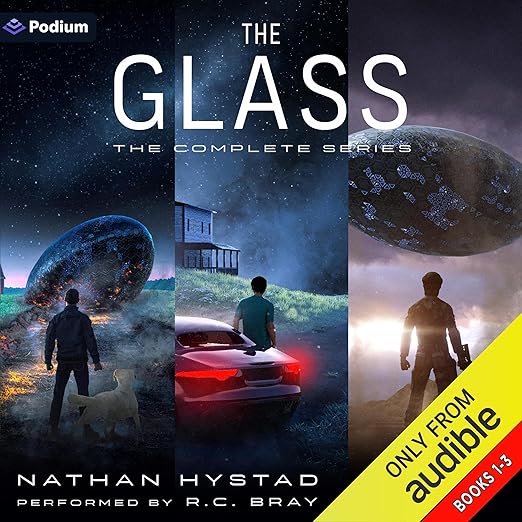
I was skeptical going into The Glass. The premise, invisible barriers appearing at random across Earth while carnivorous aliens materialize on the other side, reads like the setup for a disaster-spectacle novel rather than for the kind of sustained character work that keeps 33 hours engaging. Nathan Hystad proved me wrong. The Glass: The Complete Series collects all three books in the trilogy, The Other Place, The Hidden Space, and The Secret Base, and it builds something considerably more human than its genre premise might suggest.
The opening scenario is immediately visceral: cars crashing into invisible glass barriers, trees sliced in half at random points, and then the realization that whatever produced these barriers is on the other side and is not benign. Hystad uses this premise to scatter a set of characters across different American contexts, from urban environments to small-town situations, and then traces how they find each other and what they make of the threat once they do. R.C. Bray’s narration anchors this ensemble across the full runtime in a way that makes the shifting perspectives feel continuous rather than fragmented across three volumes.
The Ensemble Structure and How Hystad Keeps Five Characters Coherent
The cast of The Glass includes Ransom and his daughter Chrissy, whose unexplained inclinations become a central mystery; Drake, a seasoned detective; Britt, a journalist; and Peggy and Will, two small-town individuals thrust into the danger without warning. What Hystad does well is resist the pressure to make any of these characters primarily functional. They are not assembled to cover different skill sets for plot convenience. They are drawn as people who would be interesting regardless of the alien threat, which is what gives the story its staying power across the full trilogy.
Reviewers describe becoming invested in all the characters rather than primarily in the central leads, which is the best indication that an ensemble has been constructed correctly. One listener notes that Hystad’s character development kept their interest alive throughout all three volumes despite the dystopian and dimensional elements not being genres they typically enjoy. That kind of genre-crossing engagement is what the best character-driven science fiction achieves, and it explains why this series has over 5,000 ratings across its run.
Aliens, Barriers, and What Hystad Chooses Not to Explain Too Early
The alien threat in The Glass is described as carnivorous, aggressive, and definitively not interested in communication. Hystad makes the choice not to over-explain the Glass or the creatures behind it, which is the right call. Science fiction that explains too much too early loses the quality of genuine wonder that makes contact narratives work, and Hystad maintains productive ambiguity about what the Glass is, why it appeared, and what the entities behind it ultimately want across the first two books before the finale provides answers that reviewers describe as satisfying.
The pacing across three books is measured rather than relentless. Hystad structures the trilogy as a genuine arc rather than as three separate crises, which means the investment you make in the early chapters of The Other Place pays dividends in the emotional stakes of The Secret Base. A reviewer who notes the story is engaging and unfolds at a good pace is identifying this structural quality accurately. The series rewards the listener who commits to all three books rather than sampling and stopping after the first.
R.C. Bray’s Contribution and One Honest Editorial Caveat
One persistent reviewer criticism is worth noting: Hystad occasionally reaches for a more elevated vocabulary in ways that do not always serve the prose. One listener describes a tendency to use expensive words that are not quite the right words, choosing them for effect rather than precision. This is a real quality in the writing and it surfaces occasionally across all three books. It is not frequent enough to undermine the experience, but listeners with strong prose sensitivity should know it is present.
R.C. Bray compensates for this in narration by maintaining a consistent authority that makes even the rougher sentences land credibly. His character differentiation across the ensemble is clear without being theatrical, and across 33 hours he does not lose the specific quality of each voice he has established in the opening chapters. Bray is one of the few narrators who can handle a large, geographically dispersed cast in long-form science fiction without the listener losing track of who is speaking.
His work here is, as consistently reported in reviews of his output, the reason to seek the audio version of this series over the print edition. The Glass is good science fiction made better by how it sounds in Bray’s hands. Listeners who have previously enjoyed his narration of the Expeditionary Force series or Dennis E. Taylor’s Bobiverse novels will find the same reliable quality here, applied to a different genre register. The complete series format, at over 33 hours, gives Bray the runtime to develop the ensemble fully in a way that single-volume narration cannot.
Where The Glass Fits Against Other Alien Contact Fiction
Readers who come to this series with strong points of comparison from alien contact fiction will find Hystad occupying a specific register: more character-focused than event-driven, more interested in how ordinary people survive extraordinary circumstances than in the geopolitical implications of first contact. The Glass does not attempt the geopolitical scope of something like Arthur C. Clarke’s Childhood’s End or the military focus of John Scalzi’s Old Man’s War. It is a story about specific people in specific American towns facing something unprecedented, and the specificity is its strength.
That specificity is also its limitation for listeners who want their alien contact fiction to operate at civilizational scale. The Glass stays grounded by design, and that choice will either feel like exactly right or frustratingly small depending on what you want from the genre. Within its chosen scope, it executes with consistency and genuine emotional investment that justifies the 33-hour commitment the complete series requires.
Frequently Asked Questions
Is The Glass Complete Series a good entry point for readers new to Nathan Hystad, or should I start with one of his other series?
This is a self-contained trilogy and works well as an introduction to Hystad. You do not need prior familiarity with his other work to follow The Glass. The complete series format means you get the full narrative arc in one package.
Several reviews mention alien carnivorous creatures. How much horror content is in this sci-fi series?
There is genuine threat and some violent content, but the series skews toward adventure and character drama rather than horror. The alien elements are presented as terrifying but not in a gore-focused way. Think tense survival scenario rather than creature feature.
One reviewer criticized Hystad’s word choices as overreaching. Is this a widespread problem throughout the trilogy?
It surfaces occasionally, not consistently. The reviewer describes it as using elevated vocabulary that is not precisely the right word for the context. Most listeners do not flag it as a significant impediment, and R.C. Bray’s narration delivers the sentences with enough authority that the prose issue is partially mitigated in the audio format.
At 33 hours, does The Glass Complete Series sustain momentum throughout, or are there slower sections?
The pacing is deliberate across all three books, which some listeners will appreciate and others may find slow. Hystad prioritizes character development and mystery accumulation over constant action. Multiple reviewers describe it as hard to put down, but the series rewards patience with the early setup.