Before You Press Play
- Narration: Ron Rifkin's measured, authoritative delivery is legendarily well-matched to this material; he sounds like someone who carries knowledge he did not choose to carry, which is exactly the register Jonas's world demands.
- Themes: Memory versus comfort, the cost of sameness, what communities sacrifice for safety, the responsibility of those who know.
- Mood: Quiet, cumulative, and deeply unsettling in its restraint, a dystopia that reveals itself gradually rather than confronting you directly.
- Verdict: A foundational audiobook that earns its Newbery Medal with formal precision; essential listening for its age group and genuinely rewarding on adult return.
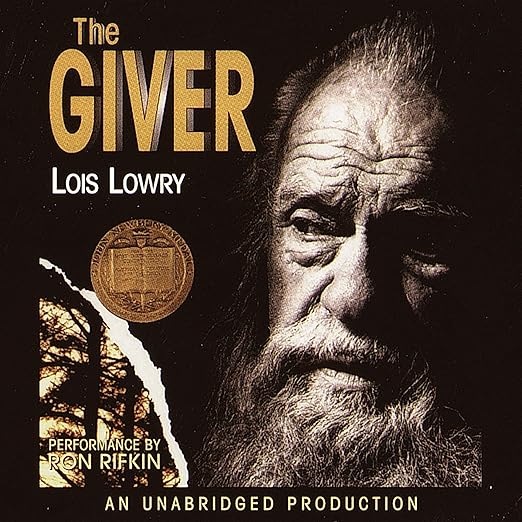
What would you surrender for a life without pain? Lois Lowry's Jonas lives in a community that has already answered that question, surrendered everything, color and music and memory and choice, and considers the bargain settled. That premise has made The Giver an enduring audiobook for readers from middle grade through adulthood since its Newbery Medal in 1994, and Ron Rifkin's narration, measured and authoritative in the exact register the material demands, remains one of the stronger performance pairings in the children's audio canon.
The Giver Established the Form Before Divergent
Lowry's achievement is architectural. She builds Jonas's community from the inside out, showing the reader a world that its inhabitants experience as orderly and safe before revealing the mechanisms of control that produce that safety. The assignment ceremony, where twelve-year-olds receive their life roles, is the pivot. Jonas is named Receiver of Memory, a position of rare honor, and from that appointment the novel's gradual revelation of what the community has erased begins. Color comes back first, then music, then history, and finally the knowledge of what is done to maintain the colorless, contentless peace that everyone else accepts.
The book's restraint is its most powerful formal feature. Lowry does not dramatize the revelations; she lets Jonas receive them at the pace of the Giver's transmission, and the cumulative weight of what is recovered and what is lost lands gradually rather than in a single scene. Readers who want a novel to confront them directly sometimes find The Giver evasive. It is not evasive. It is calibrated, and the calibration is specifically designed for an audience encountering dystopian ideas for the first time. Before The Hunger Games, before Divergent, The Giver established the form.
The ending, which Lowry deliberately leaves open to interpretation across the Giver Quartet, is the most discussed structural element of the book. Listeners who want a definitive resolution can find the quartet's subsequent volumes, Gathering Blue, Messenger, and Son, which provide additional context, though The Giver reads as complete within itself.
Rifkin's Pacing Suits Two Very Different Roles
Ron Rifkin's narration is the audio version that most readers of a certain generation first encountered, and it holds up for good reason. Rifkin brings a quality that is specific and essential: he sounds like someone who carries knowledge he did not choose to carry. The Giver is the character of that description, and Rifkin's timber and pacing suit both the old man who transmits memories and the young boy who receives them. His reading of the memory sequences, the color, the music, the sled on snow, is quiet and specific in exactly the way those passages require. He does not over-emote. The material does not need assistance.
A Spare Novel That Expands on Return
At four hours and forty-seven minutes, The Giver is a short audiobook even by middle-grade standards, and that compression is appropriate. Lowry wrote a spare novel, and Rifkin's reading honors the spare quality rather than padding it with interpretive excess. The book can be listened to in a single sitting, and that single-sitting experience, beginning in the ordered community and ending wherever the reader decides the ending ends, is the version the text anticipates.
Adult re-listeners often find The Giver expands rather than shrinks on return. The elements that seemed ambiguous in childhood reveal their deliberate ambiguity more clearly from adult perspective. Rifkin's narration accommodates that dual experience because he plays the material straight, without winking at the adult listener or simplifying for the child.
Fiona and Asher Exist to Serve the Theme
The book's brevity means that character development beyond Jonas and the Giver is limited. Fiona, Asher, and Jonas's family unit function primarily as illustrations of the community's values rather than as fully developed individuals. Readers who prioritize ensemble character development will find the cast thin by design. The novel's focus is so concentrated on Jonas's expanding perception that the world around him serves the theme more than it serves the characters themselves.
The community's social mechanics, including the family units, the birth rates, the precise age-based ceremonies, are sketched rather than fully world-built. Later dystopian fiction in this tradition often develops its societal infrastructure more exhaustively. Lowry trusts the reader to extrapolate, which is appropriate for the age group but can frustrate adult readers who want the architecture completed.
Listeners who want to understand the quartet structure should know that Gathering Blue, Messenger, and Son take place in different communities with different characters; only Messenger and Son bring Jonas directly back into the story. The connections across the quartet are thematic before they are narrative.
The Template for a Generation's Special One
The core audience is children aged nine through thirteen encountering dystopian fiction and its underlying questions for the first time. The Giver asks what a society gives up when it eliminates suffering, and it asks that question at precisely the scale and complexity level that middle-grade readers can hold. Adults re-listening to a book from childhood will find Rifkin's narration creates a different experience than the childhood reading, not nostalgic exactly, but illuminating in the way that returning to canonical work with more life behind you always is.
For listeners who want to understand the roots of the YA dystopian genre that dominated the 2000s and 2010s, The Giver is foundational. For families who want a shared audiobook that generates genuine conversation about freedom, memory, and what a meaningful life requires, this is one of the few titles that genuinely works for multiple generations at once.
The Giver's influence on subsequent dystopian fiction is real and documentable. The specific mechanics Lowry introduces, the assigned social role, the enforced sameness, the secret repository of suppressed experience held by a designated individual, recur in modified forms across the genre that followed. Jonas's assignment as Receiver of Memory is the template for the special-one trope that drives a generation of YA protagonists. Hearing the original in Ron Rifkin's narration places that influence in perspective: the innovations feel both foundational and precise, not grandiose but workmanlike in the best sense of making something that lasts.
Frequently Asked Questions
How does Ron Rifkin's narration compare to other audiobook versions of The Giver?
Rifkin's narration is the most widely praised version and has been the standard for decades. His quiet, authoritative delivery suits the spare prose and the gradual revelation structure of the novel particularly well. Listeners who have encountered other versions generally return to Rifkin.
Does this audiobook have a clear ending or is it ambiguous?
The ending is deliberately ambiguous. Lowry leaves Jonas's fate open to interpretation, and the quartet's subsequent volumes provide additional context but not a definitive resolution for the ending of The Giver specifically. The ambiguity is intentional and has been the subject of sustained reader discussion since publication.