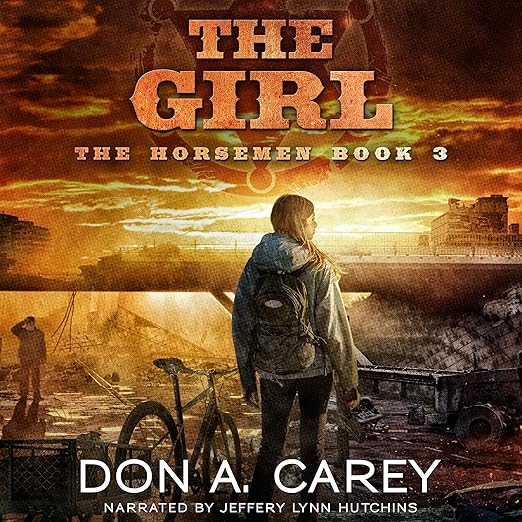
I came across The Girl through the metadata: a post-apocalyptic setting, a protagonist whose name the synopsis withholds, a series called The Horsemen. The cover gives almost nothing away. The synopsis, unusually, leans into the mystery of who this character is rather than explaining her. That choice turns out to be appropriate, because Don A. Carey has built this third installment of his trilogy around exactly that question. Who is The Girl? And what does it cost to get her home?
The world of The Horsemen series is specific in its conception. The collapse here was not a dramatic, high-concept catastrophe. No comet strike, no nuclear exchange, no singular event with a cinematic quality. It was, as Carey describes it, something worse: the failure of political systems to hold, followed by the violence and chaos that filled the vacuum. What emerged looked like the Old West of the 1800s, towns with locally enforced order and open country without it. It is a bleak setting rendered with enough specificity to feel considered rather than convenient.
Where This One Lands
The narrative runs on two tracks. The unnamed girl, stranded on an island for two years after accompanying her friend on a sudden corporate jet trip when the world fell apart, finally gets her chance to head home when travel restrictions loosen. Her trek back through a post-collapse America becomes the structural spine of the book. Goose Truman, former Ranger, former mercenary, a man built for violence and half-dismantled by it, is being urged by his partner Kelly toward a quieter life. His late wife Laura's ghost insists there is one final mission waiting for him.
Those two threads converge in the way post-apocalyptic fiction of this type tends to converge: through violence avoided where possible, unavoidable when not, and at real cost. Reviewers describe the book as 'non stop and riveting from the first page to the last,' with one specifically citing its 'heartfelt conclusion' as marking the emotional register the series has been building toward. Another reviewer notes that there is material suggesting a fourth installment could follow, which means Carey is not sealing everything off entirely.
Why The Girl Works as an Audiobook
Jeffery Lynn Hutchins carries the structural weight of two distinct protagonists reasonably well. The girl's perspective requires a quality of vulnerability and resourcefulness that is different from Goose's worn-out competence, and Hutchins manages the distinction without overcorrecting into caricature. At nine hours and eleven minutes, the runtime allows Carey to develop both threads at genuine pace rather than racing through one to service the other.
The moral seriousness of the premise is what distinguishes The Girl from post-apocalyptic action fiction that treats the collapse as adventure playground rather than catastrophe. Goose's question, whether he can turn away from violence that has defined his entire adult life, is not answered easily or cheaply. The girl's vulnerability in a landscape where travelers are prey is handled without either wallowing in it or minimizing it. Carey is interested in what kind of people survive and what they have to become to do it, which is a more interesting question than most genre entries in this space are asking.
What Gives Us Pause
This is the third book in a trilogy, and the emotional resonance of both the girl's journey and Goose's resolution depends significantly on having followed the previous two entries. Reviewers note that it picks up directly from where book two ended, and several are already anticipating the next installment rather than treating this as a complete conclusion, which suggests that while the major threads resolve, the world remains open.
The review base is thin at this point, with only three reviews available, all strongly positive. That limits the range of critical perspective available. The unanimously high ratings and the small sample size together suggest a readership that is deeply invested in the series rather than a broad cross-section of listeners. New readers approaching this entry without series context should expect to feel the gaps.
Who Should Pick Up The Girl
Readers who have followed The Horsemen series through books one and two and are ready for the resolution of Goose Truman's arc will find this a rewarding conclusion. Post-apocalyptic fiction listeners who prioritize moral complexity and character development over world-building elaboration will also connect with what Carey is doing, though starting with the first book in the series is the right move. Listeners who want their post-collapse fiction lighter in tone and heavier on action spectacle will find this more introspective than expected.
A Few Questions About The Girl
Can The Girl be read as a standalone, or is it necessary to start from book one of The Horsemen series?
The book assumes familiarity with both previous entries. Goose Truman's character, his history with Kelly and with his late wife Laura, and the post-collapse social structures the Rangers have built are all established in books one and two. Starting here without that context will leave significant gaps.
One reviewer mentions the possibility of a fourth book. Does The Girl end on a cliffhanger?
Based on reviewer comments, the major narrative threads of the trilogy appear to resolve, but Carey leaves enough of the world open that a continuation is plausible. The reviewer who senses material for a fourth installment seems to be reading possibilities rather than describing an unresolved ending.