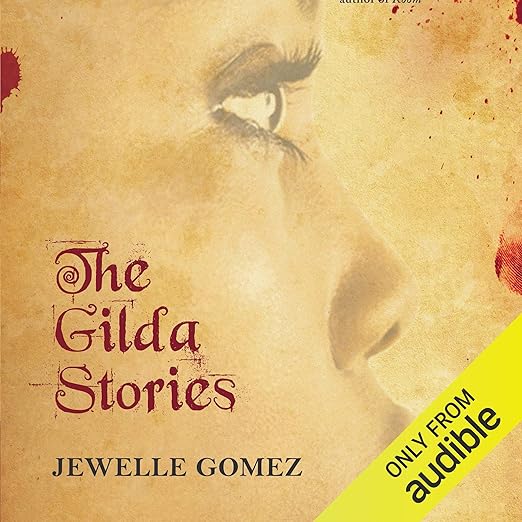
Quick Take
- Narration: Adenrele Ojo delivers a performance of real distinction, warm, grounded, and physically present in a way that matches the novel’s insistence on embodied experience; this is one of the better narrator-material matches in recent LGBTQ+ audiobook publishing.
- Themes: Black lesbian identity across historical time, radical reimagining of the vampire mythology, chosen family and community as survival
- Mood: Sensual and meditative, with an Afrofuturist undertow that gives the novel an unusual temporal depth
- Verdict: A genuine classic of lesbian literature that earns every word of that designation, Jewelle Gomez has built something that is simultaneously a vampire narrative, a historical novel, and a sustained act of Black feminist imagination.
I came to The Gilda Stories knowing its reputation, the novel was a landmark when it was first published in 1991, and it has been cited as an influence by writers working across fantasy, queer literature, and Black speculative fiction ever since. Knowing a book’s canonical status and actually experiencing it are different things, though, and I was not prepared for how immediately the first chapter pulls you in. Gilda is running from slavery in 1850s Louisiana, and within a few pages she has arrived at a brothel where the two women who take her in will initiate her into a centuries-long life. I was listening on a Saturday afternoon and did not move for two hours.
Jewelle Gomez’s novel spans from 1850 to 2050, following Gilda through the American past and into a speculative near-future. The vampire mythology she constructs is specific and deliberate: her vampires do not take; they share. The blood exchange is reciprocal. They give back something of themselves, a dream, a memory, a moment of peace, to every person they feed from. It is a mythology built entirely around care and reciprocity rather than domination and conquest, and that structural choice is the novel’s most profound argument. Gomez is not writing about what vampires are; she is writing about what they could be if you stripped away the genre’s long investment in whiteness, empire, and predation.
Our Take on The Gilda Stories
The historical range here is extraordinary. Gomez moves Gilda through the Civil War era, into the bohemian cultures of early twentieth-century New England, through the mid-century, and eventually into an Afrofuturist 2050 that reads less like science fiction than like a coherent projection of the novel’s values into the future. The choices about what historical moments to include and what to omit are deliberate: one thoughtful reviewer noted disappointment that the civil rights era of the late 1950s and 1960s received relatively little direct attention, given how consequential that period was for Black Americans and for queer communities. That is a legitimate observation about the novel’s structure. But Gomez is less interested in historical inventory than in the experience of living through time with a consciousness shaped by Black lesbian identity, and on those terms the selection is consistent.
The novel’s relationship to community and chosen family is where it does its most emotionally resonant work. Gilda does not accumulate power across two centuries; she accumulates people, relationships, obligations, losses. The community of vampires she moves through and eventually helps construct is specifically structured around mutual care and the rejection of hierarchy, which gives the book a political valence that never feels didactic because it is so thoroughly grounded in character and feeling.
Why Listen to The Gilda Stories
Adenrele Ojo’s narration is the best possible companion for this material. She brings a physical, grounded quality to Gilda’s voice that anchors the novel across its two-century span and prevents the more lyrical passages from floating free of the story’s emotional stakes. The intimacy of Ojo’s performance is particularly important in the scenes involving the blood-sharing ritual, which are erotic in a way that the audiobook format makes more rather than less affecting. Audible Studios produced this edition, and the audio quality reflects that investment.
Emma Donoghue’s description of the novel as depicting lives “communally, unapologetically, roaming fiercely over space and time” is accurate and I would add that Ojo’s narration extends that unapologetic quality into the listen itself. This is a nearly twelve-hour audiobook that moves at its own considered pace and does not apologize for the density of what it is asking.
What to Watch For in The Gilda Stories
The novel’s structure is episodic rather than conventionally plotted, which some readers find liberating and others find frustrating. The narrative does not build toward a traditional climax; it accumulates meaning laterally, through accretion of experience across time. If you read primarily for plot momentum, the novel’s architecture may test your patience in the middle chapters. If you read for prose, for character, for the experience of inhabiting a consciousness unlike your own across a vast stretch of historical time, you will be consistently rewarded.
The Afrofuturist final section, set in 2050, is the most overtly speculative portion of the novel and requires a slight recalibration from readers who have settled into the historical fiction mode of the preceding chapters. Gomez does not fully explain her future world; she drops you into it with the confidence of someone who has been thinking about it for the full duration of the novel. I found this bracing and appropriate, but listeners who prefer more narrative scaffolding around speculative settings should be aware of the shift.
Who Should Listen to The Gilda Stories
This is a book for readers who want vampire fiction that uses the genre as philosophical and political instrument rather than genre entertainment. It is also, and perhaps primarily, a book for readers of Black speculative fiction and lesbian literature who want to understand the lineage of both traditions. Dorothy Allison’s blurb, “Jewelle Gomez sees right into the heart”, is genuinely accurate and captures something the clinical description of the book cannot. If you have read Octavia Butler’s Kindred and wanted something that did similar temporal and historical work through a queer Black lens, this is essential. If you are coming primarily for vampire mythology in the conventional sense, recalibrate expectations: Gomez has remade the mythology entirely.
Frequently Asked Questions
How does Gomez’s vampire mythology differ from conventional vampire fiction, and why does it matter for how you read the novel?
Gomez’s vampires operate on a principle of reciprocity rather than predation, they give back something of themselves in every blood exchange, and the mythology explicitly rejects the domination, whiteness, and empire that characterize most of the genre’s tradition. This structural choice is the novel’s central political argument, not decorative world-building.
Does Adenrele Ojo’s narration suit the erotic and intimate scenes in the novel, which reviewers have described as part of its character?
Ojo handles those scenes with a grounded, physical presence that makes them feel integral to the story rather than interpolated. The intimacy of the narration is one of the production’s genuine strengths, and it serves a novel where embodied experience, touch, blood, sensation, is philosophically central.
The novel spans from 1850 to 2050, does it spend equal time across that range, or is the weight distributed unevenly?
The historical weight is distributed unevenly, and deliberately so. Gomez spends more time in the earlier periods and the Afrofuturist finale than in the mid-twentieth century, which some readers have noted means relatively little direct attention to the civil rights era. The novel is interested in long arcs rather than comprehensive historical coverage.
Jewelle Gomez has announced she is working on a new Gilda volume, does this first book function as a complete narrative on its own?
Yes, entirely. The Gilda Stories is a self-contained novel that brings its protagonist from 1850 to 2050 with a fully realized arc and thematic resolution. The possibility of continuation is exciting, but this book does not end on an unresolved cliffhanger, it closes with a sense of both completion and openness that is characteristic of the novel’s approach throughout.