Quick Take
- Narration: Declan Winters is excellent, handling the genre’s tonal blend of adventure, romance, and dry period humor with genuine control and making Gillian’s first-person voice consistently compelling.
- Themes: Love across the law and outlaw divide, elemental magic in an alternate Gilded Age, identity and professional loyalty
- Mood: Propulsive and atmospheric, steampunk adventure with genuine emotional stakes.
- Verdict: The second entry in C.S. Poe’s Magic and Steam series is stronger and fuller than the first, and Declan Winters’s performance makes the audio format the ideal way to experience it.
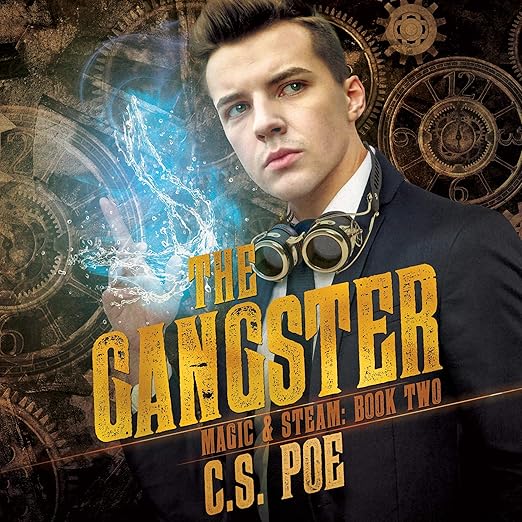
I came to the Magic and Steam series out of curiosity about how the steampunk genre handles queerness, which it has historically done with varying degrees of success. After listening to The Engineer, I moved immediately to The Gangster on a rainy Friday afternoon and did not surface until nearly dinnertime. Seven hours of alternate-history New York in 1881, with magic-infused ammunition and a romantic tension that the series has been building toward since its first pages, turned out to be exactly what that particular Friday needed.
C.S. Poe’s premise is inventive: in this version of the Gilded Age, a Federal Bureau of Magic and Steam regulates the use of elemental magic alongside conventional law enforcement, and Special Agent Gillian Hamilton is one of its more capable operatives. The Gangster picks up shortly after the events of the first book, with Gillian newly returned from Shallow Grave, Arizona, and the reader understanding from the first chapter that the relationship between him and the outlaw Gunner the Deadly is finally going to require some kind of resolution.
Our Take on The Gangster
The mystery at the center of this installment involves a gangster known as Tick Tock who has perfected the use of elemental magic ammunition, a detail that sounds abstract until Poe makes it viscerally clear what such weapons actually do in a crowded city. The investigation forces Gillian and Gunner to navigate New York’s criminal underworld together, which creates the obvious narrative tension: a law enforcement officer working alongside an outlaw, both of them trying not to acknowledge that their professional identities are fundamentally at odds with what they want from each other.
Poe is good at maintaining this tension without letting it calcify into frustration. The romance develops across the investigation rather than being held in suspension until a climactic release, which makes the emotional payoff feel earned rather than formulaic. One reviewer noted a concern about the rules of magic not being sufficiently established, and this is a fair critique: Poe operates on a show-do-not-tell principle that works for the action sequences but occasionally leaves listeners uncertain about what different kinds of magic actually cost their users. This does not significantly impede enjoyment, but it means the world-building requires a degree of tolerance for ambiguity.
The setting deserves credit as a character in its own right. Poe’s 1881 New York, layered with steam-powered infrastructure, mechanical constructs, and the social stratification of the Gilded Age now complicated by the presence of magic practitioners, feels genuinely inhabited. The specific New Year’s Eve opening, with its crowds and social obligations and the particular social performance of law enforcement at a public event, gives the novel an immediate atmosphere that the subsequent investigation maintains.
Why Listen to The Gangster
Declan Winters is the audiobook’s greatest asset. He narrates in Gillian’s first person, and the challenge with this kind of detective-romance voice is sustaining both the procedural competence and the emotional vulnerability simultaneously. Winters manages this with real skill. When Gillian is performing professional authority, the narration sounds like it; when the emotional register shifts, Winters makes the transition feel natural rather than jarring. His handling of dialogue between Gillian and Gunner captures the specific dynamic between two people who are trying very hard not to say what they mean.
The audio format also suits the period atmosphere particularly well. Winters gives the alternate-historical New York an appropriate texture through cadence and pacing, and the action sequences, of which there are several, are staged clearly enough that listeners can follow the spatial logic without visual aids.
What to Watch For in The Gangster
The mechanical man who attempts to murder Gillian early in the novel is the detail that best illustrates what Poe does with the steampunk premise. Rather than using mechanical constructs as set dressing, she makes them active threats with specific capabilities, and the investigation into who built this one and on whose behalf drives the mystery forward with genuine momentum. The climax involves a confrontation that one reviewer described as making her heart race, and Winters handles it with appropriate urgency.
Note that this book ends on a cliffhanger, and reviewers who found themselves invested in Gillian and Gunner uniformly advise having the next installment ready. Poe structures her series to reward continued reading rather than offering full standalone resolution.
Who Should Listen to The Gangster
Readers who enjoy M/M romance with genuine genre scaffolding, whether that is mystery, fantasy, or in this case alternate history, will find this series highly satisfying. Steampunk readers who have found the genre underperforms on character and emotional depth will discover that Poe takes both seriously. Listeners coming in without having experienced the first book should note that while the mystery plot of this entry is self-contained, the romantic and character arcs build directly on events from The Engineer. Starting at the beginning is strongly recommended.
Frequently Asked Questions
Do I need to have listened to The Engineer before starting The Gangster?
Yes, ideally. The Gangster functions as a direct sequel, and the romantic tension between Gillian and Gunner depends on established backstory from the first book. The mystery plot is largely self-contained, but the emotional stakes require the context that The Engineer provides.
How explicit is the romantic content between Gillian and Gunner?
The series leans toward romantic tension and emotional development rather than explicit content. The focus is on the push-and-pull of two people whose professional identities are in conflict with what they want from each other. Readers seeking more explicit M/M romance may find the series restrained by comparison to others in the genre.
How well does C.S. Poe establish the rules of magic in this world for a new listener?
This is an area where some reviewers have flagged uncertainty. Poe uses a show-do-not-tell approach that keeps the narrative moving but can leave listeners occasionally unsure about the specific mechanics and costs of different kinds of magic. Most find they can follow the story without fully resolving these ambiguities, but readers who prefer rigorous magic systems may find the framework underspecified.
Does the book end on a cliffhanger, and how long is the wait for the next entry?
Yes, The Gangster ends on a notable cliffhanger that several reviewers describe as requiring immediate access to the next book. The Magic and Steam series has multiple entries available, so listeners finishing this one will not have to wait long for continuation.