- Narrator: Jonathan Keeble brings the right combination of martial gravity and suppressed urgency to Garro's journey, his voice has been a pillar of Horus Heresy audio productions, and he's well-matched to Swallow's character-driven approach.
- Subjects: Loyalty under betrayal, faith in the midst of heresy, the cost of bearing witness
- Tone: Tense and morally charged, dense with Warhammer 40K lore
- Bottom line: The Horus Heresy's fourth entry shifts the focus from battle to conscience, James Swallow's character work on Garro makes this the series' most emotionally resonant volume to date.
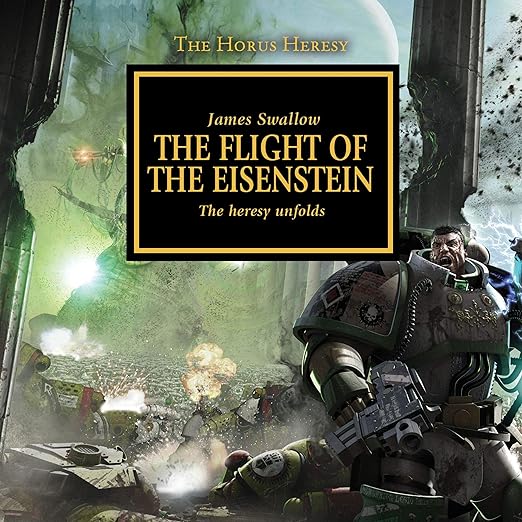
Captain Nathaniel Garro of the Death Guard has just witnessed something the Imperium was not supposed to see: the massacre on Isstvan III, Horus turning on his own forces, the beginning of the Heresy that will define the age. The Flight of the Eisenstein is the audiobook that follows what a loyal officer does next, which is not to celebrate his escape but to reckon, across twelve hours and fifteen minutes, with what it costs to be the person who saw it and survived. James Swallow's contribution to the Horus Heresy series (the fourth novel in the sequence) is the entry that finally makes the series' emotional stakes feel personal rather than merely epic.
What We Made of It
Swallow inherits a series that had, up to this point, dealt primarily in sweeping action and world-historical consequence. Horus Rising and Galaxy in Flames established the scale of the betrayal; False Gods explored Horus's corruption. What Swallow adds with this volume is a protagonist whose primary struggle is internal: Garro believes in the Emperor but has been trained in the Legion culture of certainty, and the Heresy confronts him with evidence that certainty cannot survive. The question isn't whether to fight, Garro is a Death Guard captain; fighting is the only language he knows. The question is who he's fighting for and why, and whether loyalty to an institution can survive discovering what that institution's servants are capable of.
One reviewer, who named Galaxy in Flames as their personal favorite in the series for making them care about characters they'd previously found cold, noted that Swallow's Garro achieves something similar. Space Marines in the Horus Heresy often feel like immense, emotionally distant instruments of destruction. Swallow humanizes Garro not by reducing his superhuman capability but by giving him a conscience that his capability cannot resolve. The questions he carries aboard the Eisenstein, about loyalty, faith, duty, and what it means to bear witness to atrocity, are not resolved by force of arms.
What Makes The Flight of The Eisenstein Worth Hearing
Jonathan Keeble has narrated significant portions of the Horus Heresy audio productions, and his voice has become part of how many listeners in the franchise experience these books. His performance here fits Garro's particular register: a warrior who has always operated inside clear institutional structures, now navigating a situation those structures cannot accommodate. Keeble reads Garro's internal deliberations without making them overwrought, the emotional restraint is itself a characterization choice, consistent with how this kind of soldier would actually process what he's experienced.
The warp sequence, the Eisenstein stranded in the realm of Chaos after taking enemy fire during its escape, is where Swallow makes his most significant contribution to the series lore. The warp sections allow him to explore what the Dark Powers actually feel like from inside a vessel crewed by the faithful, and the horror he generates is genuinely different from the action-horror of the massacre sequences. It's existential, which suits Garro's arc and distinguishes this volume from its predecessors in the series.
For listeners already invested in the Horus Heresy, the payoff in this volume comes from its position in the larger arc: Garro's warning to Terra is one of the pivotal early events in the long sequence leading to the Siege. Understanding that what happens here matters, not just narratively but for everything that follows across dozens of subsequent novels, gives the tension its particular weight. You're watching history being made by a man who doesn't know yet that it's history.
What Might Not Land
This is unambiguously a series book, and it requires the prior three volumes to function fully. Readers who encounter this as their first exposure to the Horus Heresy will lack the context for why Isstvan III carries the weight it does, who the Death Guard are, and what the Eisenstein's mission means for the larger story. At twelve hours and fifteen minutes, the audio is substantial, but the storytelling density is higher for listeners who arrive with established investment in the characters and factions involved.
One reviewer calibrated their four-star rating by comparison to their five-star response to the previous volume, noting that the prior book had simply gripped them more. That kind of comparative evaluation is a natural feature of franchise fiction, Swallow's approach is more character-driven and philosophically interior than the action-heavy sequences of Galaxy in Flames, and readers who come primarily for the latter may find the pacing less immediately satisfying. The chamber in which much of the novel's most important work happens is Garro's conscience rather than the battlefield.
New Warhammer 40K players sometimes use the Horus Heresy series as an entry point to the franchise, but this volume specifically assumes familiarity. Lore newcomers should begin at the series beginning rather than picking up at book four based on Swallow's reputation or Garro's later prominence in the franchise across multiple subsequent novels and audio productions.
Should You Listen to The Flight of The Eisenstein?
Horus Heresy readers who have completed the first three volumes and are ready for the series' most character-focused installment to date. Warhammer 40K lore enthusiasts who want to understand Garro's origin story before engaging with his later appearances. Listeners who have bounced off the series due to emotional distance from Space Marine protagonists, Swallow's humanizing treatment of Garro may be the entry that changes that calculus.
Skip it as a series entry point; begin at volume one. Also approach with tempered expectations if you're primarily drawn to the large-scale action of the Isstvan sequences, this volume's most important work happens in the spaces between battles, inside Garro's conscience, and in warp sections that push the story's philosophical stakes to their most demanding register. That's a feature for the right reader, and a friction point for the wrong one.