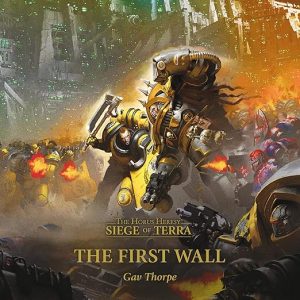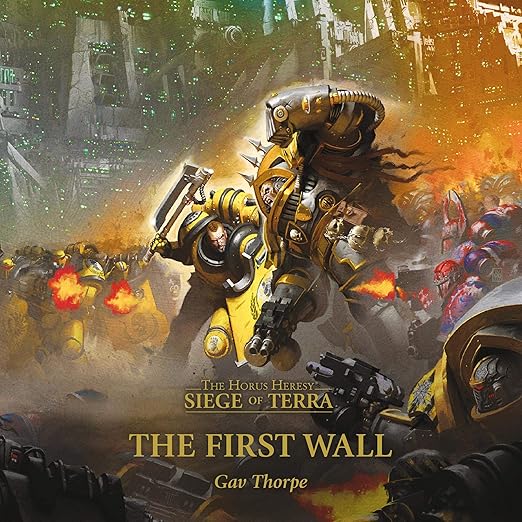
I came to The First Wall having worked through the earlier Siege of Terra volumes and knowing that Gav Thorpe's installment had a mixed reputation among the dedicated Warhammer 40,000 readership. That reputation is, I found, partially justified and partially unfair. What Thorpe delivers here is a technically accomplished military fiction that does exactly what book three of a siege narrative must do: it tightens the noose, establishes the impossibility of the defenders' position, and builds toward catastrophes that the reader can feel arriving long before they land. That it does not achieve the heights of the series' best installments is less a failure of craft than a consequence of structural position in a very long story.
The central conflict is the battle for the Lion's Gate Spaceport. Rogal Dorn, the Praetorian of Terra, has built the Imperial Palace's defenses with the obsessive precision of someone who has spent millennia thinking about nothing else. Now Perturabo, his bitter rival and the Traitor siegebreaker, is determined to tear those defenses apart. The irresistible force meets the immovable object, as the synopsis accurately notes, and the carnage that results is rendered with appropriate scale and horror. Thorpe does not shy away from the cost of this kind of warfare: the casualties are staggering, the defenders are exhausted, and the sense that the Palace itself might fall is more palpable here than in the earlier volumes.
A Closer Look at The First Wall
Reviewer Captain_Planet gave this four stars while calling it the weakest entry in the series so far, and that assessment reflects a genuine structural problem: a subplot that runs for too long relative to its narrative payoff. The counterbalancing subplot, which follows ordinary civilians traveling vast distances by train to join the defense of Terra, is actually the book's emotional highlight. The civilian perspective on a war being fought by demigods is one of the most effective humanizing devices in the entire Heresy saga, and Thorpe uses it well when he uses it at all. The issue is proportion: more of this thread and less of the underperforming B-plot would have made this a significantly stronger installment.
The Rann subplot, following the Imperial Fist Captain defending the spaceport, is excellent. Rann is not a Primarch and not a legendary hero, which makes his perspective on the siege both more vulnerable and more relatable than the Primarch-level POVs that dominate much of the series. His section of the book is where Thorpe's military SF craft shows most clearly, and listeners who find the superhuman-scale combat alienating will find this thread a useful anchor point.
Keeble has narrated enough of the Horus Heresy and Siege of Terra series to have become inseparable from the sonic identity of this universe. His voice carries the weight of ten thousand years of imperial history without irony, and he navigates the tactical complexity of siege warfare narration, which requires making spatial relationships and troop movements comprehensible through sound alone, with professional authority. In a 12-hour-plus installment that involves multiple simultaneous engagements across a vast battlespace, Keeble's clarity is not decorative: it is functional and necessary.
Things to Know Before Starting The First Wall
The Warp incursion thread, the neverborn drawn to the slaughter, introduces a supernatural escalation to what has until now been primarily a military campaign. This is structurally significant: it marks the point at which the siege is no longer merely a physical battle but a metaphysical one, with the daemonic forces gaining purchase through the sheer scale of death. Thorpe handles this transition with more care than the mixed reviews suggest, and it sets up the escalation that later Siege of Terra volumes will develop further. The enemies attacking from within as well as without create a claustrophobia that the previous books had not yet achieved.
Who Gav Thorpe Is Writing For
Committed Siege of Terra readers who have followed the series from the beginning. This is not an entry point: the narrative assumes extensive familiarity with the series, the characters, and the cosmology. For newcomers to Warhammer 40,000 fiction, begin with the original Horus Heresy series rather than the Siege of Terra subseries, and work forward from there.
Common Questions
Is The First Wall accessible to listeners new to Warhammer 40,000 or the Horus Heresy?
No. This is book three of the Siege of Terra series, which is itself a sequel series to the 54-book Horus Heresy. New listeners should begin with Horus Rising, the first Horus Heresy novel, and work through the series. Attempting The First Wall without that context would be deeply disorienting.
How does Gav Thorpe's installment compare to the other Siege of Terra books in the series?
Reviewer opinion is broadly that The First Wall is among the weaker Siege of Terra entries due to an uneven subplot that does not justify its length, though the Lion's Gate battle sequences and the civilian train subplot are praised. It is necessary reading for the overall arc but not the series' peak.
Does Jonathan Keeble narrate all the Siege of Terra books, and is his narration consistent?
Keeble is the primary narrator for the Siege of Terra series and is widely considered the definitive voice of the Warhammer 40,000 audio universe. His narration is extraordinarily consistent across volumes and is a major factor in the series' audio appeal.
What is the subplot that some reviewers found too long in The First Wall?
Reviews are deliberately vague on spoiler details, but the consensus points to a secondary plotline that runs for a disproportionate share of the runtime relative to its contribution to the overall narrative. The Rann-and-Imperial-Fists thread and the civilian train subplot are both cited as highlights, suggesting the weakness lies in a different secondary storyline.