Quick Take
- Narration: Jess Trepanier handles the survivalist action sequences with appropriate urgency, though reviewers note that some character differentiation is limited; the pacing suits the propulsive, chapter-short structure.
- Themes: EMP/grid-down survival, the vindicated prepper archetype, fractured family dynamics under crisis pressure
- Mood: Tense and kinetic, with the relentless forward momentum of a countdown timer
- Verdict: Delivers what the EMP prepper-fiction genre promises, urgent pacing and practical-ish survival framing, but be aware that its nearly 39-hour runtime reveals some rough edges in character depth and prose polish.
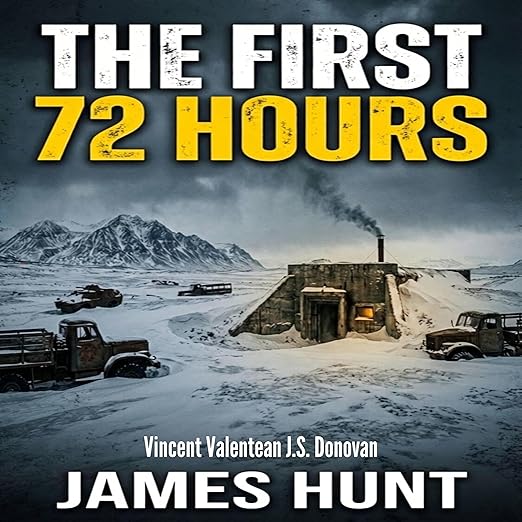
I have a soft spot for EMP collapse fiction when it is done with conviction. There is something about the genre that strips modern life down to its essential architecture, everything that hums and beeps and connects suddenly gone, and forces characters to operate on older, more physical logic. James Hunt’s The First 72 Hours commits fully to that premise. When the grid goes down in the opening chapters, protagonist Jackson Kent is the one man in his orbit who was laughed at for preparing. Now he has to drive into a darkened city to save the family that dismissed him. I started this one on a Thursday morning commute and found myself lingering in the parking lot to hear another chapter.
The setup is the EMP prepper thriller in its purest form: Kent is a survivalist who has built a mountain homestead, stockpiled supplies, and been consistently mocked by the family who rejected his warnings. The electromagnetic pulse that cripples the nation in the opening pages is not just a disaster, it is a vindication. What the book does well from that foundation is keep the action moving. At nearly 39 hours, this is a substantial listen, and Hunt structures the narrative in short, scene-driven chapters that sustain momentum across a long runtime.
Our Take on The First 72 Hours
The core tension here, a competent outsider navigating a collapsing social order to rescue people who did not believe in him, is one of the genre’s most reliable engines, and Hunt leans into it without apology. The world-building around Kent’s homestead is where the writing is most assured; the cabin, the preparations, the logic of off-grid infrastructure. One reviewer noted that the setting descriptions for Kent’s mountain property are genuinely well-realized, and I agree. Hunt has clearly spent real time thinking through what a prepared compound looks like and how it functions, and that specificity gives the book an authenticity that the action sequences sometimes lack.
The violence is present and unapologetic, this is a post-collapse scenario, and Hunt does not sanitize what happens when social order erodes within the first 72 hours of a grid failure. If you are coming to this genre expecting restraint on that front, recalibrate your expectations. The human ugliness of the collapse is part of the premise, and Hunt uses it to create stakes that feel genuine even when individual scenes veer toward the formulaic.
Why Listen to The First 72 Hours
Jess Trepanier’s narration brings the right register of controlled urgency to the material. She handles the action sequences with clean pacing and keeps the survivalist exposition from bogging down. The 38-hour-plus runtime is ambitious, and Trepanier sustains a consistent energy across it. Some listeners who followed along with the Kindle edition noted occasional pronoun inconsistencies in the text, a copy-editing issue in the source material rather than a narration problem, but for audio-only listeners this surfaces mainly as a momentary confusion in a couple of family-scenes with a female character named Lacey.
The family reconciliation arc that runs beneath the survival plot is what distinguishes The First 72 Hours from pure action fare. Kent is not just surviving, he is trying to reconstruct a relationship with people who wrote him off. That emotional thread is not always handled with full subtlety, but its presence keeps the 38 hours from feeling like an extended action set-piece.
What to Watch For in The First 72 Hours
The most consistent criticism from readers is that the supporting characters, including members of Kent’s family, feel underdeveloped relative to Kent himself. The hero gets the benefit of the prepper archetype’s inherent depth, he has a philosophy, a history, a material relationship with the world, while the family members who rejected him are sometimes more functional than fully realized. One early reviewer called them flat, and while that is a harsher judgment than I would apply to the whole cast, it is true that the narrative’s emotional investment is heavily weighted toward Kent’s perspective.
This is also a book that rewards patience with genre conventions. If the EMP prepper setup, the vindicated outsider, the collapsed infrastructure, the rural versus urban survival divide, does not interest you as a premise, the writing will not transcend it enough to convert you. But within those conventions, Hunt builds a world with enough internal consistency to sustain the substantial runtime.
Who Should Listen to The First 72 Hours
Established readers of the EMP and prepper fiction genre will find this a reliable, well-constructed entry: long enough to fully inhabit the world, with a protagonist whose competence is earned through credible preparation rather than narrative convenience. Listeners who came to this through military thriller or post-apocalyptic science fiction will likely find it approachable. If your primary interest is literary character work or nuanced ensemble drama, this is probably not the right choice. But if you want nearly 40 hours of high-stakes survival fiction with a satisfying ideological core, Hunt delivers.
Frequently Asked Questions
Is The First 72 Hours part of a series, or does it stand alone?
Based on the structure and the series-style arc, it appears to be part of a continuing series by James Hunt, though each volume tells a compelling story with a defined arc. Listeners invested in the Jackson Kent character will likely find continuation in subsequent books.
How does Jess Trepanier handle the gender of the supporting characters, given the reported pronoun inconsistencies in the source text?
The pronoun inconsistencies are copy-editing errors in the original manuscript rather than narration problems. Trepanier performs the text as written; audio-only listeners may notice brief confusion in a couple of scenes involving a female character named Lacey, but it does not significantly disrupt the listening experience.
Is the survival and prepping content in the book realistic and practically grounded?
The homestead setting and preparation details are among the most convincing elements. Hunt has clearly researched off-grid living and EMP scenarios seriously. The action sequences are more genre-conventional, but the survivalist infrastructure feels thought-through.
How graphic is the violence in this EMP post-collapse scenario?
The violence is present and unapologetic, reviewers note it is a significant element of the story. Hunt does not sanitize the collapse of social order, which is consistent with the genre’s conventions and necessary for the stakes to feel credible. Listeners sensitive to sustained conflict and danger should be aware of that before starting.