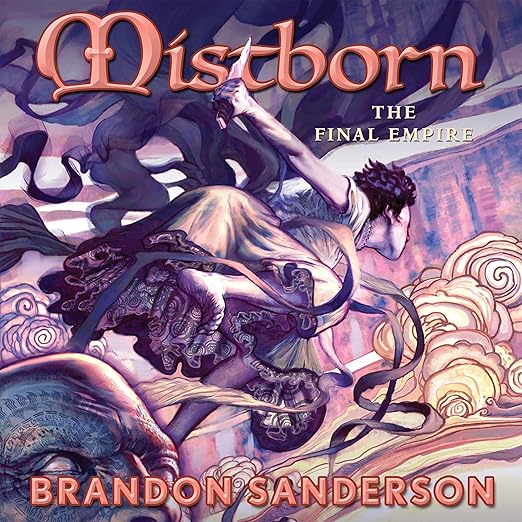
I came to Brandon Sanderson late. For years I had resisted the sprawling epic fantasy shelf, put off by doorstop-length page counts and the sheer implied commitment of multi-book series. Then, the week between Christmas and New Year's, with nothing but time and a long list of audiobooks I had been avoiding, I started The Final Empire. I finished it before January 2nd. I cancelled plans. I am not being hyperbolic about this.
The premise is deliberately, almost provocatively, subversive. Sanderson opens with a question he states plainly in the text: what if the hero of prophecy failed? The Dark Lord won a thousand years ago. The land is covered in volcanic ash that falls like snow. Flowers do not bloom. The oppressed underclass, the Skaa, live in brutal servitude under a godlike ruler called the Lord Ruler. And into this world, Sanderson drops not a chosen hero but a thief crew, planning the most audacious heist in history, with the Lord Ruler himself as the mark.
Allomancy Works Like a Locked-Room Mystery
What Sanderson does better than almost any writer working in epic fantasy today is build a magic system that functions like a locked-room mystery. The allomancy of the Mistborn world, the ability to ingest and burn metals to produce specific powers, is introduced carefully and then complicated layer by layer throughout the narrative. Unlike magic systems that exist as convenient plot scaffolding, this one has rules, limits, and costs. When the rules are stretched, the reader feels it. When they are broken, something real is at stake. The heist structure of the plot allows Sanderson to reveal the mechanics of allomancy at exactly the pace a reader needs, alongside the protagonist Vin, who is learning them herself.
Vin is one of the things that surprised me most about this book. She begins as a street thief, scarred by betrayal, conditioned to trust no one. Her arc over the course of 24 hours of audio is not a simple transformation from fear to confidence. The growth is earned, interrupted, reversed, and earned again. She is not a chosen one discovering her destiny; she is someone being given, for the first time, the possibility that she might deserve the things she wants. That is a subtler and more affecting kind of character development.
Kramer's Kelsier Carries Dangerous Enthusiasm
Michael Kramer's narration has been the gold standard for Sanderson's Cosmere for decades. His voice for Kelsier, the brilliant, charismatic, possibly reckless leader of the heist crew, carries exactly the right note of dangerous enthusiasm. He is a man who has survived the unsurvivable and decided to use that survival to do something impossibly ambitious. Kramer communicates both the charm and the shadows underneath it without overplaying either. His Vin is quieter, more interior, and he handles that interiority with care, never allowing her to seem passive even when she is observing rather than acting.
The full cast of the heist crew is substantial, and Kramer differentiates them clearly enough that you never lose track of who is speaking in group scenes. At 24 hours and 39 minutes, that consistency is not a minor achievement. The one area where some listeners have noted limitations is in Sanderson's prose style itself, which prioritizes clarity and momentum over lyrical density. Readers who come from Ursula K. Le Guin or Gene Wolfe expecting maximalist prose may need a brief adjustment period. Sanderson's language is functional and direct. What it lacks in ornament it more than makes up for in structural sophistication.
Slow Setup Pays Off in the Climax
The first third of the book is primarily world-building and crew assembly. Sanderson is meticulous about laying groundwork, and some listeners find the early sections slower than they expected given the premise. Hold on. The pace shift in the second half is significant, and the emotional payoff of the final act depends on the careful scaffolding built in the first. Sanderson has acknowledged in interviews that his endings are often where he feels most confident, and The Final Empire demonstrates exactly why. The climax recontextualizes earlier events in ways that reward attentive listening.
The book is also the first in a trilogy, and it functions as such. The ending is satisfying but not closed; threads are left deliberately open. Listeners who prefer fully self-contained narratives may find this frustrating. Those who are happy to commit to a longer journey will find that the trilogy, taken as a whole, has an architectural ambition that puts most series fiction to shame.
Heist Structure Wins Over Thriller Readers
Readers who came to fantasy through Tolkien and want something that updates that tradition with tighter plotting and a more morally complex protagonist will find this deeply satisfying. It also works for readers who primarily read crime thrillers and have not tried epic fantasy, because the heist framework gives the narrative a propulsive, goal-oriented structure that thriller readers recognize instinctively. Skip it if you need your fantasy grounded in physical or emotional realism; Sanderson's world operates by its own rules, and you will need to accept them fully to enjoy the ride.